
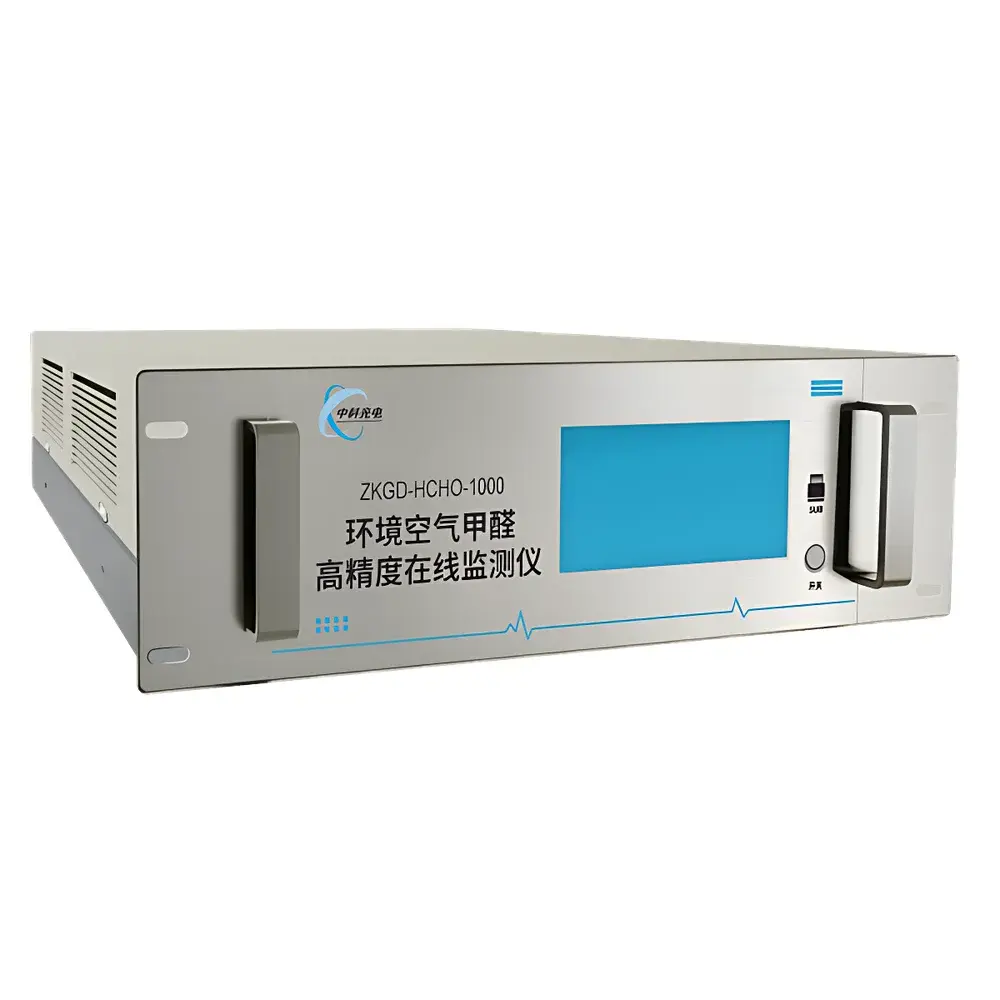
ZKGD-HCHO-1000 Formaldehyde Online Ambient Air Monitor by CASP
| Brand | CASP |
|---|---|
| Origin | Jiangsu, China |
| Manufacturer Type | Original Equipment Manufacturer (OEM) |
| Country of Origin | China |
| Model | ZKGD-HCHO-1000 |
| Price Range | USD 84,000–112,000 (FOB) |
| Measurement Principle | Photometric Detection via Chemical Derivatization (Acetylacetone Method) |
| Measurement Range | 0–100 / 0–500 / 0–1000 ppb (selectable) |
| Resolution | 0.001 ppb |
| Repeatability | ≤2% RSD |
| Sampling Method | Wet-Chemical Continuous Flow Sampling with Integrated Peristaltic Pump and Reaction Coil |
| Operating Temperature Range | 0–120 °C (for sample gas conditioning and reaction chamber) |
Overview
The ZKGD-HCHO-1000 is a fully automated, continuous ambient air formaldehyde (HCHO) monitoring system engineered for regulatory-grade compliance and long-term unattended operation in national and provincial environmental monitoring stations. It employs the internationally recognized acetylacetone (AA) derivatization method—standardized in ISO 16000-3 and EPA TO-11A—followed by high-sensitivity photometric detection at 412 nm. Unlike direct optical techniques (e.g., tunable diode laser absorption), this wet-chemical approach ensures high selectivity against common interferents such as acetaldehyde, methanol, ozone, and NOx, which are prevalent in urban and industrial ambient air matrices. The instrument integrates a precisely temperature-controlled reaction coil (0–120 °C adjustable), dual-stage particulate filtration, and humidity compensation logic to maintain measurement integrity across varying meteorological conditions. Its design adheres to the physical and spatial constraints of standard Chinese national control station (GuoKong) cabinets (600 mm × 600 mm × 1800 mm), enabling seamless rack-mount integration without structural modification.
Key Features
- Triple-range configurable detection (0–100 ppb, 0–500 ppb, 0–1000 ppb) with automatic range switching and zero/span validation scheduling
- Photometric cell with 1.5-meter optical path length, delivering sub-ppt-level effective sensitivity and minimizing signal drift
- Integrated wet-chemical sampling module featuring corrosion-resistant PFA tubing, peristaltic pump with pulse-dampening, and real-time flow monitoring (±1% accuracy)
- Onboard thermal management system maintaining reaction temperature stability within ±0.3 °C over full 0–120 °C operating envelope
- Self-diagnostic firmware with fault logging, reagent depletion alerts, and calibration history traceability compliant with GB/T 35210.1–2017
- Modular architecture supporting field-replaceable consumables (reagent cartridges, filters, reaction coils) without tools or service technician intervention
Sample Compatibility & Compliance
The ZKGD-HCHO-1000 is validated for continuous monitoring of formaldehyde in ambient air (ISO 16000-3), stack emissions (per GB 16297–1996 Annex C), and indoor air quality applications (GB/T 18883–2022). It meets the performance requirements specified in China’s “Technical Specification for Automatic Monitoring of Ambient Air Quality” (HJ 93–2013) and “Environmental Air Quality Standards” (GB 3095–2012) for formaldehyde. All wet-chemical components—including reagent formulation (acetylacetone/ammonium acetate/acetic acid buffer), delivery timing, and colorimetric incubation duration—are optimized to minimize interference from formaldehyde precursors (e.g., PAN, HONO) and co-emitted carbonyls. The system supports optional external humidity and temperature sensors for real-time environmental correction, and its data output format complies with HJ 212–2017 communication protocol for integration into provincial environmental information platforms.
Software & Data Management
The embedded Linux-based controller runs CASP’s proprietary HCHO-Monitor Suite v3.2, providing local touchscreen interface (7″ resistive LCD), remote web access (HTTPS/TLS 1.2), and RS-485/Modbus RTU and Ethernet TCP/IP connectivity. All measurements are timestamped with GPS-synchronized UTC and stored internally (16 GB eMMC) with ≥18 months of 1-minute averaged data retention. Audit trails include operator login events, calibration actions, reagent lot tracking, and instrument error logs—all structured to support GLP/GMP-aligned data integrity frameworks. Raw absorbance values, derivative curves, and diagnostic flags are exportable in CSV/NetCDF formats. Optional cloud synchronization enables centralized fleet monitoring and predictive maintenance analytics via CASP’s certified data hub (ISO/IEC 27001 certified infrastructure).
Applications
- Real-time formaldehyde surveillance at national and provincial ambient air quality monitoring stations (AQMS)
- Compliance verification for industrial emission sources subject to GB 31571–2015 (petrochemical VOCs) and GB 16297–1996
- Indoor air quality assessment in schools, hospitals, and public buildings per GB/T 18883–2022
- Research-grade longitudinal studies on secondary organic aerosol (SOA) formation and photochemical HCHO production
- Calibration reference for portable HCHO sensors and diffusion tube networks
FAQ
What formaldehyde detection method does the ZKGD-HCHO-1000 use, and why is it preferred for ambient air monitoring?
It uses the acetylacetone derivatization method coupled with photometric detection—a technique referenced in ISO 16000-3 and EPA TO-11A for its proven specificity, low detection limit, and resistance to matrix interferences in complex ambient air.
Does the system require daily manual intervention or reagent replenishment?
No. With standard reagent cartridges (7-day capacity at 1-min sampling interval), the unit operates autonomously for up to 168 hours. Reagent replacement is tool-free and takes <3 minutes.
How is humidity and temperature compensated during measurement?
Integrated Pt100 sensors monitor sample line and reaction chamber conditions; compensation algorithms adjust absorbance-to-concentration conversion using empirically derived coefficients validated across 10–95% RH and −20–50 °C ambient ranges.
Is the instrument compatible with existing Chinese environmental data reporting platforms?
Yes. It natively supports HJ 212–2017 protocol and has been certified for direct integration with the Ministry of Ecology and Environment’s (MEE) National Air Quality Monitoring Network (NAQMN) platform.
What maintenance intervals are recommended for long-term operational reliability?
Quarterly filter replacement, biannual reaction coil inspection, and annual photometer lamp intensity verification—documented in the included Maintenance Logbook and tracked automatically in the onboard scheduler.
Related Products







