
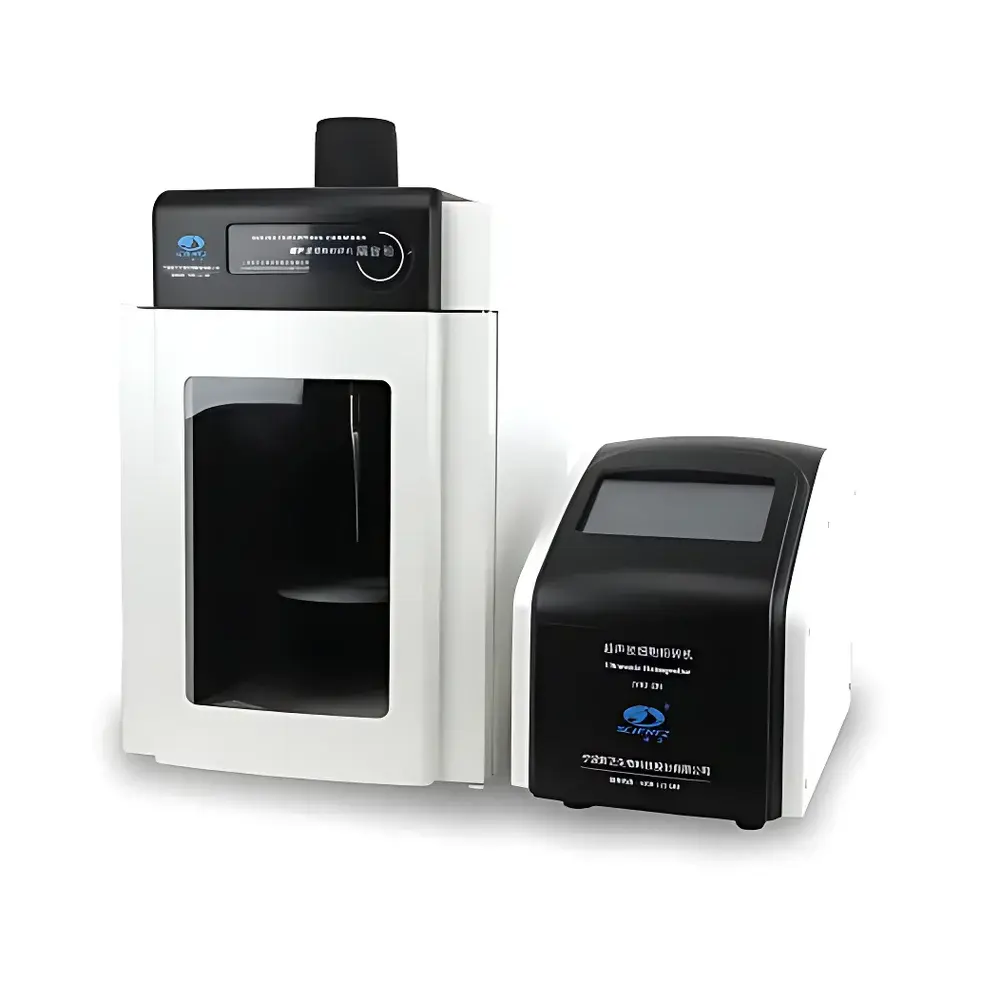
Scientz-IID Ultrasonic Cell Disruptor
| Origin | Zhejiang, China |
|---|---|
| Manufacturer Type | Authorized Distributor |
| Origin Category | Domestic (PRC) |
| Model | Scientz-IID |
| Quotation | USD 3,050 (FOB Zhejiang) |
| Instrument Type | Ultrasonic Homogenizer / Cell Disruptor |
| Sample Compatibility | Soft biological tissues, cells, microorganisms, viruses, and suspensions |
| Output Particle Size Range | 0.01–0.5 mm |
| Maximum Feed Particle Size | <15 mm |
| Sieve Cut-Off | 40 mesh |
| Batch Processing Volume | 0.5–600 mL |
| Operating Frequency | 20–25 kHz |
| Nominal Output Power | 950 W |
| Standard Probe Diameter | Φ6 mm |
| Optional Probe Diameters | Φ2, Φ3, Φ10, Φ15 mm |
| Duty Cycle Adjustment Range | 0.1–99.9% |
| Input Voltage | 220 V / 110 V AC, 50 Hz / 60 Hz |
| Net Weight (Power Supply + Transducer) | 14.3 kg |
| Power Supply Dimensions (W×D×H) | 400 × 280 × 220 mm |
| Weight | 12.2 kg |
| Packaging Dimensions (W×D×H) | 534 × 295 × 435 mm |
| Control Interface | PWM-regulated digital power supply with 50-parameter memory storage |
| Compliance | CE-marked power electronics |
Overview
The Scientz-IID Ultrasonic Cell Disruptor is an engineered benchtop system designed for controlled, non-thermal disruption of biological samples via high-intensity ultrasonic cavitation. Operating within a stable 20–25 kHz frequency band, the instrument generates acoustic energy through piezoelectric transduction, inducing transient microcavitation bubbles in liquid media. Upon collapse, these bubbles release localized shockwaves and shear forces sufficient to lyse cell membranes, fragment subcellular organelles, and disintegrate soft-tissue matrices—without significant thermal denaturation when operated under pulsed duty cycles. Unlike mechanical grinders or bead mills, this system delivers reproducible, scalable homogenization across volumes from 0.5 mL (microscale lysates) to 600 mL (preparative-scale extractions), making it suitable for both exploratory lab work and process-development workflows in regulated environments.
Key Features
- PWM-controlled digital power supply ensures linear, stepless power adjustment from 10% to 100% of nominal 950 W output—enabling precise energy dosing per sample type and volume.
- Intelligent parameter memory stores up to 50 user-defined protocols—including frequency sweep profiles, duty cycle settings, total sonication time, and probe selection—supporting method transfer and audit-ready operation.
- Interchangeable titanium alloy probes (standard Φ6 mm; optional Φ2, Φ3, Φ10, Φ15 mm) allow optimization of energy density for diverse sample viscosities and particulate loads.
- Wide-duty-cycle modulation (0.1–99.9%) mitigates heat accumulation during extended runs, preserving thermolabile biomolecules such as enzymes, antibodies, and nucleic acids.
- Robust aluminum-alloy transducer housing and sealed power electronics meet IP20 environmental rating; CE-compliant design satisfies essential safety and electromagnetic compatibility requirements per IEC 61000 series standards.
Sample Compatibility & Compliance
The Scientz-IID is validated for soft biological matrices including cultured mammalian cells, yeast suspensions, bacterial pellets, plant leaf homogenates, and viral lysates. It is not intended for fibrous, mineralized, or highly abrasive samples (e.g., bone, seeds with hard endocarps, or ceramic particles). The system supports GLP-aligned documentation practices: all executed protocols—including timestamped start/stop events, real-time power logging, and probe identification—are exportable via USB interface for traceability. While not FDA 21 CFR Part 11-certified out-of-the-box, its deterministic parameter recall and absence of cloud-based functionality enable qualification under internal SOPs for GMP-adjacent applications in pharmaceutical R&D and biomanufacturing support labs.
Software & Data Management
The instrument operates via embedded firmware with no external PC dependency. All operational parameters are configured via a backlit LCD touchscreen with tactile feedback. Protocol data—including date/time stamps, cumulative runtime, average power delivered, and selected probe ID—are stored locally in non-volatile memory and exportable as CSV files via standard USB-A port. No proprietary drivers or software installation is required; exported logs are compatible with common LIMS platforms and statistical analysis tools (e.g., JMP, Python pandas). Audit trail integrity is maintained through write-once memory architecture—entries cannot be edited or deleted post-execution.
Applications
- Cell lysis for protein extraction and subcellular fractionation in proteomics workflows.
- Preparation of antigenic lysates for immunoassay development and vaccine research.
- Nanoparticle dispersion stabilization in colloidal drug delivery systems (e.g., liposomes, polymeric micelles).
- Accelerated solvent extraction of phytochemicals from plant tissues under ambient or chilled conditions.
- Homogenization of clinical specimens (e.g., sputum, bronchoalveolar lavage fluid) prior to PCR or culture-based diagnostics.
- Routine maintenance of microbial culture stocks via controlled sonication-assisted resuspension.
FAQ
What is the maximum continuous operating time per cycle?
The system supports uninterrupted operation up to 60 minutes per cycle when configured with ≥30% duty cycle and adequate cooling (e.g., ice-water bath for sample vessel). For thermosensitive targets, intermittent pulsing (e.g., 5 s ON / 10 s OFF) is recommended.
Can the Scientz-IID be integrated into automated liquid-handling platforms?
No native RS-232, Ethernet, or TTL I/O interfaces are provided; however, external relay-triggered start/stop control is feasible using the front-panel footswitch input terminal (3.5 mm mono jack, 5 V logic level).
Is calibration traceable to national standards?
Acoustic output power is factory-verified using calorimetric methods per ISO 20487:2018 Annex C; calibration certificates (NIST-traceable temperature sensors and wattmeters) are available upon request at time of order.
What maintenance is required for long-term reliability?
Annual inspection of probe threads and transducer coupling surface is advised; replacement of ultrasonic horn tips is recommended after ~500 hours of cumulative use or visible pitting. No routine oiling or lubrication is required.
Does the system comply with noise emission regulations for laboratory use?
Measured sound pressure level at 1 m distance is ≤72 dB(A) under typical operating conditions—within OSHA PEL and EU Directive 2003/10/EC limits for intermittent exposure in shared lab spaces.



