
IMKO TRIME-PICO 64/32 TDR Portable Soil Moisture and Electrical Conductivity Analyzer
| Brand | IMKO |
|---|---|
| Origin | Germany |
| Model | TRIME-PICO 64/32 |
| Instrument Type | Soil Moisture and Salinity Analyzer (TDR-based) |
| Measurement Principle | Time Domain Reflectometry (TDR) with Intelligent MicroElements |
| Volumetric Water Content Range | 0–100% |
| ECtrime Range | 0–50 dS/m (dual-range configuration: 0–6, 6–12, 12–50 dS/m) |
| Temperature Range | −15 °C to +50 °C |
| Accuracy (VWC) | ±1% (0–40%), ±2% (40–70%) |
| Repeatability | ±0.2% (TRIME-PICO 64), ±0.3% (TRIME-PICO 32) |
| Probe Diameter | 63 mm (64), 32 mm (32) |
| IP Rating | IP68 (probe), IP67 (HD2), IP65 (AZS-100) |
| Power Supply | 7–24 V DC (probe), 4.8 V / 2000 mAh (HD2), Li-ion (AZS-100), Ni-MH (Bluetooth module) |
| Output | Dual 0–1 V analog (4–20 mA optional), IMP232 serial interface |
| Calibration | 15 user-defined curves stored onboard |
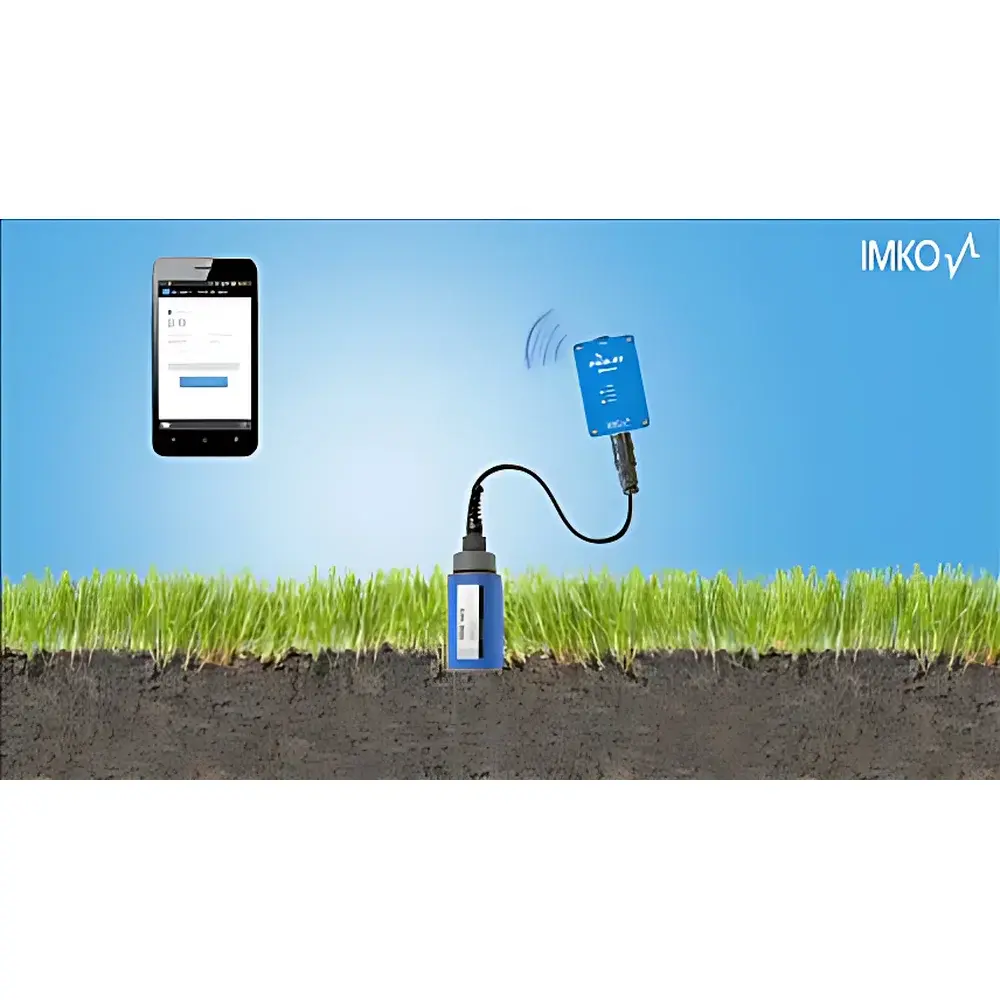
| Wireless | Bluetooth 2.0 (≤10 m), optional Wi-Fi (AIM-WiFi module) |
Overview
The IMKO TRIME-PICO 64/32 is a field-deployable, high-precision time domain reflectometry (TDR) sensor system engineered for simultaneous in-situ measurement of volumetric water content (VWC), soil temperature, and apparent electrical conductivity (ECtrime) in heterogeneous soils. Unlike conventional capacitance or frequency-domain sensors, the TRIME-PICO employs patented Intelligent MicroElements technology to generate and resolve GHz-range electromagnetic pulses (center frequency: 1 GHz) along calibrated waveguide rods. The propagation time of the reflected pulse—measured with picosecond-level resolution (down to 3 ps)—is directly correlated to the bulk dielectric permittivity (εb) of the surrounding medium. Since εb exhibits strong, non-linear dependence on water content and ionic strength, the instrument delivers physically grounded VWC estimates validated across mineral, organic, and saline soil matrices. Its dual-probe architecture (64 mm and 32 mm diameters) enables flexible deployment: the TRIME-PICO 64 targets deeper profiling and higher signal stability in coarse-textured soils, while the TRIME-PICO 32 provides minimal disturbance sampling in compacted or shallow-root zones. All measurements comply with ASTM D5778 (Standard Test Method for Electronic Friction Cone and Piezocone Penetration Testing) and ISO 11272:2017 (Soil quality — Determination of dry matter and water content), supporting traceable, reproducible data acquisition under GLP-aligned field protocols.
Key Features
- Patented TDR engine with 1 GHz pulse generation and sub-3 ps time-resolution sampling, enabling robust dielectric characterization even in high-salinity environments (up to 50 dS/m)
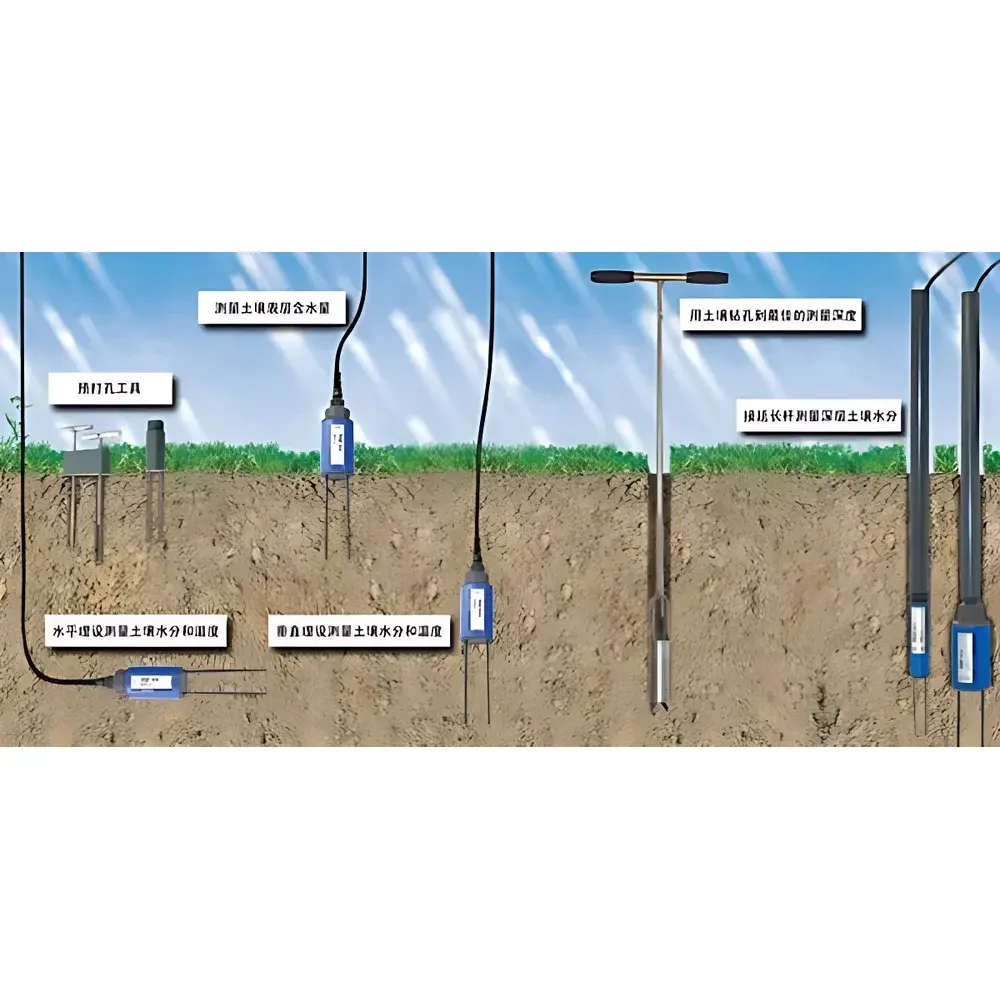
- Dual-probe configuration: TRIME-PICO 64 (63 mm Ø, 160 mm probe length, 1.25 L measurement volume) and TRIME-PICO 32 (32 mm Ø, 110 mm probe length, 0.25 L measurement volume)
- Integrated three-parameter output: volumetric water content (0–100% VWC), soil temperature (−15 °C to +50 °C, ±1.5 °C absolute accuracy), and ECtrime (0–50 dS/m, segmented range calibration)
- Onboard storage for up to 15 user-defined calibration curves—including custom Moisture–ECtrime–salinity (g/L) conversion functions aligned with FAO 2006 salinity classification guidelines
- IP68-rated probe housing with stainless-steel waveguides; operational in saturated, frozen, or chemically aggressive soils without drift or hysteresis
- Flexible connectivity: wired IMP232 serial interface, dual 0–1 V analog outputs (4–20 mA optional), Bluetooth 2.0 (≤10 m range), and optional AIM-WiFi module for cloud-integrated telemetry
Sample Compatibility & Compliance
The TRIME-PICO 64/32 is validated for direct insertion into undisturbed mineral soils (sand, loam, clay), peat, compost, and engineered substrates used in agriculture, hydrology, and landfill monitoring. Its low-intrusion geometry minimizes air-gap artifacts during installation, while the segmented ECtrime ranges accommodate both low-conductivity sandy profiles (0–6 dS/m) and sodic or irrigation-affected horizons (12–50 dS/m). Calibration adherence follows ISO 11274 (Soil quality — Guidelines for derivation of site-specific soil moisture characteristic curves) and supports compliance with US EPA Method 9081 (Soil Moisture by Time-Domain Reflectometry) and EU Regulation (EC) No 1107/2009 for pesticide fate studies. For GMP-regulated environmental monitoring programs, the AZS-100 handheld reader logs GPS-tagged metadata with timestamped audit trails compatible with FDA 21 CFR Part 11 requirements when paired with secure SD-card encryption.
Software & Data Management
Data acquisition is supported across three interoperable platforms: the HD2 handheld meter (real-time display only, no storage), the AZS-100 field terminal (3.5″ capacitive touchscreen, 300,000-point internal memory, 16 GB microSD expansion), and Android-based mobile applications via Bluetooth. All devices permit selection of factory-default or user-loaded calibration curves—including FAO-referenced salinity conversion lookups—and export ASCII or CSV files with embedded probe ID, GPS coordinates, and measurement epoch. The SM-USB calibration module and accompanying software enable post-deployment verification using glass-bead standards per ISO 14243-2, while firmware updates preserve metrological integrity across extended deployments (>5 years typical service life). Raw TDR waveform data can be exported for advanced dielectric spectroscopy analysis in MATLAB or Python environments.
Applications
- Irrigation scheduling and deficit irrigation optimization in orchards, vineyards, and row crops via real-time root-zone VWC mapping
- Salinity risk assessment in arid-zone agriculture and reclaimed coastal soils, including validation against ECe (saturated paste extract) per USDA Handbook 60
- Long-term vadose zone monitoring in landfill cover systems, tailings dams, and remediation sites under ASTM D3282
- Calibration reference for satellite-based soil moisture products (e.g., Sentinel-1 SAR, SMAP L-band) at validation transects
- Soil hydraulic property estimation (θ(ψ) curves) when combined with tensiometric or WP4C water potential measurements
- Climate resilience research: tracking freeze-thaw dynamics and solute transport in permafrost-adjacent tundra soils
FAQ
How does TRIME-PICO differentiate between soil water content and pore-water salinity?
It resolves both parameters through independent physical signatures: VWC is derived from the dominant dielectric relaxation peak (εb ≈ 3–80), while ECtrime is extracted from the low-frequency slope of the complex permittivity spectrum—enabling decoupled quantification without empirical mixing models.
Can I use the same calibration curve for different soil textures?
No. While factory calibrations cover common loams and sands, accurate salinity conversion requires site-specific Moisture–ECtrime–g/L curves established using representative soil cores and laboratory ECe analysis per ASTM D420.
Is the probe suitable for permanent burial?
Yes. The IP68-rated titanium-alloy housing and hermetically sealed electronics support continuous deployment up to 10 years; temperature drift is compensated via on-board thermistor referencing (±0.5 °C relative stability).
What is the minimum measurable soil volume for reliable ECtrime?
For TRIME-PICO 32, the effective sensing volume is 0.25 L (110 mm × Ø50 mm cylinder); below this threshold, boundary effects dominate—hence pre-drilled access tubes ≥60 mm inner diameter are recommended for profile measurements.
Does Bluetooth communication affect measurement accuracy?
No. The Bluetooth module powers the probe only during active measurement cycles (2–3 s duration); all TDR signal acquisition occurs independently of wireless state, eliminating RF interference per EN 61326-1 EMC compliance.







