
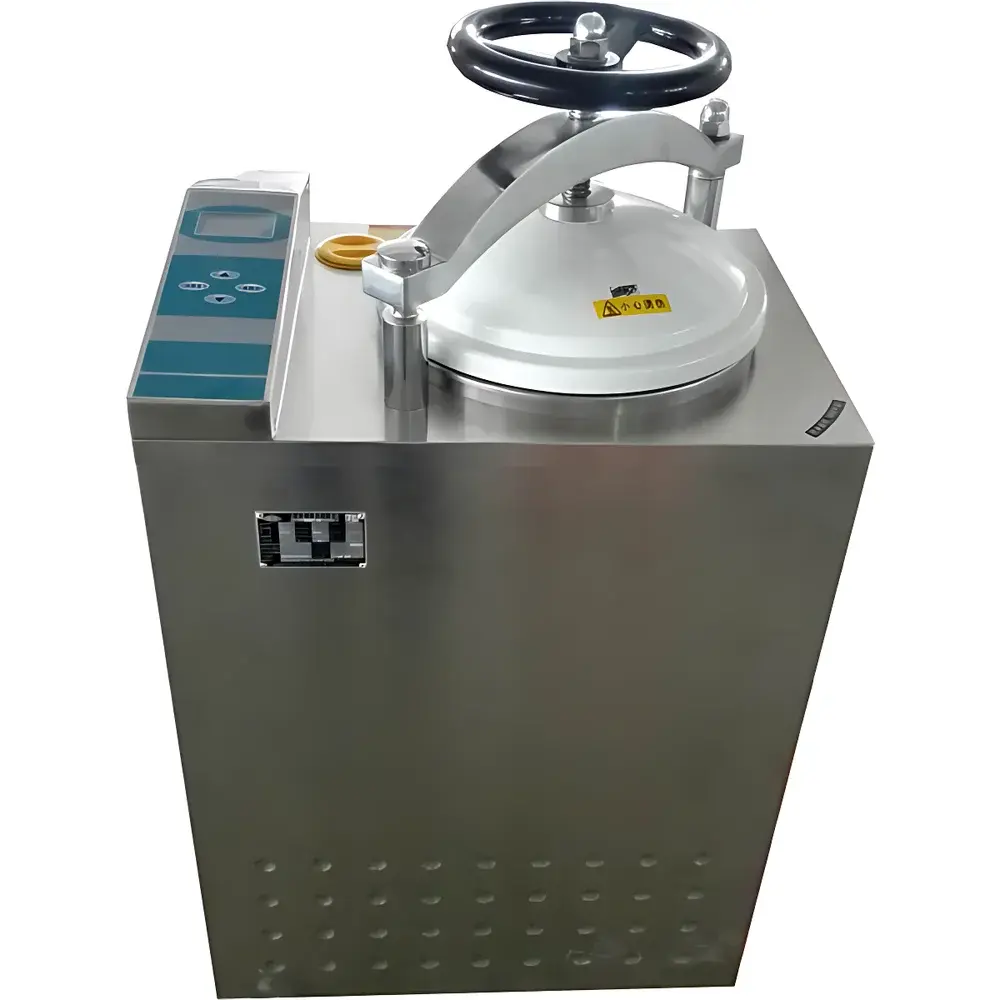
HePu LS-50HG Vertical Steam Sterilizer
| [Brand | HePu |
|---|---|
| Origin | Shandong, China |
| Model | LS-50HG |
| Chamber Volume | 50 L |
| Max Temperature | 134 °C |
| Max Pressure | 0.22 MPa |
| Chamber Dimensions | Ø340 × 550 mm |
| External Dimensions | 650 × 410 × 1140 mm |
| Power | 3000 W / AC 220 V, 50 Hz |
| Temperature Uniformity | ≤ ±1 °C |
| Timer Range | 0–99 min or 0–99 h 59 min |
| Temperature Setpoint Range | 0–134 °C (sterilization), 50–101 °C (boiling) |
| Safety Lock Activation Pressure | >0.027 MPa |
| Weight | 83 kg (net), 102 kg (gross)] |
Overview
The HePu LS-50HG Vertical Steam Sterilizer is a fully automated, microprocessor-controlled gravity-displacement and steam-saturated sterilization system engineered for consistent, repeatable terminal sterilization of heat-stable laboratory and medical materials. It operates on the principle of saturated steam under pressure—leveraging the well-established thermodynamic relationship between steam pressure and temperature to achieve microbial inactivation through protein denaturation and nucleic acid disruption. Designed for Class B (EN 13060) equivalent performance, the LS-50HG delivers validated sterilization cycles at 121 °C (0.11 MPa) and 134 °C (0.22 MPa), meeting foundational requirements for autoclaving surgical instruments, glassware, culture media, textiles, and porous loads in clinical, academic, and pharmaceutical quality control environments.
Key Features
- Microprocessor-based control system with LED backlit LCD interface displaying real-time cycle parameters—including chamber temperature, pressure, elapsed time, remaining time, and phase status (pre-vacuum, heating, sterilization, exhaust, drying).
- Integrated steam generator with external electric heating element (3000 W), ensuring rapid steam generation, high thermal efficiency, and reduced condensate accumulation.
- Automatic air removal via gravity displacement with dedicated cold-air purge phase—critical for achieving uniform steam penetration and eliminating air pockets that compromise sterility assurance.
- Multi-mode programmable cycle selection: pre-set protocols for instruments, dressings, liquids, and fixed-temperature boiling (50–101 °C); user-definable cycles with independent adjustment of sterilization temperature (0–134 °C), exposure time (0–99 min or up to 99 h 59 min), and post-sterilization drying duration.
- Steam recirculation design minimizes external venting—maintaining ambient lab humidity and eliminating visible plume discharge, supporting ISO 14644-compliant cleanroom-adjacent installations.
- Comprehensive passive and active safety architecture: mechanical pressure interlock (door remains locked until chamber pressure drops below 0.027 MPa), dual redundant overpressure relief (spring-loaded safety valve + secondary pressure release port), dry-run protection with automatic power cutoff upon water level depletion, and integrated earth leakage circuit breaker (ELCB) with overcurrent and ground-fault detection.
Sample Compatibility & Compliance
The LS-50HG accommodates standard stainless-steel instrument trays, wrapped surgical packs, unsealed liquid containers (with appropriate load configuration to prevent boil-over), and agar-based microbiological media bottles. Its 50 L cylindrical chamber (Ø340 × 550 mm) supports typical laboratory batch volumes while maintaining ≤ ±1 °C temperature uniformity across the load—validated per ISO 17665-1 Annex C methodologies. Though not independently certified to EN 13060 or FDA 510(k), the unit’s operational parameters align with widely adopted national standards including YY 0504–2016 (Chinese standard for horizontal/vertical sterilizers) and GB 8599–2008. For GLP/GMP-regulated workflows, users may perform IQ/OQ/PQ validation using calibrated PT100 probes and biological indicators (e.g., Geobacillus stearothermophilus spores) in accordance with ISO 11138-3 and ISO 11140-1.
Software & Data Management
The LS-50HG features embedded firmware without external PC connectivity or proprietary software. All cycle logs—including date/time stamp, selected mode, setpoints, actual temperature/pressure profiles, and fault codes—are stored internally and viewable on the LCD screen for immediate review. While it does not support electronic record archiving or 21 CFR Part 11-compliant audit trails natively, its deterministic cycle execution, visual alarm signaling (audible beep + LED indicator), and non-volatile parameter retention enable manual documentation suitable for basic QA/QC traceability. Optional external data loggers (e.g., USB-connected thermocouple arrays) may be deployed for enhanced validation reporting.
Applications
- Sterilization of reusable surgical tools, forceps, scissors, and clamps in hospital central sterile supply departments (CSSD).
- Decontamination of microbiological culture media (e.g., nutrient agar, LB broth) and Petri dishes in academic and industrial R&D labs.
- Preparation of sterile saline solutions, buffer preparations, and distilled water for analytical use.
- Processing of cotton gauze, linen drapes, and other absorbent medical textiles requiring steam-permeable sterilization.
- Boiling disinfection of non-critical items at sub-sterilization temperatures (50–101 °C) for preliminary decontamination prior to disposal or reuse.
FAQ
What is the maximum recommended load volume for optimal sterilization efficacy?
For consistent steam penetration and thermal uniformity, we recommend loading no more than 70% of chamber volume—approximately 35 L of porous or wrapped items, or 40 L of solid metal instruments. Overloading may impede air removal and extend cycle times.
Does the LS-50HG support vacuum-assisted air removal?
No—the LS-50HG relies solely on gravity displacement for air removal. It is not equipped with a vacuum pump and therefore does not meet EN 13060 Class S or Class B requirements for porous load sterilization without supplementary validation.
Can liquid media be sterilized without boil-over or container rupture?
Yes—when using the dedicated “Liquid” cycle mode, the unit employs slow exhaust and controlled depressurization to minimize turbulence. Users must ensure containers are loosely capped and filled to ≤75% capacity; glass bottles should be placed upright on wire racks with ≥2 cm spacing.
Is routine maintenance required beyond daily draining and weekly chamber wiping?
Yes—monthly inspection of the safety valve lift mechanism, quarterly descaling of the steam generator (using food-grade citric acid solution), and annual verification of door gasket integrity and pressure sensor calibration are essential for long-term reliability and regulatory compliance.
What electrical infrastructure is needed for safe operation?
A dedicated 20 A, grounded AC 220 V / 50 Hz circuit with GFCI protection is mandatory. The unit must be installed on a level, non-porous surface with ≥10 cm clearance on all sides for ventilation and service access.



