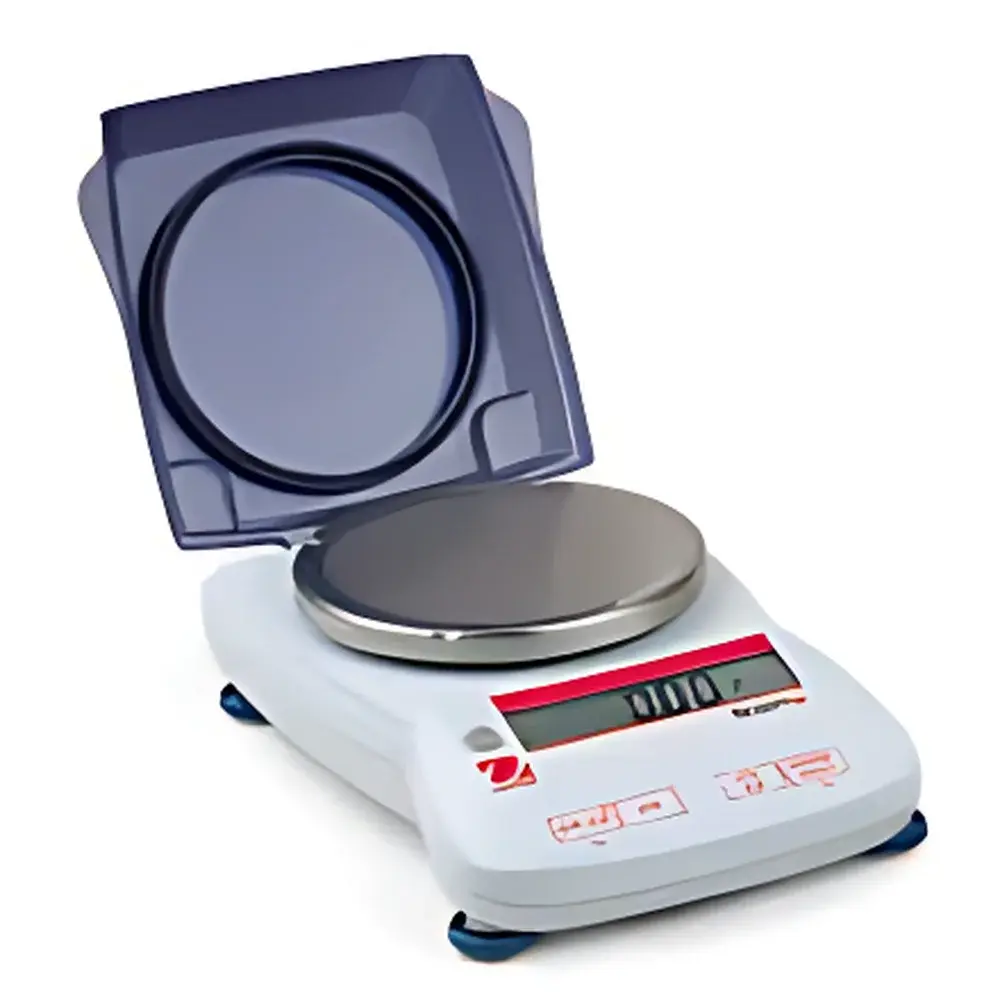
OHAUS Scout SE Textile Balance
| Brand | OHAUS |
|---|---|
| Model | Scout SE |
| Origin | USA |
| Type | Precision Textile Balance for Grammage (g/m²) Measurement |
| Readability | 0.01 g |
| Capacity | 200 g or 400 g |
| Pan Size | 120 mm × 120 mm |
| Construction | ABS housing, ABS draft shield, stainless-steel pan |
| Power | AC adapter (included) or 4 × AA batteries (up to 25 h in auto-off mode) |
| Interface | Optional RS232 or USB |
| Compliance | OIML R76 Class F2 / ASTM E1223 Class 4 |
| IP Rating | IP42 (dust-protected, drip-resistant) |
| Features | Removable stainless-steel pan, under-hook weighing, transport lock, calibration lock, auto-zero tracking, overload/underload indication, low-battery alert, auto-power-off |
Overview
The OHAUS Scout SE Textile Balance is an entry-level precision balance engineered specifically for textile laboratories and quality control environments where grammage (mass per unit area, expressed in g/m²) measurement is a routine requirement. Designed around the standardized test method for fabric weight—commonly performed on 100 cm² circular specimens—the Scout SE integrates dedicated textile unit conversion logic directly into its firmware. Unlike general-purpose analytical balances, the Scout SE supports direct input of sample area (e.g., 100 cm²), enabling real-time calculation and display of grammage without external computation. Its measurement principle follows electromagnetic force compensation (EMFC), delivering high reproducibility and long-term stability under variable ambient conditions typical in production labs. The balance complies with international metrological standards for non-automatic weighing instruments, including OIML R76 (Class F2) and ASTM E1223 (Class 4), ensuring traceable performance suitable for ISO/IEC 17025-accredited testing workflows.
Key Features
- Precision EMFC sensor architecture with 0.01 g readability across 200 g and 400 g capacity variants
- Dedicated textile mode supporting automatic grammage (g/m²) calculation based on user-defined sample area
- Backlit LCD display with large, high-contrast digits optimized for rapid visual verification in ambient-lit factory or lab settings
- Robust mechanical design: removable stainless-steel pan (120 mm × 120 mm), ABS plastic draft shield, and impact-resistant ABS housing
- Integrated operational safeguards: transport lock, calibration lock, overload/underload warning, low-battery indicator, and programmable auto-off (1–60 min)
- Flexible power options: internal AC adapter (100–240 V, 50/60 Hz) or four AA batteries (25-hour runtime in default auto-off configuration)
Sample Compatibility & Compliance
The Scout SE accommodates standard textile specimens—including woven, knitted, nonwoven, and coated fabrics—within its defined pan geometry. Its 120 mm × 120 mm pan allows stable placement of circular cutouts (e.g., ASTM D3776, ISO 3801, GB/T 4669 test specimens) and irregular samples up to 400 g. The balance meets OIML R76 Class F2 accuracy requirements for legal-for-trade applications involving textile mass determination, and conforms to ASTM E1223 Class 4 specifications for laboratory-grade non-automatic balances. Its IP42 enclosure rating provides protection against dust ingress and vertically falling water droplets—suitable for use in controlled manufacturing floors or QC labs without laminar flow hoods. All models ship with factory calibration documentation traceable to NIST standards; optional external calibration with certified weights (included for ≤500 g models) supports GLP/GMP audit readiness.
Software & Data Management
While the Scout SE operates as a standalone instrument, its optional RS232 or USB interface enables seamless integration into laboratory data management systems. When connected to a host PC, the balance transmits stabilized weight values and calculated grammage results in ASCII format—compatible with common LIMS platforms, Excel automation scripts, and statistical process control (SPC) software. No proprietary drivers are required for USB-HID operation; RS232 communication supports standard baud rates (9600–115200) and configurable data framing (e.g., , , or both). All transmitted data includes timestamping via host system clock—critical for FDA 21 CFR Part 11-compliant environments when paired with validated electronic record systems. Firmware updates (if released) are delivered via OHAUS-provided utilities and do not require service intervention.
Applications
- Determination of fabric grammage per ASTM D3776, ISO 3801, and JIS L1096 standards
- Raw material acceptance testing for yarn, fiber blends, and technical textiles
- In-process quality monitoring during weaving, knitting, and finishing operations
- Comparative density analysis of laminated composites and coated substrates
- Supporting ISO 9001 internal audits through documented, repeatable mass measurement protocols
- Education and vocational training in textile engineering curricula
FAQ
What textile standards does the Scout SE support out-of-the-box?
The balance natively implements calculation logic aligned with ASTM D3776 Method A (100 cm² specimen) and ISO 3801, allowing direct g/m² output without manual conversion.
Is the balance suitable for use in humid or dusty production environments?
Yes—its IP42-rated enclosure protects against dust accumulation and incidental moisture exposure, though extended use in high-humidity (>80% RH) or corrosive atmospheres is not recommended without environmental controls.
Can I perform internal calibration without external weights?
No—internal calibration requires an external Class M2 or better reference weight; however, models with ≤500 g capacity include a certified 100 g calibration weight in the shipping package.
Does the USB interface support plug-and-play operation on Windows and macOS?
Yes—USB-HID mode functions as a virtual COM port without driver installation on Windows 10/11 and macOS 12+; RS232 requires a standard serial-to-USB adapter.
How is traceability maintained for regulatory audits?
Each unit ships with a Certificate of Conformance referencing NIST-traceable calibration; users must maintain records of periodic verification using documented procedures per ISO/IEC 17025 Section 6.5.