
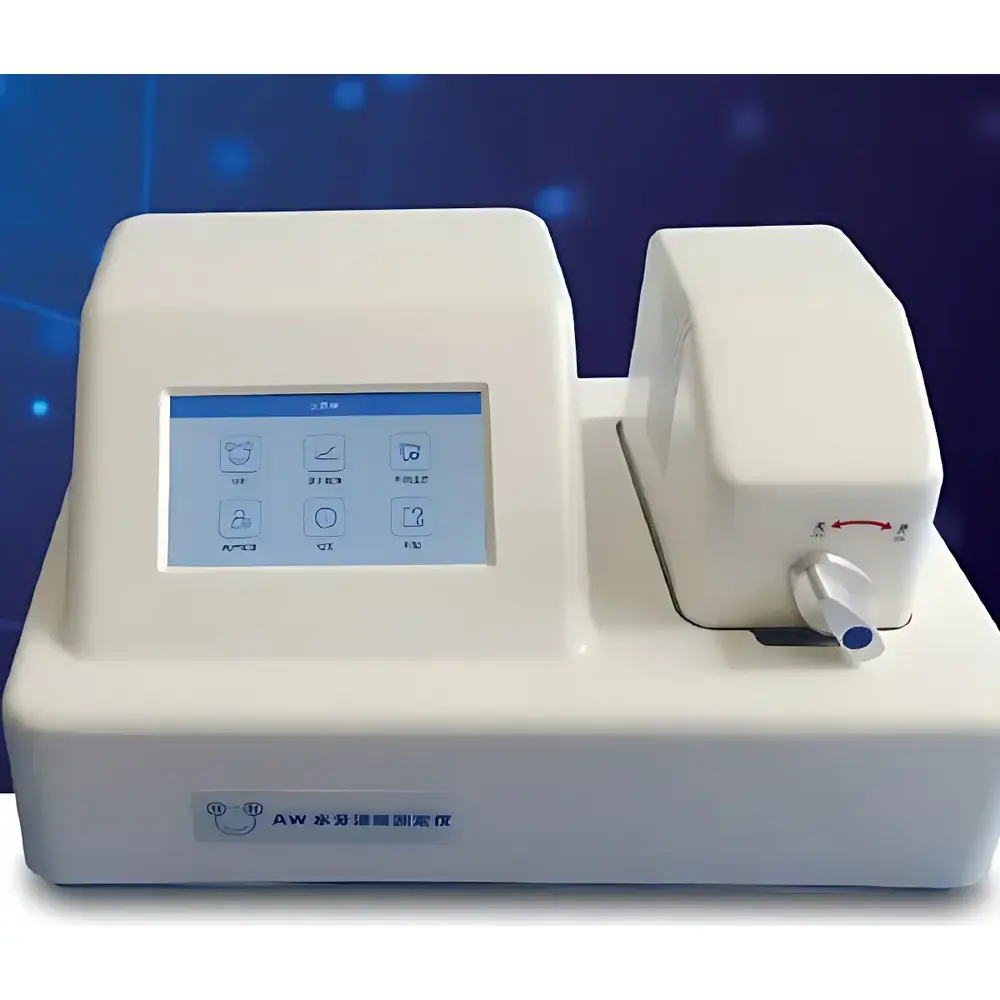
ChangerTek AW1000T Water Activity Analyzer
| Brand | ChangerTek |
|---|---|
| Model | AW1000T |
| Origin | Shanghai, China |
| Detection Principle | Vapor Pressure Ratio (Equilibrium Relative Humidity Method) |
| Display | 5-inch capacitive touchscreen (480 × 854 px) |
| Interface | Chinese-language UI |
| Temperature Control | Integrated Peltier element |
| Temperature Range | Ambient to 50 °C (user-selectable, ±0.2 °C accuracy, 0.1 °C resolution) |
| aw Measurement Range | 0.000–1.000 aw |
| aw Accuracy | ±0.005 aw at 25 °C |
| aw Resolution | 0.001 aw |
| Sample Temperature Sensing | Non-contact infrared sensor |
| Equilibration Method | Dynamic vapor equilibrium acceleration |
| Calibration | Multi-point, up to 11 certified standard salt solutions (full-range traceable calibration) |
| Data Storage | 2000 test records with timestamp, sample ID, temperature, and aw value |
| User Management | Role-based access control (admin/operator) |
| Dimensions | 340 × 230 × 170 mm |
| Weight | 4.7 kg |
| Compliance | Designed for GB/T 23490, ISO 21807, AOAC 978.18, USP <1112>, FDA Guidance for Industry (Food Safety Modernization Act – Preventive Controls), HACCP prerequisite programs, and GMP-aligned documentation workflows |
Overview
The ChangerTek AW1000T Water Activity Analyzer is an engineered precision instrument designed for rapid, reproducible determination of water activity (aw) in food, pharmaceutical, cosmetic, and agricultural products. It operates on the thermodynamic principle of equilibrium relative humidity (ERH): aw is defined as the ratio of the vapor pressure exerted by water in a sample to the vapor pressure of pure water at the same temperature — expressed dimensionlessly as aw = p/p0. This fundamental parameter directly reflects the thermodynamic availability of water for microbial metabolism, enzymatic reactions, and chemical degradation pathways. Unlike moisture content alone, aw quantifies the *energetic state* of water — making it the primary predictor of microbiological stability, shelf-life kinetics, and formulation robustness. The AW1000T implements a closed-chamber dynamic equilibration system, where sample headspace humidity is measured via high-stability capacitive RH sensors, while an integrated Peltier module maintains precise, programmable sample chamber temperature — critical for minimizing measurement drift and ensuring compliance with standardized test conditions (e.g., ISO 21807:2022 specifies 25 °C ± 0.5 °C).
Key Features
- 5-inch high-resolution capacitive touchscreen (480 × 854 px) with intuitive Chinese-language interface — optimized for routine QC laboratory operation without specialized training
- Active thermal management via solid-state Peltier element, enabling stable temperature control from ambient up to 50 °C with ±0.2 °C accuracy and 0.1 °C resolution
- Non-contact infrared temperature sensing eliminates probe interference and ensures accurate real-time sample surface temperature monitoring
- Dynamic equilibrium acceleration algorithm reduces typical measurement time by up to 40% compared to passive equilibration methods — critical for high-throughput production environments
- Full-range multi-point calibration capability using up to 11 NIST-traceable saturated salt standard solutions (e.g., LiCl, MgCl₂, NaBr, NaCl, KCl), supporting both verification and full recalibration per ISO/IEC 17025 requirements
- Onboard data storage for 2000 complete test records, each including timestamp, operator ID, sample identifier, chamber temperature, measured aw, and equilibration duration
- Role-based user access control (administrator and operator levels) supports audit-ready workflows aligned with FDA 21 CFR Part 11 expectations for electronic records and signatures
Sample Compatibility & Compliance
The AW1000T accommodates standard 35-mm diameter aluminum or stainless-steel sample cups (included), suitable for solids, powders, pastes, gels, and low-viscosity liquids. Its sealed measurement chamber prevents cross-contamination and enables analysis of volatile or hygroscopic materials without desiccation artifacts. The instrument meets technical requirements specified in multiple international standards: GB/T 23490–2009 (China), ISO 21807:2022 (Food and animal feeding stuffs — Determination of water activity), AOAC Official Method 978.18, and USP (Application of Water Activity Determination to Nonsterile Pharmaceutical Products). Its design facilitates integration into HACCP plans, GMP documentation systems, and preventive control procedures under FSMA. Traceability is supported through built-in calibration logging, user-defined sample metadata fields, and exportable CSV reports compatible with LIMS platforms.
Software & Data Management
Data acquisition and reporting are fully embedded — no external PC required for routine operation. All measurements are timestamped and tagged with operator credentials and configurable sample IDs. The internal database supports chronological sorting, keyword search, and batch export via USB interface. Audit trails record all calibration events, user logins, parameter modifications, and test deletions — satisfying GLP and GMP documentation integrity requirements. Exported files include raw sensor readings, temperature profiles, and equilibrium convergence curves — enabling secondary review and statistical process control (SPC) analysis. Optional firmware updates maintain alignment with evolving regulatory guidance and metrological best practices.
Applications
- Microbial safety assessment: Correlating aw values with inhibition thresholds for pathogens (e.g., Staphylococcus aureus growth ceases below aw ≈ 0.86; toxigenic molds such as Aspergillus flavus require >0.80)
- Shelf-life modeling: Inputting aw into predictive microbiology tools (e.g., ComBase, Pathogen Modeling Program) to estimate maximum safe storage duration under defined temperature/humidity conditions
- Packaging validation: Evaluating barrier performance by monitoring aw drift over time in accelerated aging studies
- Formulation optimization: Quantifying water migration between multi-phase components (e.g., fillings vs. crusts in baked goods; active ingredients vs. excipients in tablets)
- Process consistency monitoring: In-line or at-line verification of drying, crystallization, or blending steps where water distribution critically affects functionality
- Regulatory submission support: Generating auditable aw evidence for FDA Food Facility Registration, EU Novel Food dossiers, or Health Canada Natural Health Product license applications
FAQ
What is the fundamental difference between moisture content and water activity?
Moisture content measures total water mass per unit sample mass (e.g., % w/w), whereas water activity measures the *thermodynamic energy* of that water — specifically its vapor pressure relative to pure water. Two samples with identical moisture content can exhibit vastly different aw values depending on how tightly water is bound (e.g., via hydrogen bonding or capillary forces), directly impacting microbial risk.
Can the AW1000T be used for regulatory-compliant testing?
Yes — its measurement principle, calibration protocol, temperature control fidelity, and data integrity features align with ISO 21807, USP , and AOAC 978.18. When operated under documented SOPs with periodic verification using certified standards, it supports GMP and HACCP compliance.
How does temperature control affect measurement accuracy?
aw is temperature-dependent. Without active thermal regulation, ambient fluctuations cause significant deviation — especially near critical inhibition thresholds (e.g., ±0.5 °C shift may alter aw by ±0.01–0.02). The Peltier-controlled chamber ensures measurement repeatability within ±0.005 aw at 25 °C.
Is multi-point calibration necessary for routine use?
While single-point verification (e.g., using saturated NaCl at 0.752 aw) suffices for daily checks, full multi-point calibration using ≥3 standards is recommended before first use, after maintenance, or when validating method equivalence across instruments — as required by ISO/IEC 17025 Clause 6.4.6.
Does the instrument support data export for statistical analysis?
Yes — all stored records can be exported via USB as CSV files containing timestamps, operator IDs, sample IDs, temperature, aw, and equilibration time — compatible with JMP, Minitab, Excel, and LIMS integration.



