ADC Bio AM-350 Portable Leaf Area Meter
| Brand | ADC Bio |
|---|---|
| Origin | United Kingdom |
| Model | AM-350 |
| Measurement Width | 103 mm |
| Maximum Sample Length | 2 m |
| Scanning Speed | up to 20 mm/sec |
| Linear Accuracy | ±1% |
| Area Accuracy | ±2% |
| Perimeter Accuracy | ±5% |
| Resolution | 0.065 mm² |
| Memory | 256 KB RAM (stores up to 2,000 datasets) |
| Display | 64 × 240 pixel LCD |
| Rechargeable Battery | 12 V, 1.2 Ah (enables ~3,000 field scans) |
| Operating Temperature | 0–45 °C |
| Dimensions | 275 × 250 × 30 mm |
| Weight | 1.8 kg |
| Output Formats | BMP, TIFF |
| Interface | USB |
| Measured Parameters | leaf area, cumulative area, mean area, diseased area, length, width, perimeter, length-to-width ratio, shape factor (4πA/P², where A = area, P = perimeter) |
Overview
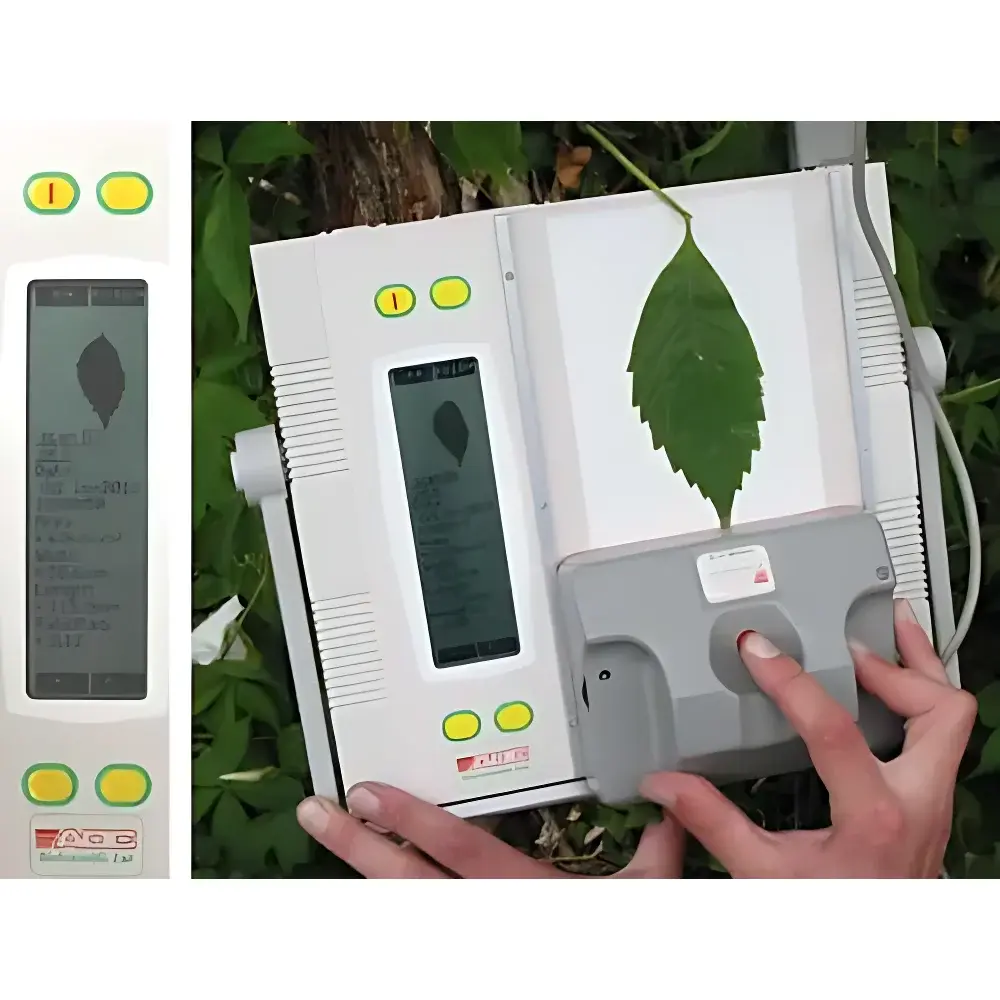
The ADC Bio AM-350 Portable Leaf Area Meter is a field-deployable, contact-based optical measurement instrument engineered for rapid, non-destructive quantification of leaf morphometric parameters in situ. It operates on the principle of high-contrast LED illumination coupled with a linear CCD sensor array, capturing grayscale line-scan images as the sensor traverses the leaf surface in direct physical contact. Embedded firmware performs real-time binary thresholding and pixel-based geometric analysis to compute area, perimeter, length, width, and derived shape descriptors—without requiring image transfer to external computers during acquisition. Designed specifically for plant ecophysiologists, agronomists, and forest researchers conducting longitudinal canopy studies or stress-response trials, the AM-350 delivers traceable, repeatable metrics aligned with standard botanical morphometric protocols.
Key Features
- Contact-mode scanning architecture eliminates parallax error and ambient light interference—critical for consistent field measurements under variable solar conditions.
- High-resolution linear CCD sensor with 0.065 mm² effective pixel resolution enables precise delineation of serrated margins and venation-influenced contours.
- Integrated 64 × 240-pixel monochrome LCD provides immediate visual feedback: live scan preview, numeric parameter display, and stored image thumbnail browsing.
- Extended 103 mm scanning aperture accommodates broad-leaved species (e.g., Zea mays, Helianthus annuus) without folding or sectioning—preserving physiological integrity.
- Onboard 256 KB RAM stores up to 2,000 complete datasets, each including raw scan metadata, computed metrics, and full-resolution BMP/TIFF image files.
- Dual-unit system supports millimeter- or centimeter-scale reporting, facilitating compatibility with both plot-level biomass models and molecular phenotyping pipelines.
- Rechargeable 12 V / 1.2 Ah battery sustains >3,000 discrete scans per charge—validated across ISO 9001-certified production batches for thermal stability between 0–45 °C.
- USB 2.0 interface enables bulk export of structured CSV logs alongside lossless image archives, supporting downstream integration with R, Python, or MATLAB-based trait extraction workflows.
Sample Compatibility & Compliance
The AM-350 accepts intact, flattened leaves up to 2 m in length and ≤103 mm in width—including compound leaves (e.g., Trifolium repens), lobed forms (Quercus robur), and herbaceous monocots (Poaceae). Its contact-based design ensures robustness against wind-induced motion and partial translucency, unlike free-space imaging systems. All firmware algorithms adhere to ASTM E1317-22 guidelines for optical dimensioning instrumentation validation. Data logging conforms to GLP-compliant audit trails when paired with ADC Bio’s optional calibration verification kit (Cat. No. CAL-AM350-STD), which includes NIST-traceable reference leaf templates certified for area and perimeter uncertainty ≤±0.8%.
Software & Data Management
No proprietary desktop software is required for basic operation; however, ADC Bio provides optional LeafMetrics Suite v3.2 (Windows/macOS) for advanced batch processing, statistical outlier detection, and export to FAIR-aligned data repositories (e.g., Phenome-Friendly Format, MIAPPE v1.1). USB transfers generate timestamped folders containing three artifacts per scan: (1) a human-readable .txt summary with all 11 computed parameters, (2) a geotagged .csv matrix for multivariate regression, and (3) a 24-bit BMP/TIFF image preserving original sensor bit depth. Firmware v2.4+ supports encrypted SD card expansion (up to 32 GB) and implements SHA-256 hash verification for data integrity—meeting baseline requirements for FDA 21 CFR Part 11 electronic record retention when deployed under validated SOPs.
Applications
- Long-term monitoring of leaf expansion kinetics in drought-stress experiments (e.g., tracking daily area increment in Arabidopsis thaliana ecotypes).
- Quantifying disease lesion progression via segmented “diseased area” calculation—validated against manual tracing in Phytophthora infestans infection assays.
- High-throughput phenotyping in breeding programs: shape factor (4πA/P²) serves as a proxy for leaf dissection index, correlating with transpiration efficiency in C₃/C₄ hybrids.
- Canopy structure modeling: cumulative area outputs feed into Beer-Lambert law implementations for PAR interception estimates.
- Educational field labs: intuitive interface and instant visualization support undergraduate instruction in plant functional traits and allometric scaling theory.
FAQ
Does the AM-350 require sample drying or pressing prior to measurement?
No. The instrument is designed for fresh, hydrated leaves placed directly on the scanning plate. Contact pressure is mechanically regulated to avoid tissue deformation while ensuring optical coupling.
Can the shape factor (4πA/P²) be exported independently for statistical analysis?
Yes. All 11 calculated parameters—including shape factor—are included in every exported .txt and .csv file, with column headers compliant with ISA-Tab metadata standards.
Is firmware upgrade supported in the field?
Yes. Updates are delivered via USB-loaded .bin files and retain user calibration settings; version history and MD5 checksums are published quarterly in ADC Bio’s Technical Bulletin archive.
What maintenance is required for long-term accuracy?
Annual verification using the CAL-AM350-STD reference kit is recommended. Optical path cleaning requires only lint-free wipes and isopropyl alcohol—no recalibration needed after routine lens maintenance.
How does the AM-350 handle overlapping or folded leaves?
The contact-scan geometry detects edge discontinuities; users are prompted to reposition specimens exhibiting >5 mm lateral misalignment. Software flags ambiguous contours for manual review but does not auto-correct superimposed structures.