
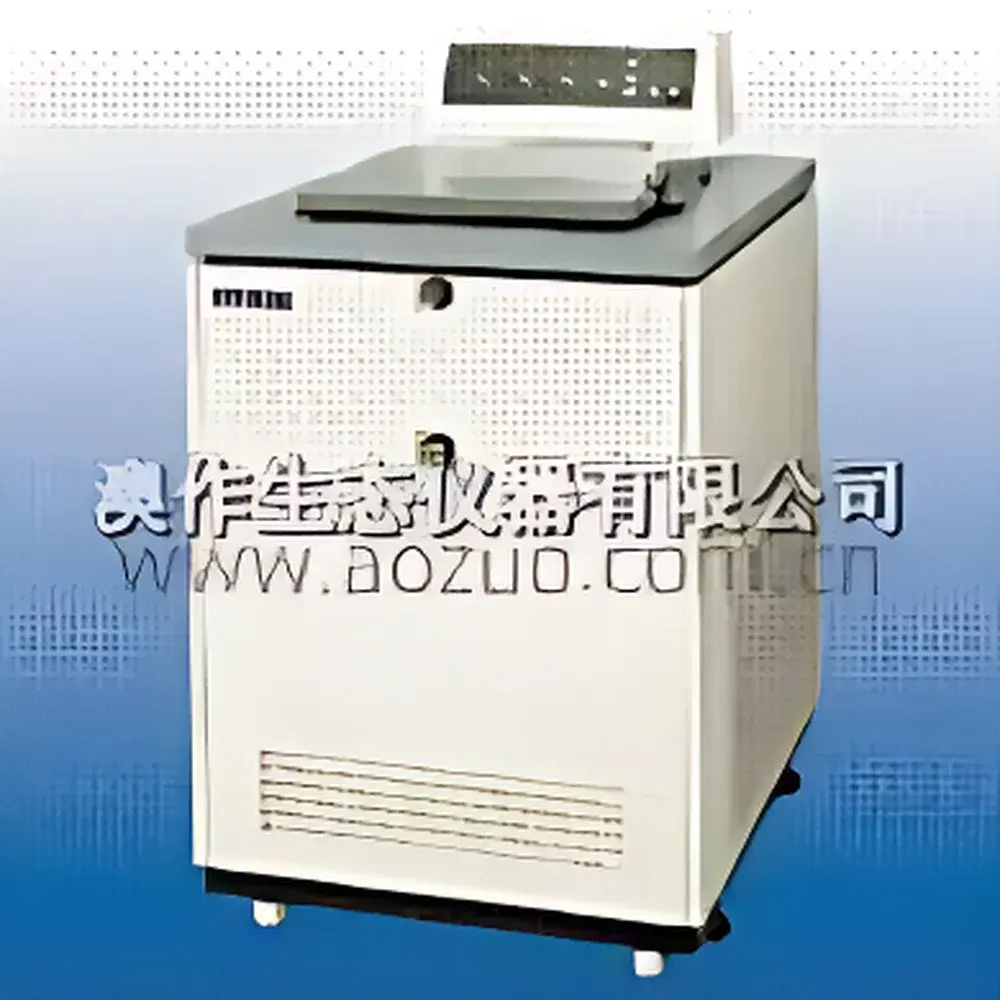
SW-PF Rapid Soil Water Retention Curve Measurement System
| Origin | Japan |
|---|---|
| Manufacturer Type | Authorized Distributor |
| Origin Category | Imported |
| Model | SW-PF |
| Pricing | Available Upon Request |
| Measurement Range | pF 2.0–4.2 |
| Maximum Speed | 14,000 rpm |
| Maximum Centrifugal Force | 25,220 × g |
| Maximum Capacity | 3,000 mL |
| Sample Throughput | 4 samples per run |
| Control System | Microprocessor-based controller with transformer and three-position operational selector switch |
| Power Supply | 220 V, 50 Hz, 50 A |
| Dimensions (W×D×H) | 700 × 860 × 980 mm |
Overview
The SW-PF Rapid Soil Water Retention Curve Measurement System is a precision-engineered centrifugal apparatus designed to determine the soil water retention curve (SWRC) — the fundamental relationship between soil water potential (expressed as pF) and volumetric or gravimetric water content. Unlike traditional pressure plate or tensiometric methods, the SW-PF leverages controlled centrifugation to apply calibrated matric suction across a continuous pF range (2.0–4.2), corresponding to suction pressures from ~10 kPa to ~16,000 kPa. This enables high-resolution characterization of soil hydraulic properties without phase transition artifacts or prolonged equilibration times. The system operates on the principle of hydrostatic equilibrium in rotating porous media: under defined angular velocity, centrifugal force generates a known suction gradient within saturated soil cores, allowing simultaneous measurement of gravimetric water content and bulk density at discrete pF levels. Its architecture integrates mechanical stability, thermal management, and vibration damping to ensure reproducible sample conditioning — critical for generating SWRCs compliant with ISO 11277 and ASTM D4944 standards.
Key Features
- Centrifugal suction generation across pF 2.0–4.2 (10–16,000 kPa), covering the full functional range for unsaturated zone modeling and irrigation scheduling.
- High-capacity rotor accommodating four standardized soil cores (e.g., 50 mm diameter × 25 mm height) per run, enabling statistically robust replicate analysis.
- Microprocessor-controlled operation with three predefined mode settings: standby, acceleration ramp, and sustained centrifugation — ensuring consistent rotational profile execution.
- Robust stainless-steel chamber and balanced rotor assembly rated for continuous operation at 14,000 rpm and peak centrifugal force of 25,220 × g.
- Integrated safety interlocks including lid-lock detection, overspeed cutoff, and real-time temperature monitoring to prevent sample desiccation or structural degradation.
- Compact footprint (700 × 860 × 980 mm) optimized for laboratory integration without requiring dedicated reinforced flooring.
Sample Compatibility & Compliance
The SW-PF accepts intact or repacked soil cores in standard cylindrical holders compatible with USDA and ISO-defined dimensions. It supports mineral soils ranging from coarse sand to clay loam (texture classes per USDA TR-42), provided samples are pre-saturated and sealed to minimize evaporative loss during rotation. Bulk density changes during desaturation are automatically accounted for via concurrent mass and volume tracking — essential for deriving accurate water content–suction relationships under shrink-swell conditions. The system meets mechanical and electrical safety requirements per IEC 61010-1 and is designed to support GLP-compliant workflows, including operator ID logging, method version control, and audit-trail-capable data export (CSV/Excel). While not inherently certified for regulatory submission, its output aligns with input requirements for HYDRUS-1D, STANMOD, and UNSODA database formatting.
Software & Data Management
The SW-PF operates via embedded firmware with no external PC dependency; however, raw mass readings (pre- and post-centrifugation), rotational parameters, and timestamp metadata are exportable via USB interface. Optional companion software (sold separately) enables automated fitting of van Genuchten, Brooks-Corey, and Kosugi parametric models to measured points, calculates air-entry value (AEV), residual water content (θr), and saturated hydraulic conductivity (Ks) estimates via Mualem-van Genuchten correlation. All exported datasets include ISO 8601 timestamps, instrument serial number, and user-defined sample IDs — satisfying traceability requirements under ISO/IEC 17025 and FDA 21 CFR Part 11 when paired with validated electronic signature modules.
Applications
- Calibration and validation of vadose zone flow models in hydrological and agricultural simulation platforms.
- Determination of plant-available water capacity (PAWC) and permanent wilting point (PWP) for crop-specific irrigation planning.
- Soil hydraulic property mapping in environmental impact assessments and land reclamation projects.
- Quality control of engineered soils used in landfill liners, green roof substrates, and bioswale media.
- Research on soil structural dynamics, including swelling/shrinkage hysteresis and pore-size distribution evolution under cyclic wetting-drying.
FAQ
What pF range does the SW-PF cover, and how does it translate to physical suction units?
The system measures across pF 2.0–4.2, equivalent to matric suction values from approximately 10 kPa to 16,000 kPa — encompassing the full range relevant to root water uptake, drainage, and capillary rise.
Can the SW-PF accommodate organic-rich or highly expansive soils?
Yes, though samples with >15% organic matter or significant smectite content require extended saturation protocols and careful handling to avoid slurry formation during centrifugation.
Is calibration required before each use?
No routine recalibration is needed; however, annual verification of rotational speed accuracy (via tachometer) and mass sensor linearity (using NIST-traceable weights) is recommended per ISO/IEC 17025.
Does the system comply with ASTM or ISO standards for SWRC determination?
It implements the centrifuge method described in ASTM D7184 and ISO/TS 17892-9, with enhanced throughput and pF resolution relative to manual variants.
What maintenance is required for long-term reliability?
Biannual lubrication of rotor bearings, quarterly inspection of O-ring seals, and annual replacement of desiccant in the chamber humidity control module ensure optimal performance over 10+ years of service life.
Related Products







