
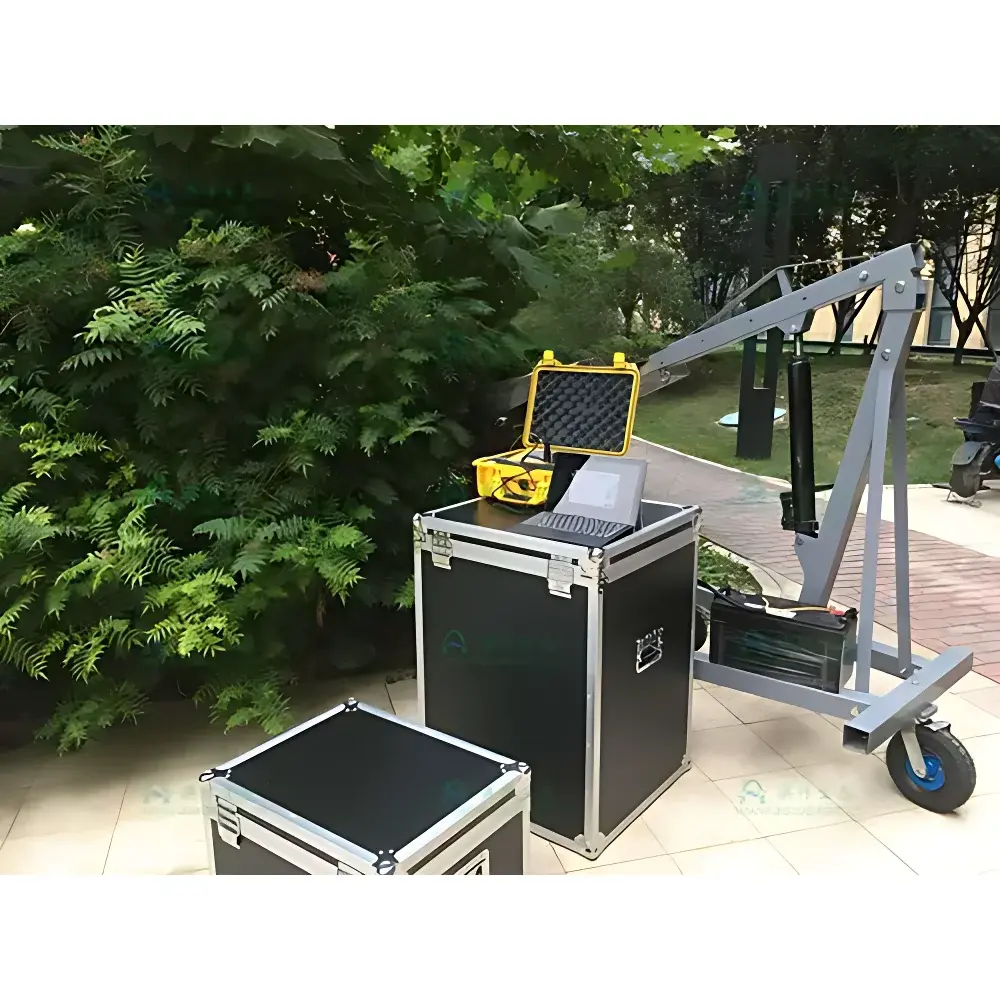
AZ LP-100 In Situ Plant Dust Retention Analysis System
| Brand | AZ (Beijing AoZuo Ecological Instruments Co., Ltd.) |
|---|---|
| Origin | Beijing, China |
| Manufacturer Type | Direct Manufacturer |
| Model | LP-100 |
| Measurement Method | Controlled-airflow particle resuspension coupled with real-time optical particle detection |
| Measured Parameters | TSP, PM₁₀, PM₂.₅, PM₁.₀ dust retention per unit leaf area |
| Measurement Range | 0–60 mg/m³ (indicator range), 0–6 mg/m³ (quantitative accuracy range) |
| Measurement Interval | 1 s – 4 h |
| Sampling Flow Rate | 600 cm³/min |
| LOD | 0.01 µg/m³ |
| Flow Stability | ±0.1% over 5-min measurement cycle |
| Particle Size Detection Range | 0.5–20 µm (aerodynamic diameter) |
| Wind Speed Range (integrated sensor) | 0–60 m/s, resolution 0.1 m/s, accuracy ±3% |
| Temperature Range | −40 to +55 °C, resolution 0.1 °C, accuracy ±0.2 °C |
| Relative Humidity Range | 1–100%, resolution 0.1%, accuracy ±3–5% |
| Rainfall Rate Range | 0–4 mm/min, resolution 0.1 mm, accuracy ±4% |
Overview
The AZ LP-100 In Situ Plant Dust Retention Analysis System is an engineered field-deployable instrument designed for quantitative, non-destructive, and time-resolved assessment of atmospheric particulate matter (PM) accumulation on living plant foliage. Unlike conventional gravimetric or filter-based ex situ methods—where leaves are harvested, dried, and weighed—the LP-100 applies a controlled resuspension principle grounded in aerosol dynamics and optical scattering physics. It isolates a representative branch within a sealed, transparent measurement chamber and subjects the leaf surface to programmable, multi-directional airflow generated by a rotating multi-nozzle blower. This mechanical agitation dislodges adhered particles (TSP, PM₁₀, PM₂.₅, PM₁.₀) into the chamber air stream, where real-time concentration is quantified via 90° laser light scattering (Mie scattering regime). The system computes dust retention per unit leaf area (µg/cm² or mg/m²) by integrating particle mass concentration over the measured volume and normalizing to scanned or manually input leaf surface area. Its design prioritizes physiological fidelity: measurements are completed within ≤5 minutes to minimize stomatal closure, transpiration disruption, or wettability changes—critical for ecological validity in urban forestry and green infrastructure research.
Key Features
- True in situ capability: Measures live, intact branches without harvesting or leaf detachment—enabling longitudinal monitoring of the same individual over days, weeks, or seasonal cycles.
- Modular, scalable chamber design: Cylindrical acrylic chambers (diameter 20–50 cm, height 30–100 cm, customizable) accommodate small shrubs to mature tree branches; integrated sealing end-caps ensure atmospheric isolation during measurement.
- Dynamic airflow control: External high-speed blower (ozone-free operation) feeds through flexible tubing to an internal DC-motor-driven rotating multi-nozzle assembly, ensuring uniform particle resuspension across heterogeneous leaf surfaces—including adaxial/abaxial sides and venation microtopography.
- Multi-parameter environmental co-monitoring: Integrated sensors continuously log chamber-internal wind speed, temperature, relative humidity, and barometric pressure—parameters directly influencing particle adhesion strength and resuspension efficiency.
- Real-time particle detection: Laser diode-based optical sensor (90° scattered light intensity calibration traceable to NIST-traceable aerosol standards) delivers continuous PM concentration data at 1-second resolution, with full-range linearity from 0.01 µg/m³ to 60 mg/m³.
- Field-ready architecture: Ruggedized housing, rechargeable lead-acid battery (≥8 h operation), IP54-rated electronics, and dual communication interfaces (RS-232 serial + TCP/IP Ethernet) support unattended deployment in remote urban parks, roadside green belts, or rooftop gardens.
Sample Compatibility & Compliance
The LP-100 accommodates broad botanical diversity—including deciduous and evergreen broadleaf species (e.g., Platanus acerifolia, Broussonetia papyrifera), conifers (Pinus tabuliformis), and shrubs (Ligustrum lucidum)—provided the branch fits within the selected chamber dimensions. Leaf morphology (trichome density, cuticle waxiness, surface roughness) is preserved throughout measurement; no chemical solvents or physical abrasion are used. The system complies with core methodological principles outlined in ISO 16000-27 (Indoor air — Part 27: Determination of particle deposition velocity on surfaces) and aligns with ASTM D7795-22 (Standard Guide for Assessing Vegetative Filters for Airborne Particulate Matter). While not certified for regulatory compliance reporting, its data structure supports GLP-aligned metadata logging (time-stamped operator ID, GPS coordinates, chamber ID, meteorological context), enabling audit-ready datasets for peer-reviewed ecological studies and municipal green infrastructure assessments.
Software & Data Management
Ecograph software—developed in-house by AZ for over a decade—serves as the system’s operational and analytical hub. It features a fully localized English interface (with optional multilingual support), real-time parameter dashboards, and synchronized multi-sensor acquisition. All raw time-series data (PM concentration, wind vector, RH/T/P, leaf area input) are timestamped, georeferenced (via optional GNSS module), and stored in standardized CSV/NetCDF formats. The software implements built-in algorithms to calculate cumulative dust retention, saturation capacity (via repeated measurements on the same branch), and normalized deposition flux (µg·cm⁻²·h⁻¹). Dual-Y axis plotting, batch curve overlay, spatial mapping of multi-chamber deployments (via embedded GIS layer), and automated report generation (PDF/Excel) meet publication-grade documentation requirements. Data export supports FDA 21 CFR Part 11-compliant audit trails when deployed with user authentication and electronic signature modules.
Applications
- Urban forestry selection trials: Quantifying interspecific differences in PM interception efficiency under real-world exposure conditions—supporting evidence-based species recommendations for pollution mitigation.
- Green infrastructure performance validation: Evaluating temporal dynamics of dust accumulation and wash-off during rainfall events, informing maintenance schedules for street trees and vertical green walls.
- Phytoremediation mechanism studies: Correlating leaf surface traits (SEM-imaged microstructures, elemental composition via optional LIBSChem integration) with measured retention kinetics.
- Climate–pollution interaction modeling: Capturing diurnal and seasonal variations in retention capacity as functions of RH, temperature, and boundary-layer turbulence—inputs for regional air quality models.
- Educational field laboratories: Enabling undergraduate and graduate students to conduct hypothesis-driven experiments on plant–aerosol interactions with reproducible, instrument-calibrated outcomes.
FAQ
How does the LP-100 differentiate between loosely adhered and strongly bound particles?
The system does not chemically fractionate particles; instead, it uses calibrated airflow profiles (0–60 m/s, adjustable ramp rates) to probe adhesion thresholds. Sequential measurements at incrementally higher wind speeds generate retention–velocity curves, empirically distinguishing labile vs. resistant fractions.
Can the system operate during rain or high-humidity conditions?
Yes—the chamber is sealed and internally climate-controlled. However, external rainfall must be shielded (e.g., via weatherproof enclosure) to prevent water ingress; high ambient RH (>95%) may reduce resuspension efficiency due to capillary bridging, a known physical limitation acknowledged in ISO 16000-27 Annex B.
Is leaf area measurement automated or manual?
Both options are supported: users may input leaf area manually (from digital caliper or scanner-derived estimates), or integrate third-party leaf area analyzers (e.g., LI-COR LI-3100C) via RS-232 for automated real-time area registration.
What calibration standards are recommended for routine verification?
NIST-traceable PSL (polystyrene latex) spheres (1–10 µm) and Arizona Test Dust (ISO 12103-1, A2) are recommended for optical sensor verification; flow rate is validated using a primary-standard dry gas meter (±0.5% uncertainty).
Does the system support remote monitoring and alarm triggers?
Yes—via TCP/IP, Ecograph enables remote login, live parameter streaming, and configurable threshold alerts (e.g., “PM concentration >5 mg/m³ sustained for >30 s”) sent via email or SMS through compatible gateway hardware.
Related Products







