
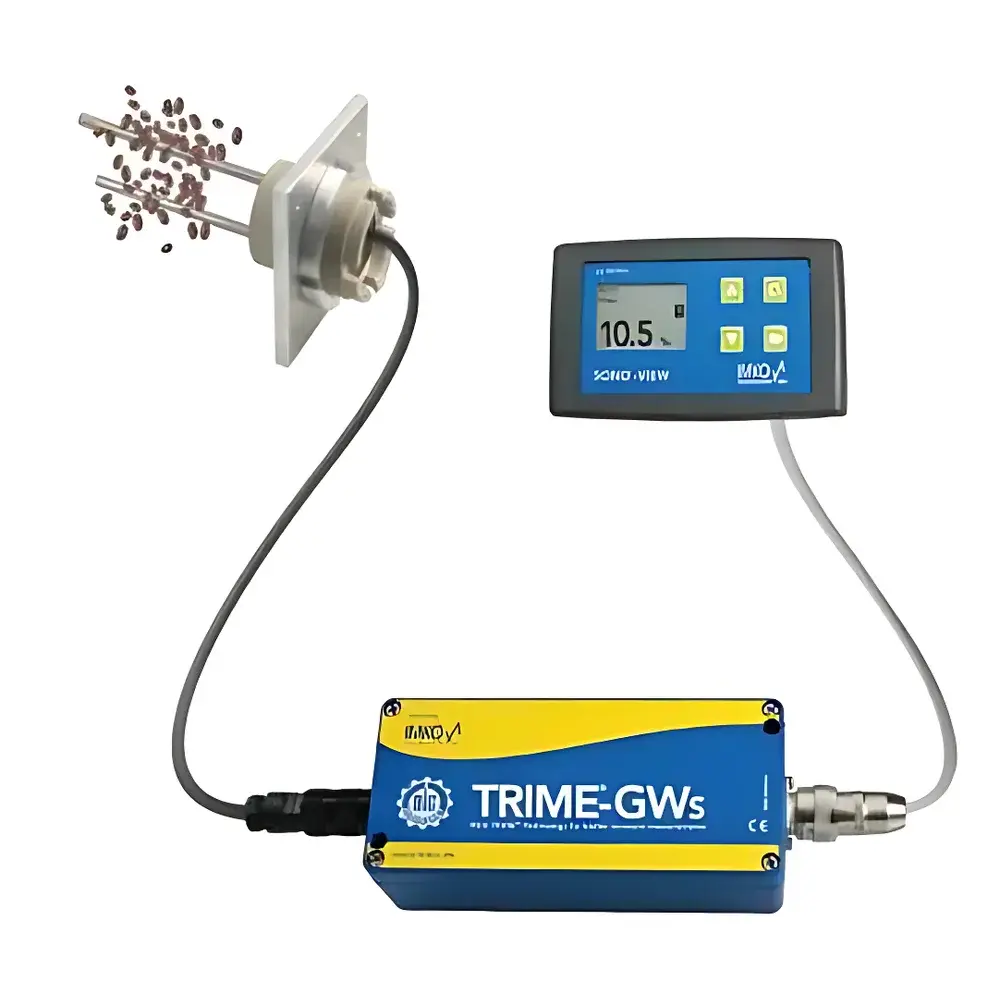
IMKO TRIME-GWs Grain Moisture Measurement System
| Brand | IMKO |
|---|---|
| Origin | Germany |
| Model | TRIME-GWs |
| Instrument Type | Portable |
| Measurement Principle | Time Domain Reflectometry (TDR) |
| Moisture Range (w/w) | 3–45% |
| Accuracy | ±0.2% repeatability |
| Standard Deviation | 0.6% (3–20%), 1.0% (20–45%) |
| Sensor Temp. Range | 0–130 °C (up to 150 °C peak) |
| Transmitter Temp. Range | −10–+60 °C |
| Output | 4–20 mA analog, RS485, IMP232/MICRONET |
| Power Supply | 12–24 V DC, 3 W |
| IP Rating | IP65 (transmitter), IP67 (sensor) |
| Cable Length | 2.5 m standard |
| Conductivity Range | 0–1 mS/cm (GR/GRr), 0–2.5 mS/cm (WS2) |
| Built-in Temperature Sensor | Yes |
| Compliance | DLG-certified (German Agricultural Society) |
Overview
The IMKO TRIME-GWs Grain Moisture Measurement System is an industrial-grade, TDR-based (Time Domain Reflectometry) online moisture analyzer engineered for continuous, non-destructive, and calibration-free monitoring of bulk grain and granular agricultural commodities during drying, storage, and conveying operations. Unlike conventional oven-drying or capacitance-based methods, the TRIME-GWs employs high-frequency electromagnetic pulse propagation (up to 1 GHz) along robust waveguide probes to determine the dielectric permittivity of the material in situ. Since water exhibits a significantly higher dielectric constant (~80) compared to dry grain (~2–5), the system precisely correlates time-of-flight delay—resolved down to 1 ps—with volumetric and gravimetric moisture content. This physics-based measurement principle ensures stable performance across varying particle size distributions, density gradients, and temperature fluctuations typical in grain drying environments—from fluidized beds and rotary dryers to silos and belt conveyors.
Key Features
- TDR-based real-time moisture measurement with no sample extraction required—eliminates operator-induced variability and delays inherent in offline lab testing.
- Three sensor variants optimized for distinct operational conditions: GR (standard granular grains), GRr (high-conductivity or steam-saturated environments), and WS2 (coarse particles, high-mineral-content feeds, or elevated-temperature applications up to 150 °C peak).
- Integrated Pt100 temperature sensing within each probe enables automatic temperature compensation—critical for maintaining accuracy across drying profiles from ambient to 130 °C continuous operation.
- Multi-protocol digital interface (RS485, IMP232/MICRONET) plus isolated 4–20 mA analog output for seamless integration into PLC, DCS, or PAC-based control architectures supporting PID or fuzzy logic drying optimization.
- Robust mechanical design: stainless steel probe bodies, IP67-rated sensors, IP65-rated transmitter enclosures, and 2.5 m shielded cable pre-terminated for industrial EMI resilience.
- User-configurable measurement intervals (from seconds to minutes), enabling adaptive data logging aligned with process dynamics without overloading control networks.
Sample Compatibility & Compliance
The TRIME-GWs system is validated for direct in-line measurement of cereals including wheat, corn (maize), rye, barley, oats, rice, and sorghum—as well as oilseeds (soybean, sunflower), malt, coffee beans, and powdered feedstuffs. Its TDR architecture inherently accommodates heterogeneous particle morphology and variable bulk density without recalibration. The system conforms to DLG (Deutsche Landwirtschafts-Gesellschaft) certification standards—the benchmark for agricultural instrumentation in Europe—and supports traceability requirements under ISO 9001 and ISO/IEC 17025 quality management systems. While not FDA 21 CFR Part 11–certified out-of-the-box, audit-ready data logs (timestamped, uneditable, with metadata tagging per measurement cycle) are exportable via MICRONET for GLP/GMP-aligned documentation workflows.
Software & Data Management
Data acquisition and visualization are supported through IMKO’s proprietary MICRONET software suite (Windows-based), which provides real-time trend plotting, historical data archiving, alarm configuration (e.g., moisture deviation >±0.5%), and CSV/Excel export. All measurements include synchronized timestamps, probe ID, temperature, conductivity, and calculated moisture values. For enterprise-level integration, the RS485 interface supports Modbus RTU protocol, enabling bidirectional communication with SCADA platforms. No cloud dependency or SaaS subscription is required; local database storage ensures full data sovereignty—a key requirement for food safety auditors and facility compliance officers.
Applications
The TRIME-GWs is deployed globally in automated grain drying facilities where precise moisture endpoint detection prevents under-drying (microbial risk) and over-drying (weight loss, germination damage, energy waste). Documented installations include Anheuser-Busch’s malt drying lines (180+ units), Stela Laxhuber’s continuous-flow grain dryers (280+ units), Procter & Gamble’s coffee bean conditioning systems, Nidera’s South American oilseed dryers, and AB Liros’ Nordic cereal terminals. Its adaptability extends beyond agriculture to biomass preprocessing, animal feed production, and starch manufacturing—anywhere hygroscopic particulate flow demands closed-loop moisture feedback.
FAQ
Does the TRIME-GWs require periodic recalibration?
No. The TDR measurement principle is physics-based and drift-free; calibration is factory-established and remains stable over the sensor’s service life under normal operating conditions.
Can it measure moisture in wet steam environments?
Yes—specifically the GRr and WS2 sensor variants are designed for high-humidity, condensing, or steam-laden dryer exhaust zones with enhanced corrosion resistance and conductivity compensation.
Is temperature compensation automatic?
Yes. Each sensor incorporates a built-in Pt100 RTD; moisture algorithms apply real-time thermal correction using embedded polynomial coefficients.
What is the minimum and maximum grain particle size it supports?
The system performs reliably across particle diameters from fine milled flour (5 mm), provided bulk density remains ≥300 kg/m³ for consistent waveguide coupling.
How is electrical conductivity handled in saline or high-mineral feeds?
Conductivity is measured simultaneously (0–2.5 mS/cm range on WS2) and factored into the dielectric model—ensuring accuracy even in mineral-rich soybean or seaweed-based feedstocks.





