
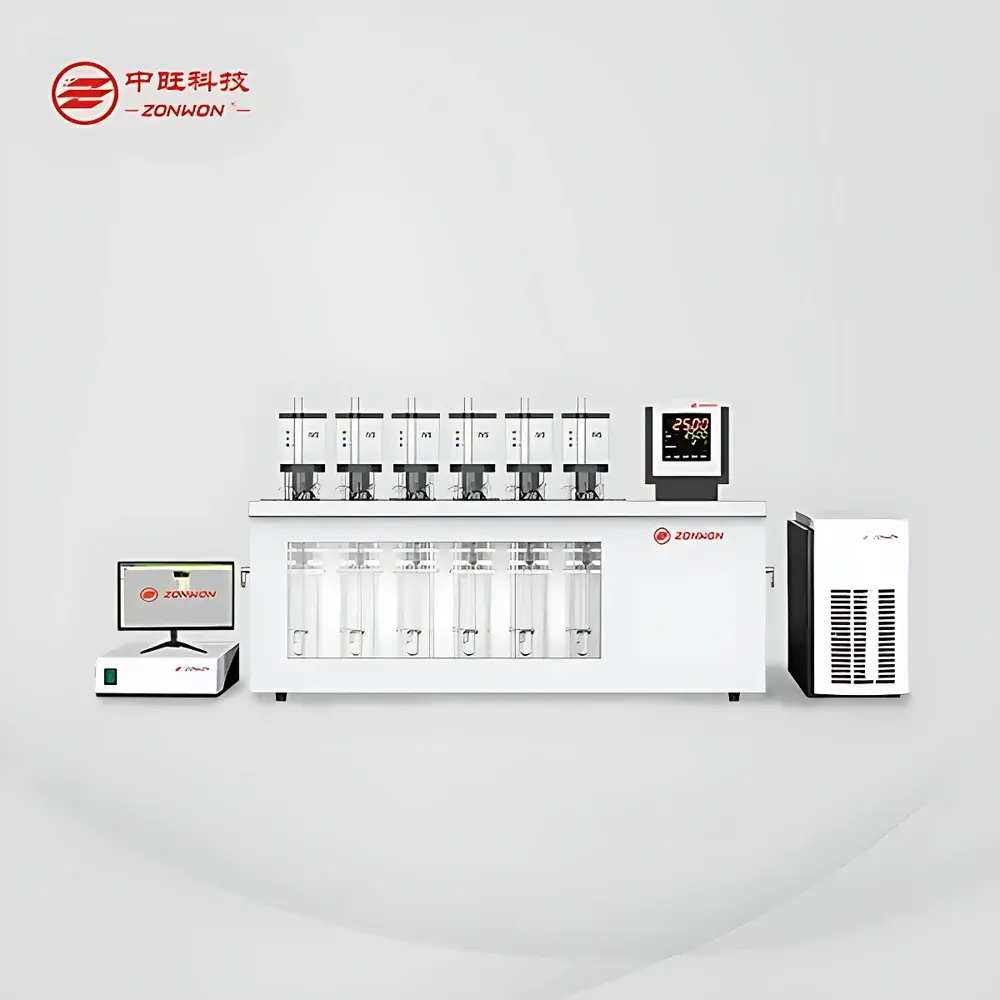
ZONWON IVS400-6 Automated Ubbelohde Viscometer
| Brand | ZONWON |
|---|---|
| Origin | Zhejiang, China |
| Manufacturer Type | Direct Manufacturer |
| Instrument Category | Domestic |
| Model | IVS400-6 |
| Instrument Type | Capillary Viscometer |
| Mounting Style | Benchtop Fixed System |
| Operating Environment | Ambient Temperature |
| Viscosity Range | 0.3–100,000 mm²/s |
| Temperature Range | 15–65 °C |
| Temperature Resolution | ≤ ±0.01 °C |
| Temperature Accuracy | ≤ ±0.01 °C |
| Timing Range | 0–9999.999 s |
| Timing Resolution | 0.001 s |
| Bath Volume | 25 L |
| Power Supply | 220 V / 50 Hz / 1200 W |
| Control Unit Dimensions | 85 × 245 × 240 mm |
| Bath Dimensions | 610 × 270 × 500 mm |
| Measurement Units Supported | Up to 6 SC400 capillary modules |
Overview
The ZONWON IVS400-6 is an automated Ubbelohde capillary viscometer engineered for high-precision, high-throughput kinematic viscosity measurement in polymer, pharmaceutical, petrochemical, and quality control laboratories. It operates on the principle of gravity-driven laminar flow through a standardized Ubbelohde-type capillary tube, where efflux time is measured under controlled thermal conditions and converted to kinematic viscosity (mm²/s) using calibration constants. Unlike rotational or vibrational viscometers, this instrument delivers traceable, ASTM D445- and ISO 3104-compliant results for Newtonian and near-Newtonian fluids—particularly critical for polymer characterization (e.g., intrinsic viscosity, limiting viscosity number) and solvent purity verification. The system integrates a thermostatically stabilized 25 L bath with ±0.01 °C uniformity and repeatability, ensuring compliance with GLP/GMP environmental monitoring requirements for regulated testing environments.
Key Features
- Automated multi-step workflow: simultaneous sample loading, timed efflux measurement, solvent rinsing, waste evacuation, and nitrogen-assisted drying—all without manual intervention or capillary disassembly.
- Dual-mode cleaning architecture: supports both on-the-fly rinse-between-samples and full post-run cleaning cycles; compatible with up to three programmable solvents (e.g., toluene, chloroform, THF) via optional DX10 reagent delivery module.
- Intelligent waste management: single centralized waste collection system serves up to six measurement units; segregated reservoirs enable solvent recovery and compliant hazardous waste segregation per EPA 40 CFR Part 261 guidelines.
- Low-reagent consumption design: each cleaning cycle uses only 10–12 mL of solvent—reducing operational cost and exposure risk while meeting OSHA laboratory safety standards (29 CFR 1910.1200).
- Benchtop fixed configuration with modular SC400 capillary units: scalable from 1 to 6 parallel channels; all units synchronized and monitored via unified controller interface.
- Embedded temperature stability assurance: Peltier-assisted cooling (integrated refrigeration unit), PID-controlled heating, and real-time bath homogeneity monitoring ensure <±0.01 °C spatial and temporal accuracy across the full 15–65 °C operating range.
Sample Compatibility & Compliance
The IVS400-6 accommodates a broad range of organic solvents, polymer solutions (e.g., PET, PA6, PS in phenol/o-chlorophenol), lubricants, and bio-based fluids. Its Ubbelohde geometry eliminates hydrostatic pressure effects, enabling accurate determination of intrinsic viscosity ([η]), reduced viscosity (ηsp/c), inherent viscosity (ln(ηr)/c), Fickentscher’s K-value, and calculated weight-average molecular weight (Mw) via Mark–Houwink–Sakurada relationships. All measurements adhere to ASTM D445 (Standard Test Method for Kinematic Viscosity of Transparent and Opaque Liquids), ISO 3104 (Petroleum Products — Determination of Kinematic Viscosity), and USP (Viscosity). Data integrity meets FDA 21 CFR Part 11 requirements through role-based access control, electronic audit trails, and immutable raw timing logs.
Software & Data Management
Viscobee™ v4.x software provides a validated, bilingual (English/Chinese) interface supporting Windows XP through Windows 10. It enables real-time status visualization across all six measurement channels, automated outlier detection with configurable deviation thresholds (e.g., ±0.2% relative standard deviation), and conditional re-measurement logic. The platform supports serial and parallel extrapolation protocols—including mandatory 4+ concentration points for Huggins and Kraemer plot generation—and allows user-defined formula registration (e.g., custom Mark–Houwink coefficients) without code modification. Export options include timestamped Excel (.xlsx) datasets with metadata (operator ID, batch ID, ambient RH, bath temp log), PNG/PDF reports, and CSV-compatible raw efflux times. Audit trail records all parameter changes, login/logout events, and result modifications with ISO/IEC 17025-aligned traceability.
Applications
- Polymer QC/QA: routine intrinsic viscosity screening for synthetic fibers, engineering plastics, and biopolymers during production and incoming raw material inspection.
- Pharmaceutical excipient testing: viscosity assessment of cellulose derivatives (e.g., HPMC, MC) and polyvinylpyrrolidone in dissolution media per USP monographs.
- Petrochemical analysis: kinematic viscosity grading of base oils, hydraulic fluids, and transformer oils per ASTM D445 Classifications I–IV.
- Academic research: fundamental rheological studies requiring high-accuracy, low-shear-rate viscosity data at defined thermodynamic states.
- Smart lab integration: native compatibility with ZONWON FLYLAB IoT ecosystem for remote monitoring, predictive maintenance alerts, and LIMS interoperability via HL7 or RESTful API extensions.
FAQ
What capillary standards are supported by the IVS400-6?
The system accepts ASTM D445-compliant Ubbelohde capillaries (e.g., Cannon-Fenske Routine, SUS, or micro-Ubbelohde variants) with certified calibration constants traceable to NIST SRM 2785.
Can the IVS400-6 perform intrinsic viscosity calculations without external software?
Yes—Viscobee software executes all standard polymer viscosity calculations (Huggins, Kraemer, Schulz–Blaschke) in real time using user-input concentration series and preloaded solvent parameters.
Is the system compliant with 21 CFR Part 11 for regulated environments?
Yes—electronic signatures, audit trails, permission tiers, and data immutability features are preconfigured and documented in the system validation package (IQ/OQ/PQ available upon request).
How is temperature uniformity verified across the bath?
A calibrated platinum RTD array (3-point probe mapping) validates thermal homogeneity during installation qualification; annual recalibration is recommended per ISO/IEC 17025 Clause 6.5.
What maintenance intervals are recommended for long-term reliability?
Capillary cleaning every 200 runs; bath fluid replacement every 6 months; refrigerant pressure check annually; full system performance verification every 12 months using certified reference oils (e.g., Cannon SRM series).



