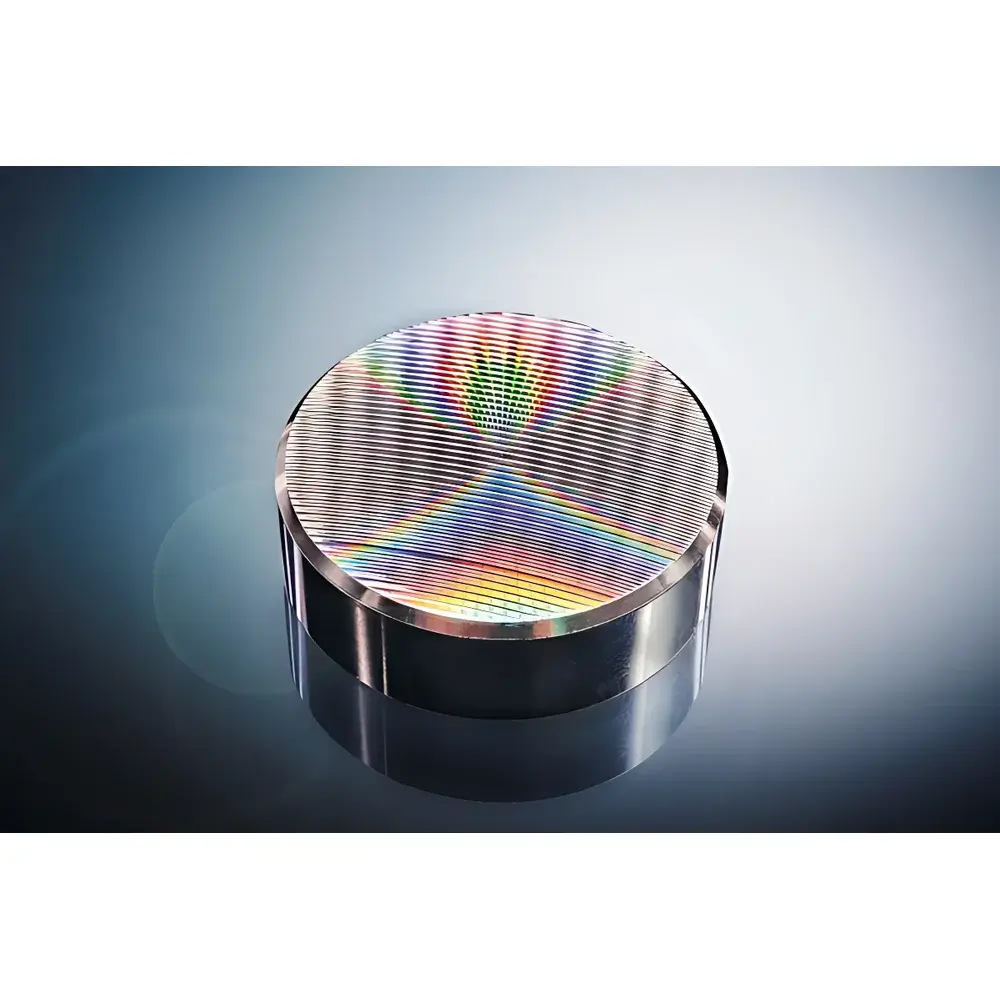
optiXfab 1-inch Mo/Si Multilayer EUV Mirror for 13.5 nm
| Brand | optiXfab |
|---|---|
| Origin | Germany |
| Manufacturer Type | Authorized Distributor |
| Origin Category | Imported |
| Component Type | Optical Element |
| Substrate Material | Fused Silica |
| Diameter | 25.4 ± 0.1 mm |
| Thickness | 6.35 ± 0.1 mm |
| Surface Figure Accuracy | λ/20 @ 632.8 nm |
| Surface Roughness | < 0.2 nm RMS |
| Coating Material | Mo/Si |
| Central Wavelength | 13.5 nm |
| Reflectivity | >65% (AOI = 5°, planar), >67% (AOI = 45°, planar), >65% (AOI = 5°, spherical) |
| Bandwidth (FWHM) | ~500 pm (planar, 5°), ~950 pm (planar, 45°), ~500 pm (spherical, 5°) |
| Radius of Curvature | 500 mm ±1% (spherical variant) |
| Application Domain | EUV Lithography R&D, HHG-based Coherent Imaging, Laser-Driven Plasma Sources |
Overview
The optiXfab 1-inch Mo/Si Multilayer EUV Mirror for 13.5 nm is a precision optical component engineered for high-efficiency reflection in the extreme ultraviolet spectral region. Based on the commercially matured Mo/Si multilayer deposition technology originally developed at Fraunhofer IOF and industrialized by optiXfab since 2012, this mirror leverages periodic nanoscale layer stacking—typically 40–60 bilayers—to achieve constructive interference at the target wavelength of 13.5 nm. This wavelength corresponds to the emission peak of laser-produced plasma (LPP) and discharge-produced plasma (DPP) sources used in next-generation lithography, as well as high-harmonic generation (HHG) systems employed in ultrafast science laboratories. The mirror’s design adheres to rigorous physical optics constraints governing EUV reflectance, including critical-angle limitation, interfacial diffusion control, and interface roughness minimization—all essential for maintaining high reflectivity and spectral fidelity.
Key Features
- Three standardized configurations: planar mirror at 5° angle of incidence (AOI), planar mirror at 45° AOI, and spherical mirror (R = 500 mm ±1%) at 5° AOI—each optimized for distinct beam path geometries in EUV optical trains.
- Mo/Si multilayer coating deposited via ion-beam sputtering under ultra-high vacuum (UHV) conditions, ensuring atomic-level interface sharpness and minimal interdiffusion.
- Fused silica substrate with surface figure accuracy better than λ/20 @ 632.8 nm and root-mean-square surface roughness < 0.2 nm—critical for preserving wavefront fidelity in coherent imaging and interferometric applications.
- Measured peak reflectivity exceeding 65% at 13.5 nm for both planar (5°) and spherical variants, and up to 67% for the 45° planar configuration—consistent with industry benchmarks for research-grade EUV optics.
- Narrow spectral bandwidth (FWHM ≈ 500–950 pm depending on AOI and curvature), enabling selective coupling into narrowband EUV experiments while suppressing out-of-band radiation.
Sample Compatibility & Compliance
These mirrors are compatible with standard 1-inch kinematic mounts and vacuum-compatible optical tables. All substrates undergo full metrology certification—including interferometric surface figure mapping and AFM-based roughness validation—prior to coating and shipment. The manufacturing process complies with ISO 9001 quality management standards; coating uniformity and stoichiometry are verified using X-ray reflectometry (XRR) and grazing-incidence X-ray fluorescence (GIXRF). While not certified for production-line semiconductor lithography tools (which require additional ASML or Nikon qualification protocols), these components meet the technical specifications referenced in ASTM F3113–17 (Standard Guide for EUV Optics Characterization) and are routinely deployed in GLP-aligned academic and national lab environments conducting EUV source development and metrology.
Software & Data Management
No embedded firmware or proprietary software is associated with this passive optical component. However, optiXfab provides comprehensive optical performance data sheets—including measured reflectance spectra (13–14 nm range), angular sensitivity curves, and polarization-dependent response—for integration into optical simulation platforms such as Synopsys LightTools, Zemax OpticStudio, or SRW (Synchrotron Radiation Workshop). All delivered units include traceable calibration reports with serial-number-matched measurement files in ASCII format, supporting audit-ready documentation for federally funded research projects requiring compliance with NIH or DOE data retention policies.
Applications
- Coherent diffraction imaging (CDI) and ptychography using tabletop HHG sources, where high reflectivity and low wavefront distortion enable sub-10-nm resolution reconstruction.
- EUV microscopy setups employing Schwarzschild or Wolter-type objectives, where the spherical variant serves as a primary collection or relay optic.
- Time-resolved photoelectron spectroscopy (TR-PES) beamlines, where the 45° planar mirror facilitates compact in-vacuum folding without introducing significant chromatic aberration.
- Mask inspection systems for EUV photomasks, supporting aerial image contrast evaluation and defect detection sensitivity down to 16 nm half-pitch features.
- Plasma diagnostics of laser-driven tin or xenon plasmas, where calibrated reflectivity enables absolute radiant intensity measurements at 13.5 nm.
FAQ
What is the typical damage threshold for these mirrors under pulsed EUV illumination?
For femtosecond HHG sources (<100 µJ/pulse, 10⁹ pulses. For high-repetition-rate LPP sources (>100 kHz), thermal loading must be evaluated case-by-case; contact technical support for flux-density modeling.
Can custom AOIs or radii of curvature be ordered?
Yes—optiXfab supports custom geometries including non-standard AOIs (e.g., 13.5° for off-axis parabola coupling), elliptical substrates, and aspheric profiles. Minimum order quantity applies.
Is there a warranty or lifetime specification for the Mo/Si coating?
The coating is guaranteed against delamination or measurable reflectivity loss (>3%) under standard UHV storage (<1×10⁻⁷ mbar) and clean-handling protocols for 5 years from date of shipment.
Do you provide mounting hardware or vacuum feedthrough-compatible holders?
Standard kinematic mounts (e.g., Thorlabs KM100 series) are compatible. Vacuum-rated mirror mounts with CF-35 or ISO-KF flange interfaces are available upon request.
How is reflectivity calibrated, and what uncertainty is associated with the reported values?
Reflectivity is measured using synchrotron-based EUV reflectometers (e.g., BESSY II Metrology Beamline) with NIST-traceable Si photodiode standards. Uncertainty is ±0.8% absolute for peak reflectance at 13.5 nm.