
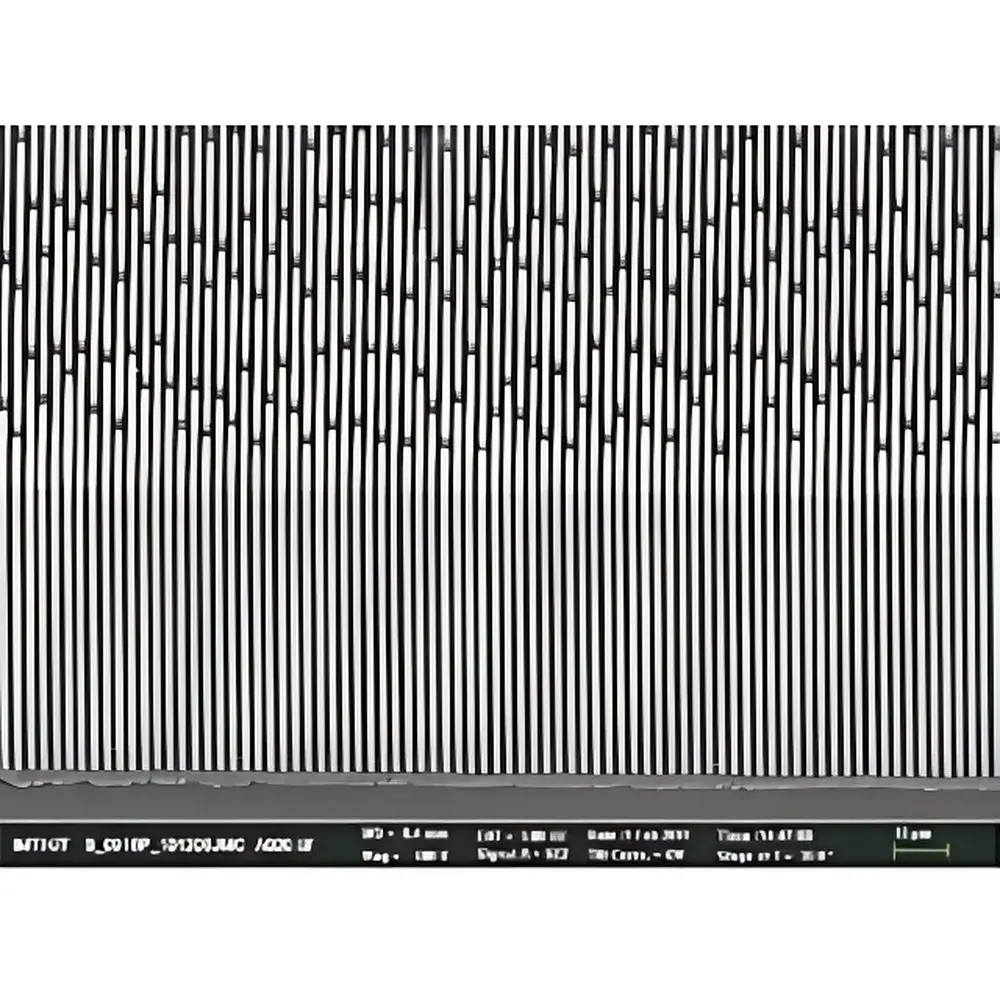
Microworks Custom X-ray Phase-Contrast Imaging Grating
| Brand | Microworks |
|---|---|
| Origin | Germany |
| Manufacturer Type | Authorized Distributor |
| Product Category | Imported Optical Component |
| Model | Grating |
| Component Type | Optical Element |
| Substrate Options | 4-inch (70–90 mm diameter), 6-inch (up to 110 mm diameter, subject to design constraints) |
| Fabrication Technology | X-ray LIGA with electroformed Ni/Au structures |
| Typical Grating Periods | G1 = 2.4 µm or 4.37 µm (Ni) |
| Beam Compatibility | Parallel and cone-beam geometries |
| Structural Form | Planar or curved (custom curvature available) |
| Aspect Ratio | >100:1 |
| Minimum Feature Size | <1 µm |
| Compliance | Designed for Talbot-Lau interferometry in laboratory and synchrotron environments |
Overview
The Microworks Custom X-ray Phase-Contrast Imaging Grating is a high-precision microstructured optical component engineered for Talbot and Talbot-Lau interferometric X-ray imaging systems. Developed from decades of LIGA-based microfabrication expertise at the Karlsruhe Institute of Technology (KIT), these gratings are fabricated using synchrotron-grade X-ray lithography followed by high-fidelity electroforming—enabling sub-micrometer critical dimensions, extreme aspect ratios (>100:1), and nanoscale structural uniformity across wafer-scale substrates. Unlike conventional absorption-based X-ray optics, phase-contrast gratings exploit wavefront modulation to enhance soft-tissue contrast in low-dose imaging applications. They serve as core elements in G1 (phase grating), G2 (analyzer grating), and optionally G0 (source grating) configurations—operating at photon energies from 17.8 keV (synchrotron BL-14C beamline) to 25 keV (microfocus tube sources). Their design supports both parallel-beam and cone-beam geometries, with optional curvature to mitigate geometric distortion under divergent illumination.
Key Features
- Sub-1 µm feature resolution and structural fidelity maintained across full substrate area (up to 110 mm diameter on 6-inch wafers)
- Electroformed nickel (G1) and gold (G2) structures offering high X-ray absorption efficiency and mechanical stability
- Customizable grating periods—including standard configurations: 2.4 µm (Ni/Au) and 4.37 µm (Ni)—aligned with common Talbot-Lau interferometer designs
- High-aspect-ratio microstructures (>100:1) enabling efficient phase stepping and robust fringe visibility
- Planar or precision-curved variants, with curvature radius tailored to source-to-grating distance and beam divergence requirements
- Monolithic fabrication process ensures inter-grating alignment consistency; multi-panel tiling solutions available for extended field-of-view applications (R&D stage)
Sample Compatibility & Compliance
These gratings are compatible with laboratory-scale microfocus X-ray sources (e.g., 40 kV, 120 µA tubes) and synchrotron beamlines (e.g., BL-14C at SPring-8, E = 17.8 keV with 2.0 mm Al filtration). They meet dimensional and material specifications required for ISO/IEC 17025-accredited metrology labs performing phase-contrast validation. While not certified to a specific medical device standard, their fabrication traceability—including process logs, SEM cross-section verification, and periodicity mapping reports—supports GLP-compliant experimental documentation. All gratings undergo non-destructive inspection via scanning electron microscopy (SEM) and laser diffraction verification prior to shipment.
Software & Data Management
Microworks provides detailed technical documentation—including grating orientation markings, period calibration certificates, and thermal expansion coefficients—for seamless integration into third-party interferometric reconstruction pipelines (e.g., MATLAB-based phase-stepping analysis, Python-based TIE solvers, or commercial CT reconstruction platforms such as Octopus or Dragonfly). No proprietary control software is required; however, users must implement appropriate phase-stepping routines aligned with grating pitch and source geometry. For regulated environments, raw diffraction data generated during calibration can be archived with audit-trail metadata compliant with FDA 21 CFR Part 11 when paired with validated lab information management systems (LIMS).
Applications
- Talbot-Lau interferometry for biomedical soft-tissue imaging (e.g., murine lung, cartilage, and tumor margin delineation)
- Materials science characterization: void detection in composites, crack propagation monitoring under load, and porosity mapping in additively manufactured alloys
- Synchrotron-based quantitative phase tomography (QPT) at beamlines requiring high-spatial-coherence gratings
- Development of compact X-ray dark-field imaging systems for industrial NDT (non-destructive testing) of polymer foams and fiber-reinforced plastics
- Calibration reference standards for grating interferometer performance assessment per ASTM E2737-21 (Standard Practice for Evaluating X-ray Phase Contrast Imaging Systems)
FAQ
What substrate sizes and materials are supported?
Standard substrates include silicon wafers (4-inch and 6-inch diameters) with optional quartz or low-expansion glass for thermal stability. Maximum usable diameter is 90 mm on 4-inch wafers and up to 110 mm on 6-inch wafers—subject to pattern uniformity constraints.
Can gratings be curved for cone-beam applications?
Yes. Microworks offers custom curvature radii optimized for specific source-to-grating distances. Curved gratings require specialized handling fixtures and are characterized using profilometry and Talbot fringe analysis.
How is grating period verified and certified?
Each batch undergoes SEM-based pitch measurement at ≥5 locations per wafer, with statistical reporting (mean ± 3σ). A calibration certificate documents nominal period, measured deviation, and uncertainty budget per ISO/IEC 17025 guidelines.
Are multi-panel tiled gratings commercially available?
Tiled configurations are currently offered as R&D prototypes under collaborative development agreements. Full production scalability is under evaluation based on demand and metrological validation outcomes.
Do you supply matching G0, G1, and G2 grating sets?
Yes. Microworks provides matched trios with synchronized fabrication batches to minimize inter-grating period mismatch (< ±0.5% typical), ensuring optimal fringe contrast in Talbot-Lau setups.




