
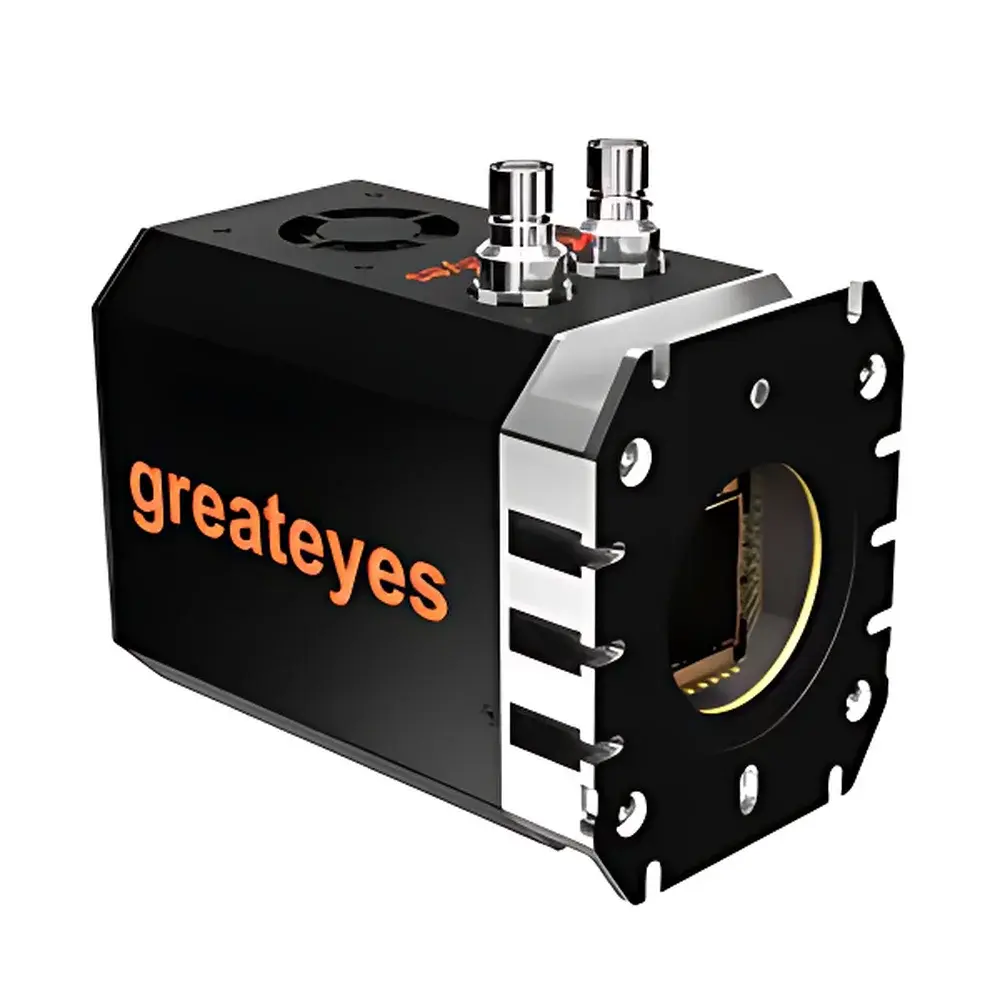
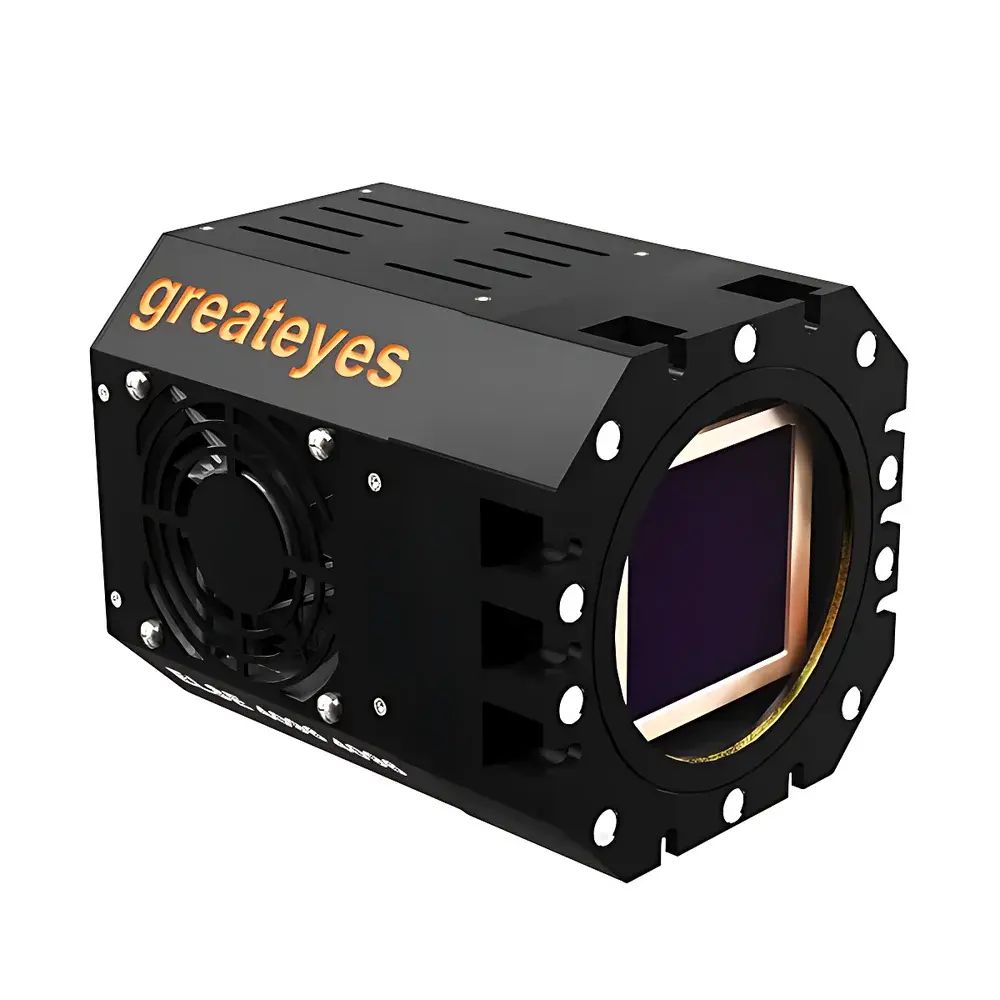
greateyes ELSE-i Series Full-Frame CCD Camera for Visible Light Imaging
| Brand | greateyes |
|---|---|
| Origin | Germany |
| Model | ELSE-i 4096×4096 |
| Effective Pixels | 4096 × 4096 |
| Pixel Size | 13.5 µm × 13.5 µm |
| Readout Speed | 50 kHz – 5 MHz |
| ADC Resolution | 18-bit |
| Operating Temperature | ≤ −100 °C |
| Quantum Efficiency | Up to 98% (UV–VIS–NIR optimized variants available) |
| Dark Current | ≤ 0.00015 e⁻/pixel/s at −100 °C |
| Read Noise | 3.4 e⁻ (typ. @ 50 kHz), 6.7 e⁻ (typ. @ 1 MHz), 13.1 e⁻ (typ. @ 3 MHz) |
| Full Well Capacity | 150 ke⁻ (standard), up to 350 ke⁻ (DD NIR variants) |
| Sensor Grade | Grade 0 or Grade 1 |
Overview
The greateyes ELSE-i Series is a family of scientific-grade, full-frame CCD cameras engineered for ultra-low-noise, high-fidelity imaging and spectroscopy across the ultraviolet–visible–near-infrared (UV–VIS–NIR) spectrum. Developed in Berlin and manufactured in Germany, these cameras leverage deep-cooled, back-illuminated CCD sensors coupled with proprietary low-noise electronics architecture. The core measurement principle relies on photon integration in a charge-coupled device under thermoelectrically stabilized conditions—enabling sub-electron read noise performance and exceptional dynamic range. Designed for demanding applications where signal integrity, spatial resolution, and temporal stability are critical—including fluorescence lifetime imaging, astronomical photometry, LIBS spectral acquisition, and synchrotron-based X-ray or neutron radiography—the ELSE-i platform delivers reproducible quantitative data without compromise. Its modular sensor selection (e.g., BI UV3, BI BR, DD NIR) allows precise spectral response tailoring to match optical system throughput and detector quantum efficiency requirements.
Key Features
- Deep thermoelectric cooling to ≤ −100 °C, minimizing dark current to < 0.00015 e⁻/pixel/s and enabling long-exposure stability
- 18-bit analog-to-digital conversion preserving full sensor dynamic range and maximizing signal-to-noise ratio (SNR)
- Flexible readout speeds from 50 kHz to 5 MHz—optimized for both high-sensitivity static imaging and time-resolved acquisition
- Back-illuminated (BI) and deep-depletion (DD) sensor options with peak quantum efficiency exceeding 98% in selected wavelength bands
- Compact, rigid mechanical housing with integrated shielding against EMI and thermal drift—designed for vacuum-compatible and vibration-sensitive environments
- Standard Grade 0 or Grade 1 sensor selection per ISO 14524 compliance for scientific metrology applications
Sample Compatibility & Compliance
The ELSE-i Series supports a broad range of optical configurations including fiber-coupled spectrometers, microscope-mounted imaging paths, and collimated beamline setups. Its C-mount and optional F-mount interfaces ensure seamless integration with commercial and custom optical systems. All models comply with CE marking requirements and meet IEC 61000-6-3 (EMC emission) and IEC 61000-6-2 (immunity) standards. For regulated laboratory environments, the camera firmware supports timestamped metadata embedding and raw image export formats (e.g., FITS, TIFF, HDF5), facilitating traceability in GLP/GMP workflows. While not FDA 21 CFR Part 11–certified out-of-the-box, the system’s audit-ready data structure enables validation under ISO/IEC 17025 or ASTM E2916 frameworks when deployed with validated acquisition software.
Software & Data Management
greateyes provides the open-source greateyes SDK (C/C++, Python bindings) and the cross-platform greateyes Control Center application for configuration, acquisition, and real-time histogram analysis. All acquired images include embedded EXIF-style metadata: exposure time, sensor temperature, gain setting, readout speed, and hardware calibration flags. Data output supports lossless 16-bit and 32-bit integer formats, as well as floating-point FITS files compliant with NASA/ESA astronomical data standards. Integration with third-party platforms—including LabVIEW, MATLAB Image Acquisition Toolbox, and Python-based pipelines using NumPy/SciPy—is fully documented and tested. Optional OEM licensing enables white-label integration into OEM spectrometer or microscopy systems requiring deterministic trigger timing and multi-camera synchronization.
Applications
- Fluorescence and bioluminescence imaging: High-contrast detection of weak signals in live-cell and whole-animal studies, especially under low-light or time-gated conditions
- Astronomical photometry and spectroscopy: Precision stellar photometry, exoplanet transit monitoring, and echelle spectrograph detection with minimal read noise contribution
- Laser-induced breakdown spectroscopy (LIBS): Time-resolved spectral acquisition with microsecond-scale gating synchronized to laser pulses
- Neutron and X-ray radiography: High-resolution transmission imaging using scintillator-coupled configurations for materials science and nuclear research
- Electroluminescence (EL) and photoluminescence (PL) characterization: Quantitative defect mapping and quantum efficiency assessment in solar cell R&D
- Ultracold atom and quantum optics experiments: Single-photon counting capability in coincidence mode via external triggering and frame-stacking protocols
FAQ
What sensor architectures are supported in the ELSE-i Series?
The ELSE-i platform offers multiple back-illuminated (BI) and deep-depletion (DD) CCD variants—including BI UV3, BI BR, BI MID, DD NIR, and DD MU2—each optimized for specific quantum efficiency profiles across UV (200–400 nm), visible (400–700 nm), and near-infrared (700–1100 nm) bands.
Is vacuum operation supported?
Yes—selected ELSE-i models feature vacuum-compatible housings and optional CF flange mounts for integration into UHV chambers used in synchrotron or electron microscopy facilities.
Can the camera be synchronized with external hardware triggers?
Absolutely—the ELSE-i includes TTL-compatible input/output trigger ports supporting master-slave configurations, programmable delay lines, and hardware-level exposure control with jitter < 100 ns.
How is calibration handled?
Each unit ships with factory-measured bias, dark, and flat-field reference frames. Users may perform routine recalibration using the greateyes SDK or integrate with third-party calibration suites such as IRAF or PyRAF.
What operating systems are officially supported?
Windows 10/11 (64-bit), Linux (Ubuntu LTS, CentOS/RHEL 8+), and macOS 12+ (Intel and Apple Silicon via Rosetta 2 or native ARM64 binaries).



