
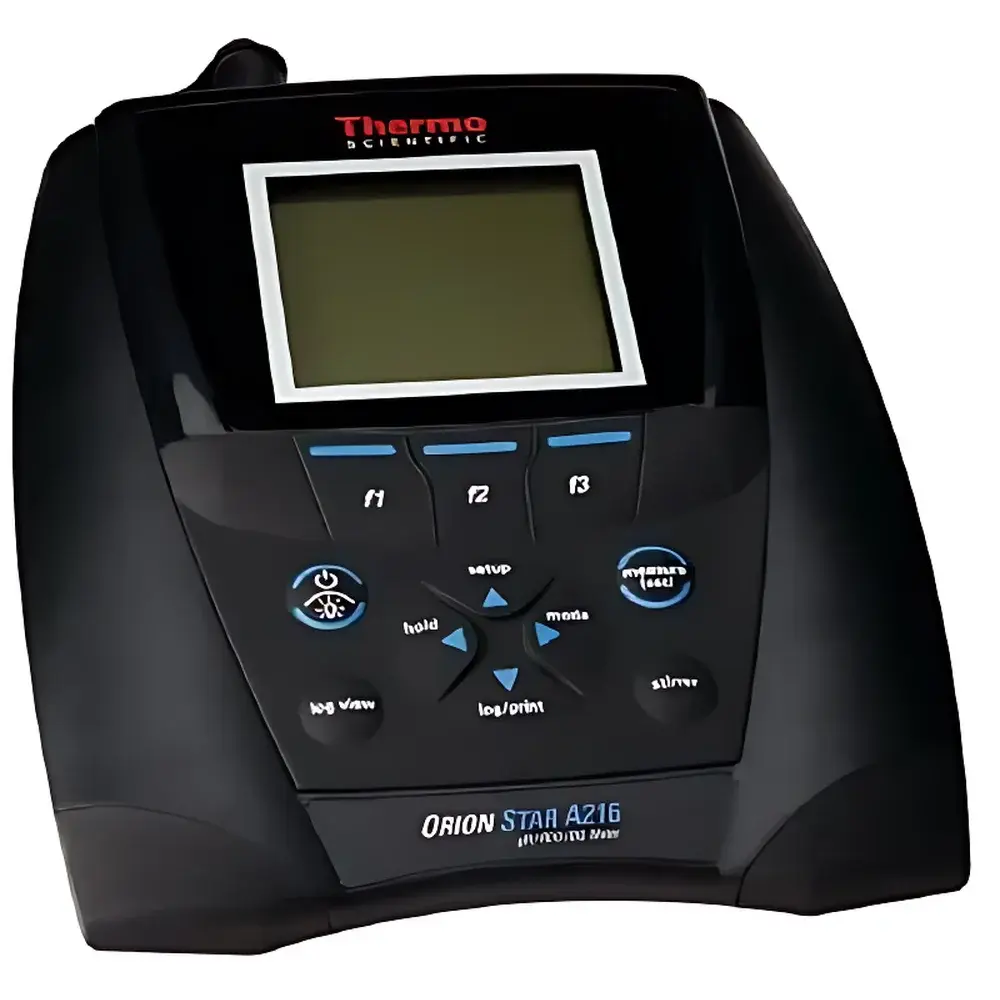
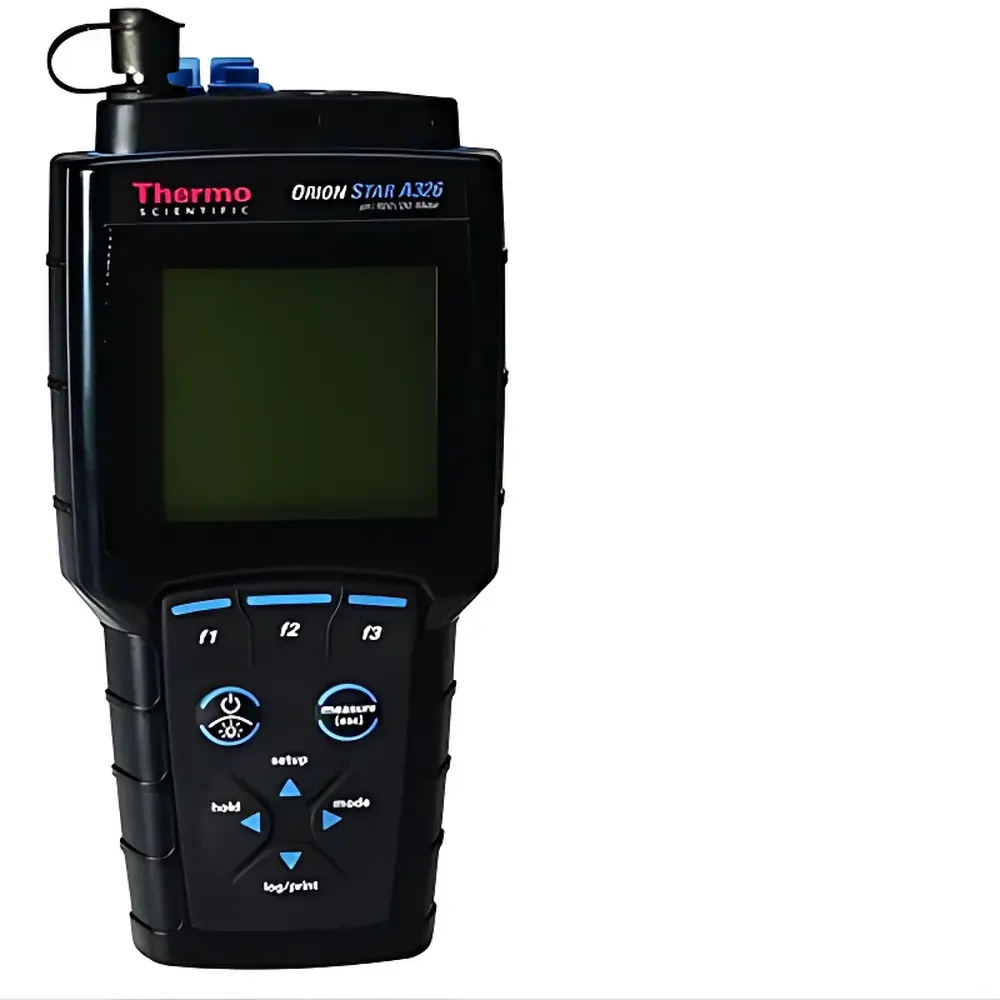
Thermo Scientific Orion Star A216 / A326 Benchtop & Portable pH / Dissolved Oxygen Meter (Model 410D-01A & 420D-01A)
| Brand | Thermo Scientific Orion |
|---|---|
| Origin | USA |
| Model | 410D-01A (Benchtop) / 420D-01A (Portable) |
| Instrument Type | Laboratory-grade pH and DO meter |
| Measurement Principle | Potentiometric (pH), Clark-type polarographic & luminescence-based RDO (Ruthenium-based optical fluorescence) |
| pH Range | −2.000 to 20.000 |
| pH Resolution | 0.001 |
| pH Accuracy | ±0.001 |
| pH Calibration Points | Up to 5-point, editable calibration curve |
| mV Range | ±2000.0 mV |
| mV Resolution | 0.1 mV |
| mV Accuracy | ±0.1 mV |
| DO Concentration Range (RDO) | 0–50 mg/L |
| DO Resolution (RDO) | 0.01 mg/L (≤8 mg/L), 0.1 mg/L (>8 mg/L) |
| DO Accuracy (RDO) | ±0.1 mg/L (0–8 mg/L), ±0.2 mg/L (8–20 mg/L), ±10% of reading (20–50 mg/L) |
| DO Saturation Range (RDO) | 0–500% |
| Saturation Resolution | 0.1% |
| Saturation Accuracy | ±2% |
| Temperature Range | −5 to 105 °C (pH) |
| Temp Resolution | 0.1 °C |
| Temp Accuracy | ±0.1 °C |
| Atmospheric Pressure Compensation | 450.0–850.0 mmHg |
| Salinity Compensation | 0–45 ppt (manual or auto, when conductivity module is connected) |
| Data Storage | 5000 GLP-compliant entries (portable), 2000 entries (benchtop) |
| Connectivity | USB + RS232 |
| Power | 4 × AA alkaline batteries or universal AC adapter (100–240 V AC) |
| Enclosure Rating | IP54 (benchtop), IP67 (portable) |
Overview
The Thermo Scientific Orion Star A216 (benchtop) and A326 (portable) pH / Dissolved Oxygen Meters (Models 410D-01A and 420D-01A) are dual-parameter, laboratory-validated instruments engineered for high-reliability water quality analysis across environmental monitoring, regulatory compliance, academic research, and industrial process control. These meters integrate two distinct electrochemical measurement principles: potentiometric pH determination using high-stability ROSS™ triple-junction pH electrodes, and dissolved oxygen quantification via either Clark-type polarographic or luminescence-based Ruthenium-doped optical (RDO) sensor technology. The RDO method eliminates oxygen consumption, membrane fouling, and electrolyte depletion—offering superior long-term stability, minimal maintenance, and rapid response in variable salinity or low-oxygen environments. Designed to meet the operational demands of field sampling and controlled lab settings alike, the platform supports seamless transition between benchtop and portable workflows without sacrificing data integrity or traceability.
Key Features
- Intuitive multi-language interface (English, Chinese, Spanish, French, German, Portuguese) with tactile navigation and responsive touchscreen-like button layout.
- AUTO-READ™ functionality automatically locks stable readings and displays visual confirmation—critical for compliance-driven documentation where endpoint certainty is mandatory.
- Programmable timed data logging (1-second to 24-hour intervals) enables unattended monitoring of diurnal DO fluctuations or pH drift during incubation studies.
- Intelligent probe recognition: automatically detects and configures parameters for both polarographic DO probes and RDO optical sensors—including built-in temperature compensation and pressure correction algorithms.
- Editable pH calibration curves allow post-hoc refinement of slope and offset values without full recalibration—enhancing measurement continuity after electrode conditioning or buffer verification.
- Dual power architecture: operates continuously on 4 × AA alkaline batteries (up to 8,000 hours in low-power mode) or universal AC adapter—ensuring uninterrupted operation during extended field deployments or overnight lab runs.
- Ruggedized mechanical design: benchtop unit meets IP54 (dust-protected, splash-resistant); portable variant achieves IP67 (submersible up to 1 m for 30 min), validated per IEC 60529.
Sample Compatibility & Compliance
The Star A platform accommodates diverse aqueous matrices including freshwater, seawater, wastewater effluents, biological growth media, pharmaceutical buffers, and industrial process streams. Its RDO sensor demonstrates minimal interference from hydrogen sulfide, chlorine, or heavy metals—unlike conventional Clark cells—making it suitable for anaerobic digesters, aquaculture systems, and bioreactor monitoring. All instruments comply with GLP (Good Laboratory Practice) requirements through embedded audit-trail metadata: each stored reading includes timestamp, operator ID (optional), electrode serial number, calibration history, ambient pressure, salinity setting, and temperature-compensated DO value. Data export files include ISO/IEC 17025-aligned metadata headers and support direct import into LIMS or ELN platforms. While not FDA 21 CFR Part 11–certified out-of-the-box, the system supports electronic signature implementation via third-party validation packages aligned with GMP and USP analytical instrument qualification guidelines.
Software & Data Management
Data transfer occurs via USB mass-storage mode or RS232 serial protocol—no proprietary drivers required. Included Thermo Scientific Orion Com software (v4.0+) enables batch download, spectral visualization of time-series trends, statistical summary (mean, SD, min/max), and customizable PDF report generation with embedded calibration certificates. Raw .csv exports retain full GLP fields for traceability. Firmware updates are delivered via signed binary packages with SHA-256 hash verification. For enterprise integration, the instrument supports Modbus RTU over RS232—enabling direct SCADA connectivity in municipal water treatment or industrial hygiene applications.
Applications
- Regulatory environmental monitoring: EPA Method 4500-O G (luminescent DO), ASTM D888-22 (oxygen solubility), and ISO 5814:2012 (electrochemical DO).
- BOD₅ and respirometry testing: paired with 970802BOD stirrer and 080360 BOD adapter for standardized dilution and agitation per APHA Standard Methods 5210B.
- Pharmaceutical water system qualification: USP purified water and WFI monitoring, supporting PQ validation with documented calibration and performance checks.
- Marine ecology studies: real-time profiling of hypoxic zones using RDO’s salinity-independent accuracy and zero-oxygen-consumption operation.
- Academic teaching labs: modular electrode compatibility (e.g., 8157BNUMD SuperROSS, 083005MD polarographic DO) supports comparative methodology instruction across electrochemical principles.
FAQ
Does the 410D-01A support both polarographic and RDO probes interchangeably?
Yes—the instrument auto-detects probe type via hardware handshake on the 9-pin mini-DIN interface and loads appropriate calibration coefficients and temperature compensation models.
Is manual salinity entry required when measuring seawater DO?
No; if a compatible conductivity module (e.g., 013005MD) is connected, salinity is derived in real time and applied to DO solubility calculations per Weiss equation (1970).
Can calibration data be exported separately from measurement logs?
Yes—Orion Com software allows selective export of calibration event records (.csv) including date/time, buffer IDs, measured mV/pH, slope, offset, and electrode impedance.
What is the minimum sample volume required for accurate RDO measurement?
For static measurements, ≥5 mL is recommended; for flow-through or stirred applications, continuous circulation at ≥100 mL/min ensures representative equilibrium readings.
Are NIST-traceable calibration standards included in the 410D-01A kit?
The standard kit includes individually packaged, lot-certified buffer sachets (pH 4.01, 7.00, 10.01) and RDO zero-standard solutions, each bearing NIST-traceable uncertainty statements per manufacturer’s CoA.
Related Products







