
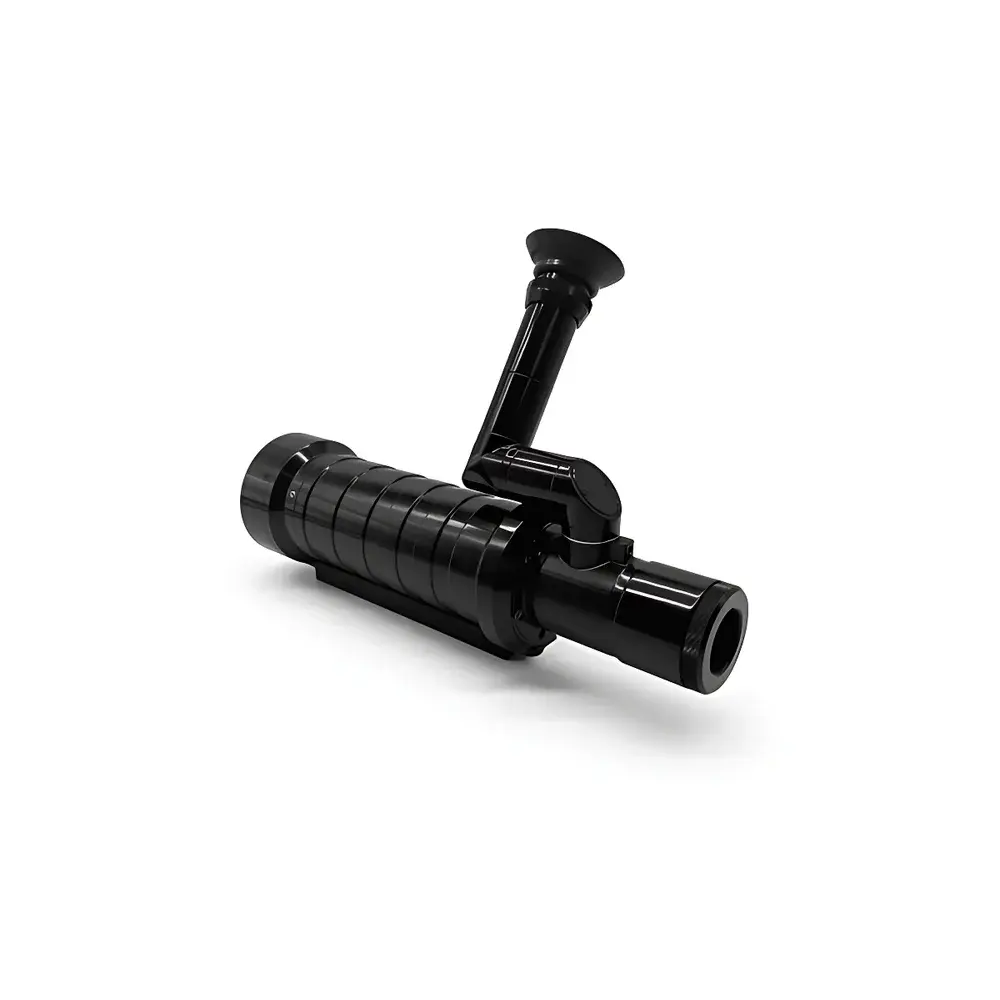
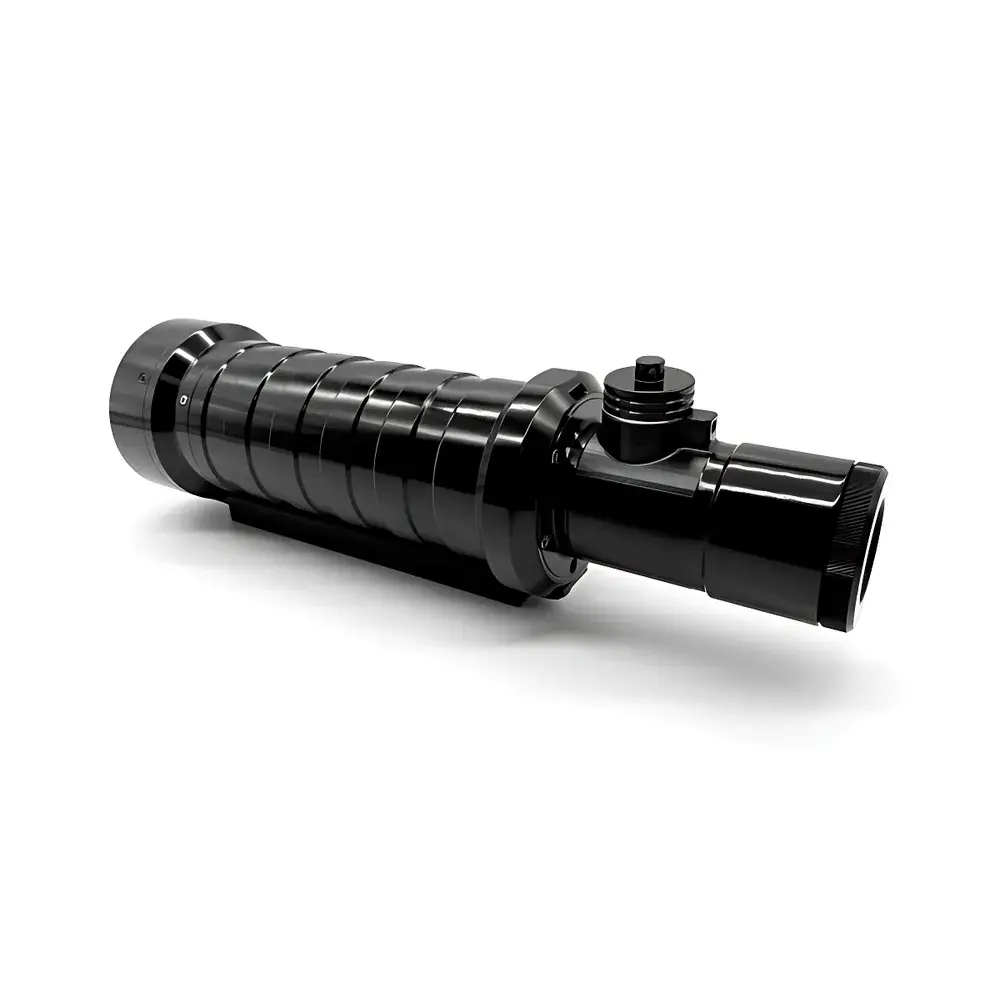
Colorimetry Research CR300 Portable Spectroradiometer
| Brand | Colorimetry Research (CRI) |
|---|---|
| Origin | USA |
| Model | CR300 |
| Spectral Range | 380–780 nm |
| Spectral Bandwidth | 2 nm |
| Detector | 512-pixel CMOS image sensor |
| Spectral Accuracy | ±0.3 nm |
| Spectral Resolution | 0.8 nm/pixel |
| Luminance Range | 0.05–230,000 cd/m² (nits) |
| Luminance Accuracy | ±2% |
| Luminance Repeatability | ≤1% |
| Chromaticity Accuracy | ±0.0015 in CIE 1931 x,y |
| Chromaticity Repeatability | ±0.0005 in CIE 1931 x,y |
| Polarization Error | ≤0.5% |
| Digital Resolution | 16-bit |
| Viewing Angle Options | 3°, 2°, 1°, 0.5°, 0.25°, 0.125° (fixed aperture, selected at order) |
| Focus Range | 200 mm to infinity |
| Viewfinder | Patent-pending removable and rotatable optical viewfinder with optional VO-201 attachment |
| Synchronization Frequency | 10–10,000 Hz |
| Exposure Time | 0.04–30 s |
| Power Supply | 5 V, 120 mA via USB 2.0 (600 mW) |
| Interfaces | USB 2.0, Ethernet, RS-232 |
| Weight | 1.034 kg (base unit) |
Overview
The Colorimetry Research CR300 Portable Spectroradiometer is a field-deployable, high-fidelity optical measurement instrument engineered for absolute spectral radiance, luminance, chromaticity, correlated color temperature (CCT), and color rendering index (CRI) characterization of light-emitting and reflective surfaces. Operating on the principle of slit-based grating spectrometry coupled with a calibrated 512-pixel CMOS linear array detector, the CR300 delivers laboratory-grade spectral data across the photopic visible range (380–780 nm) with 2 nm full-width-at-half-maximum (FWHM) spectral bandwidth and <0.3 nm wavelength accuracy traceable to NIST standards. Its compact form factor, robust thermal management architecture—including optional low-temperature auto-heating for operation down to –20 °C—and modular optical path design enable reliable use in diverse environments: from display manufacturing cleanrooms and LED production lines to outdoor roadway lighting audits and architectural daylighting studies.
Key Features
- High-resolution spectral acquisition: 512-pixel CMOS sensor with 0.8 nm/pixel dispersion and 16-bit digitization ensures fine-grained spectral shape fidelity and low-noise signal capture.
- Patent-pending rotatable and removable optical viewfinder enables precise targeting without parallax error; compatible with optional VO-201 camera module for real-time test-point verification and spatial registration.
- Multiple fixed-aperture options (3°, 2°, 1°, 0.5°, 0.25°, 0.125°) allow flexible trade-offs between measurement area, solid angle, and radiometric sensitivity—calibrated per IEC 61000-4-3 and CIE S 026/E:2019 requirements.
- Thermally stabilized optical bench and onboard dark-current compensation support stable operation across ambient temperatures from –20 °C to +50 °C, validated per MIL-STD-810G thermal shock protocols.
- Multi-interface connectivity (USB 2.0, Ethernet, RS-232) enables seamless integration into automated test systems, QA/QC workflows, and remote monitoring platforms.
- Comprehensive radiometric and photometric output: spectral radiance (W·sr⁻¹·m⁻²·nm⁻¹), luminance (cd·m⁻²), CIE 1931 xy and CIE 1976 u’v’ coordinates, CCT (K), Duv, CRI (Ra), TM-30 Rf/Rg, and optical density (for transmissive samples).
Sample Compatibility & Compliance
The CR300 supports reflectance, transmittance, and self-luminous measurements without hardware modification. Its calibrated spectral response conforms to CIE Publication No. 127:2007 for LED measurement geometry and meets the spectral matching requirements of CIE 15:2018 for photopic luminous efficiency (V(λ)). For regulatory compliance, the instrument’s calibration certificate includes uncertainty budgets compliant with ISO/IEC 17025:2017, and raw spectral data export supports audit-ready documentation per FDA 21 CFR Part 11 and EU Annex 11 when used within GLP/GMP-controlled environments. Reflectance measurements utilize an integrated reference white tile (certified per ASTM E308-22), while transmittance mode accommodates standard cuvette holders and flat-panel diffusers per ISO 9050:2003.
Software & Data Management
The CR300 operates with CR-Suite software (Windows 10/11), which provides real-time spectral visualization, batch measurement scripting, pass/fail thresholding, and automated report generation in PDF or CSV formats. All acquired spectra are stored with embedded metadata—including aperture selection, exposure time, integration time, GPS coordinates (when connected), and operator ID—enabling full traceability. The software supports spectral averaging, dark-signal subtraction, and stray-light correction algorithms validated against NIST SRM 2035. Exported data complies with IEC 62471 photobiological safety reporting templates and is compatible with third-party analysis tools including MATLAB, Python (via .spc and .jdx import), and LightTools for optical simulation input.
Applications
- Display calibration and uniformity mapping for OLED, microLED, and LCD panels in R&D and production line testing.
- LED binning, flux consistency verification, and lifetime degradation tracking under accelerated aging conditions.
- Roadway and tunnel lighting assessment per CIE 115:2010 and EN 13201-3:2015, including mesopic photometry extensions.
- Automotive interior lighting validation per SAE J1383 and UNECE R112 requirements.
- Museum lighting conservation analysis, where spectral power distribution (SPD) and UV/IR content must be quantified to prevent artifact fading.
- AR/VR near-eye display evaluation using customized close-focus adapters and angular response correction models.
FAQ
Is the CR300 suitable for measuring very low-luminance displays, such as OLEDs in dark-room conditions?
Yes—the CR300 achieves a minimum measurable luminance of 0.05 cd/m² with <1% repeatability, enabled by long-exposure capability (up to 30 s), low-read-noise CMOS architecture, and thermally compensated dark-current subtraction.
Can the CR300 perform absolute spectral irradiance measurements?
No—it is configured and calibrated exclusively for spectral radiance and luminance (radiant and photometric exitance). For irradiance, a cosine-corrected diffuser accessory (CR-DIFF-180) is required and must be separately calibrated.
Does the CR300 support automated measurement sequences for production-line throughput?
Yes—CR-Suite includes a scriptable API (COM/ActiveX) supporting trigger-based acquisition, coordinate-driven XY stage control, and pass/fail logic with configurable tolerance bands per parameter.
How is calibration traceability maintained over time?
Each CR300 ships with a NIST-traceable calibration certificate valid for 12 months. Optional annual recalibration services include spectral responsivity verification, wavelength accuracy validation, and aperture geometric characterization per ISO/IEC 17025-accredited procedures.
Is firmware upgradable in the field?
Yes—firmware updates are delivered via CR-Suite and preserve all user-configured settings, measurement profiles, and calibration coefficients without requiring return-to-factory service.






