
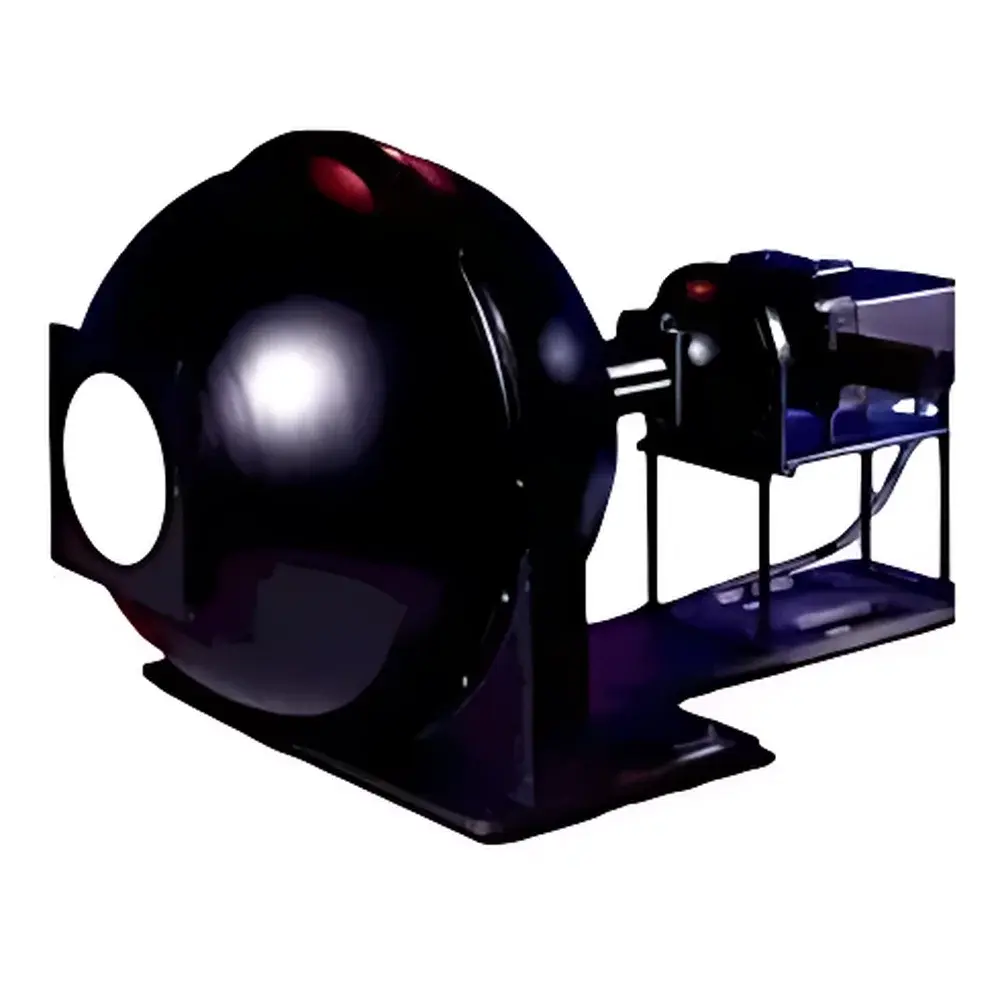
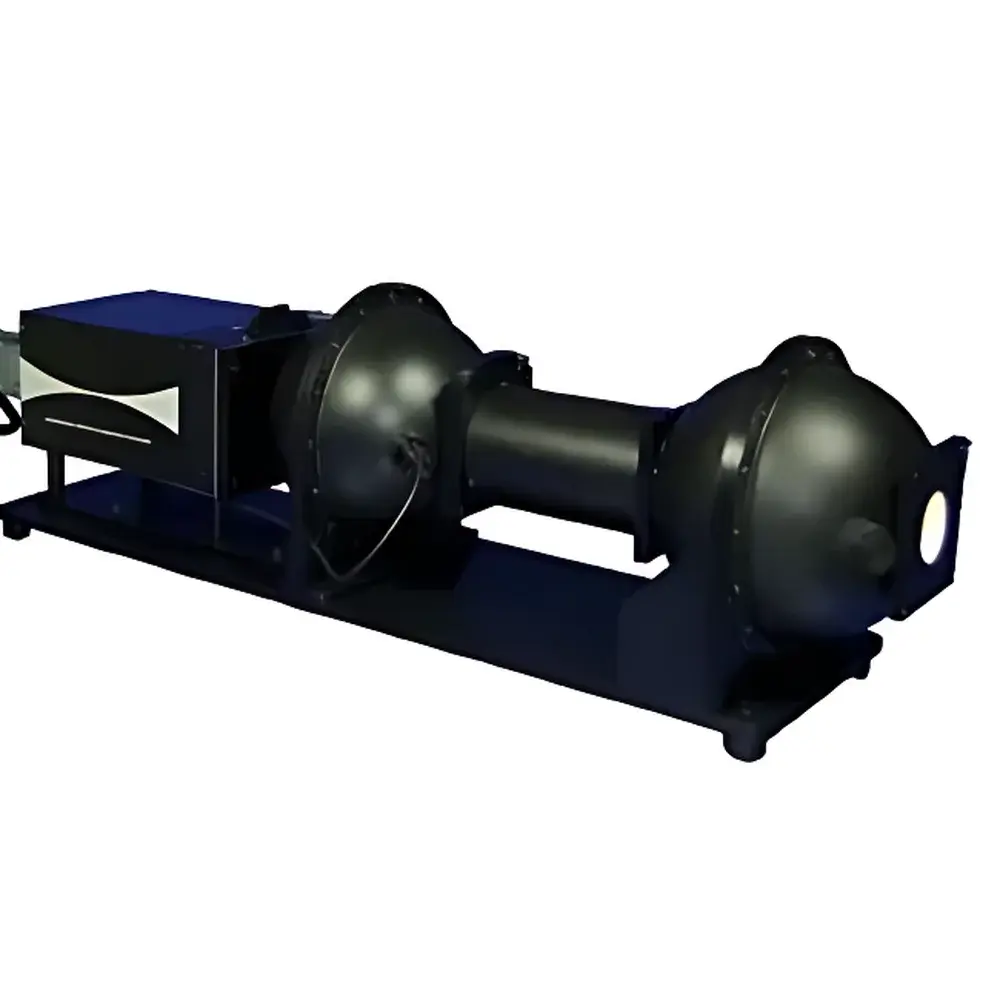
OL426 Micro-Luminance Integrating Sphere Source
| Brand | Optronic Laboratories |
|---|---|
| Origin | USA |
| Model | OL 426-S / OL 426-SA |
| Configuration | Dual-integrating-sphere optical head + standalone OL 400-CS controller (precision power supply & real-time luminance monitoring) |
| Sphere diameters available | 6", 8", 12", 18" |
| Output port diameters | 1.5", 2", 3", 6" |
| Luminance dynamic range | 10⁶ (with stable CCT maintenance) |
| Control mode | Manual (OL 426-S) or motorized, programmable (OL 426-SA) |
| Calibration traceability | NIST-traceable spectral radiance and luminance standards |
Overview
The OL426 Micro-Luminance Integrating Sphere Source is a precision-engineered optical calibration standard designed for traceable photometric and spectroradiometric characterization of ultra-low-light detection systems. Based on a dual-integrating-sphere architecture, it generates spatially uniform, Lambertian-emitting radiation fields with exceptional angular and temporal stability—critical for calibrating high-sensitivity instruments such as microphotometers, image intensifiers, Gen-III night vision tubes, astronomical photometers, and hyperspectral radiometers. The system operates on the principle of multiple diffuse reflections within two concentrically aligned integrating spheres: the primary sphere homogenizes lamp output into a spatially uniform exit beam; this beam is then injected into the secondary sphere, where further scattering yields a highly isotropic, low-stray-light output aperture. This cascaded design enables stable, repeatable luminance levels down to sub-millilambert (mL) regimes while preserving correlated color temperature (CCT) constancy across the full 10⁶ dynamic range.
Key Features
- Dual-integrating-sphere architecture ensures <0.2% spatial non-uniformity (per ANSI/ISO 9050) and <0.15% angular non-Lambertian deviation over ±80° viewing cone
- NIST-traceable spectral radiance calibration available for each unit, covering 380–1050 nm with uncertainty budgets compliant with ISO/IEC 17025-accredited procedures
- Modular optical head configuration supports interchangeable sphere sizes (6″, 8″, 12″, 18″) and corresponding output ports (1.5″, 2″, 3″, 6″) to match detector étendue and field-of-view requirements
- OL 400-CS controller integrates high-stability DC power supply (ripple < 0.01%), real-time silicon photodiode-based luminance monitor with 16-bit ADC resolution, and analog/digital interface for external DAQ synchronization
- Manual (OL 426-S) and automated (OL 426-SA) variants support both laboratory benchtop operation and integration into automated calibration workflows per ISO/IEC 17025 Clause 7.7
Sample Compatibility & Compliance
The OL426 series is compatible with detectors requiring calibrated input irradiance in the 10⁻⁴ to 10² cd/m² range—including cooled CCD/CMOS sensors, photomultiplier tube (PMT) arrays, and single-photon avalanche diodes (SPADs). Its output spectral distribution conforms to CIE Standard Illuminant A (2856 K) when operated with tungsten-halogen lamps; optional quartz-tungsten-halogen (QTH) sources support extended UV-VIS-NIR coverage. All units are supplied with full calibration certificates meeting ASTM E308-22 (Standard Practice for Computing the Colors of Objects), ISO 11664-3 (Colorimetry – Part 3: CIE Tristimulus Values), and USP (Analytical Instrument Qualification) requirements. System design adheres to IEC 61000-4-3 (EMC immunity) and UL 61010-1 safety standards.
Software & Data Management
While the OL426-S operates via analog control, the OL 426-SA variant supports IEEE-488 (GPIB), RS-232, and USB 2.0 interfaces for remote command execution using SCPI-compliant syntax. Optronic Laboratories provides the OL-Control Suite—a Windows-based application enabling script-driven luminance ramping, dwell time sequencing, and real-time logging of monitored output values with timestamped metadata. All calibration data files are exportable in CSV and HDF5 formats, supporting integration into LIMS environments compliant with FDA 21 CFR Part 11 (electronic records/signatures) and GLP audit trails. Firmware updates maintain backward compatibility with legacy OL 400-CS controllers.
Applications
- Primary and secondary calibration of low-light radiometers and photometers used in defense night-vision testing (MIL-STD-3009)
- Characterization of quantum efficiency and linearity response in scientific CMOS sensors under starlight-equivalent illumination
- Validation of stray-light rejection performance in spaceborne Earth observation spectrometers (e.g., VIIRS, OLI-TIRS)
- Traceable verification of dark-current and read-noise specifications in cryogenic infrared focal plane arrays
- Reference source for inter-laboratory comparison exercises organized by NMIs (National Metrology Institutes) under CIPM MRA framework
FAQ
Is the OL426-S suitable for absolute spectral radiance calibration?
Yes—each unit can be delivered with NIST-traceable spectral radiance calibration at discrete wavelengths (380–1050 nm), with expanded uncertainties ≤1.2% (k=2) for typical configurations.
Can the OL426 be integrated into an automated calibration station?
The OL426-SA model supports full remote control and synchronization with motion stages, shutter systems, and spectroradiometers via standard SCPI commands and TTL triggers.
What lamp types are supported, and how often must they be replaced?
Standard configuration uses calibrated 12 V / 100 W tungsten-halogen lamps with 2000-hour rated life; QTH and deuterium options are available for UV extension. Lamp replacement requires re-calibration to maintain traceability.
Does the system comply with FDA or ISO 13485 requirements for medical device testing?
While not a medical device itself, the OL426 meets metrological requirements referenced in ISO 13485 Annex C and FDA guidance documents for optical test equipment used in ophthalmic instrument validation (e.g., fundus cameras, OCT systems).
How is thermal drift managed during extended low-light measurements?
The OL 400-CS controller incorporates active thermal stabilization of the monitoring photodiode and closed-loop lamp current regulation, limiting luminance drift to <0.05%/hour at 0.01 cd/m² output level.






