
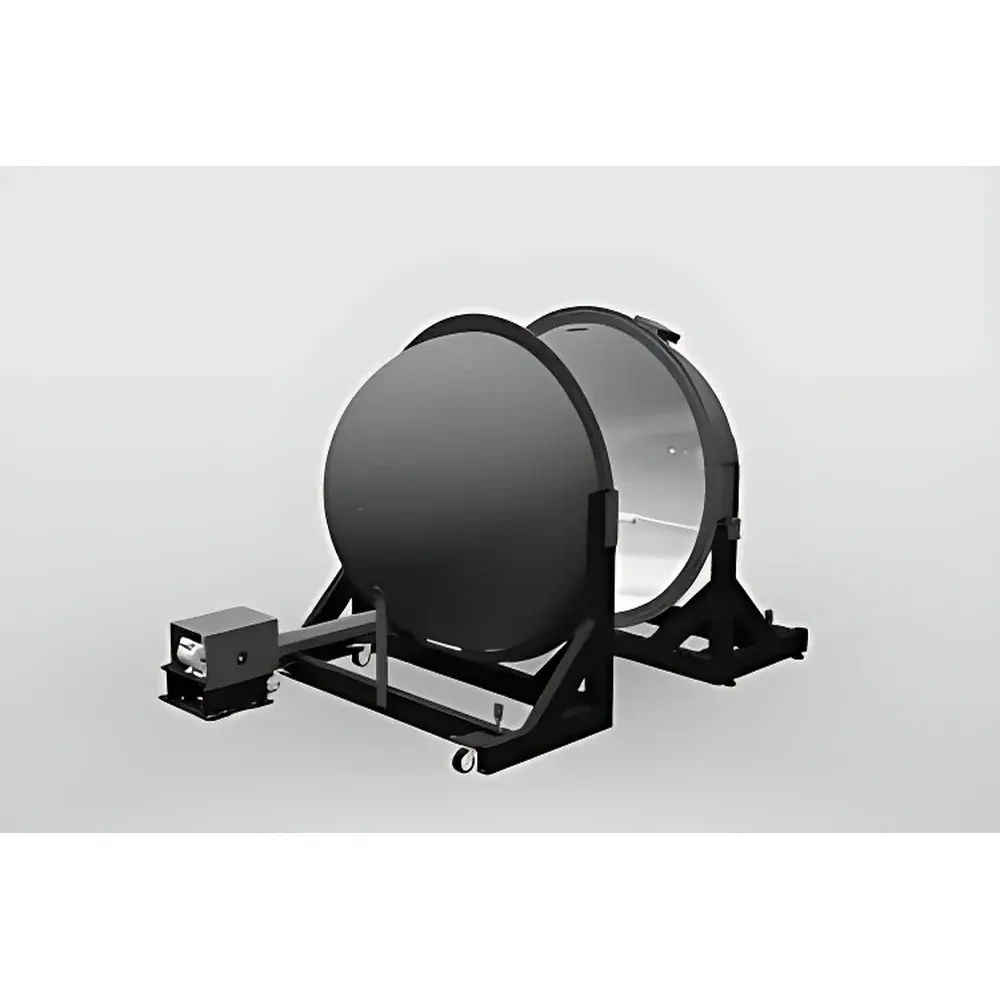
Multi-Functional Safety Motorized Integrating Sphere
| Brand | Optronic Laboratories |
|---|---|
| Origin | USA |
| Manufacturer Type | Authorized Distributor |
| Import Status | Imported |
| Price Range | USD 0 – 7,200 (est.) |
| Sphere Diameter | 2 m |
| Spectral Range | 400–1100 nm |
| Coating Reflectance | >98% (400–1100 nm) |
| Compliance | IES LM-79, CIE 127, LM-80 ready |
| Safety Features | Interlocked optical sensors, industrial-grade slip-clutch drive, safety foot pads |
| Cooling | Dual thermal fans + real-time temperature monitoring |
| Mounting Options | Suspension or upward support |
| Auxiliary Lamp | Integrated for self-absorption correction |
| Compatible Spectrometer | OL 770 series |
Overview
The Multi-Functional Safety Motorized Integrating Sphere is a high-precision photometric measurement system engineered for total luminous flux (lumens) characterization of lamps, LED modules, and solid-state lighting (SSL) products. Designed in accordance with the fundamental principles of integrating sphere photometry—where diffuse reflection within a highly reflective, Lambertian cavity enables spatially uniform irradiance distribution—the system delivers traceable, reproducible measurements under controlled thermal and geometric conditions. Developed by Gooch & Housego Orlando (acquired technology formerly under Optronic Laboratories’ engineering lineage), this 2-meter-diameter motorized sphere integrates advanced mechanical actuation, optical safety interlocks, and spectrally stable coating technology to meet the stringent requirements of national calibration laboratories and accredited testing facilities. Its deployment at the National Semiconductor Lighting Product Quality Supervision and Inspection Center (Hangzhou, China) in June 2015 marked one of the earliest operational installations of a fully automated, safety-certified large-aperture integrating sphere for LM-79-compliant photometric testing.
Key Features
- Motorized, programmable aperture and baffle positioning ensures repeatable geometry control for both lamp-in and lamp-out configurations, minimizing operator-induced variability.
- Optolon™ 2 proprietary coating—developed and validated by Gooch & Housego—provides >98% diffuse reflectance across 400–1100 nm, with exceptional resistance to abrasion, UV degradation, and repeated cleaning using isopropyl alcohol wipes.
- Dual active cooling system (two thermostatically regulated axial fans) maintains cavity wall temperature stability within ±0.5°C during extended measurement cycles, critical for thermal drift mitigation in LM-80 lumen maintenance studies.
- Integrated auxiliary lamp with calibrated spectral output corrects for self-absorption effects inherent to directional or high-power SSL sources, directly supporting IES LM-79 Section 9.3 and CIE 127:2007 Annex B methodologies.
- Industrial-grade slip-clutch motor drive prevents mechanical overtorque during obstruction events; optically coupled safety sensors automatically halt motion upon beam path interruption, satisfying ISO 13857 and ANSI B11.19 functional safety requirements.
- Modular mounting interface supports both ceiling-suspended and floor-upward configurations, enabling in-situ aging orientation alignment per IES LM-80 Section 5.2.2 for accurate lumen depreciation tracking.
Sample Compatibility & Compliance
The system accommodates luminaires up to 1.2 m in maximum dimension and 25 kg in mass, with configurable port layouts for integrated electrical feedthroughs, thermal probes, and external power supplies. It complies with photometric test conditions specified in IES LM-79-19 (Electrical and Photometric Measurements of Solid-State Lighting Products), CIE 127:2007 (Measurement of LEDs), and serves as a foundational platform for LM-80-15 (Lumen Maintenance of LED Light Sources) long-term testing protocols. All mechanical motion sequences are logged with timestamped audit trails, supporting GLP-aligned documentation workflows. The sphere’s physical design—including recessed sensor ports, shielded cabling pathways, and EMI-suppressed motor drivers—meets FCC Part 15 Class A and CE EMC Directive 2014/30/EU requirements.
Software & Data Management
Control and data acquisition are managed via the OL 770-compatible SpectraSuite™ software suite (v5.4+), which provides instrument synchronization, spectral radiance integration, colorimetric coordinate calculation (CIE 1931 xy, u’v’, CCT, CRI/Rf), and automated report generation compliant with ISO/IEC 17025 documentation standards. Raw spectral data is stored in vendor-neutral .jdx and .csv formats; metadata fields include ambient temperature, cavity temperature, auxiliary lamp status, motor position ID, and user authentication logs. Optional FDA 21 CFR Part 11 compliance package includes electronic signature enforcement, role-based access control, and immutable audit trail export for regulated QA/QC environments.
Applications
- Primary photometric certification of LED lamps, troffers, streetlights, and horticultural lighting systems per LM-79-19.
- Lumen maintenance profiling (LM-80) under controlled thermal setpoints (Ts = 55°C, 85°C, or user-defined) with synchronized spectral acquisition every 1,000 hours.
- Relative spectral power distribution (SPD) validation for color-tunable and human-centric lighting products.
- Calibration transfer between reference standards (e.g., NIST-traceable tungsten halogen lamps) and working standards in metrology labs.
- Thermal management validation—correlating junction temperature rise (via forward voltage drop or IR thermography) with photometric output decay.
FAQ
What spectral range does the Optolon™ 2 coating support?
The coating delivers >98% average diffuse reflectance from 400 nm to 1100 nm, with verified performance down to 360 nm and up to 1700 nm (reflectance ≥92%); full spectral characterization reports are provided with each sphere shipment.
Is the system compatible with third-party spectrometers?
Yes—while optimized for OL 770 series detectors, the sphere features standardized SMA905 and FC/PC optical interfaces, allowing integration with Ocean Insight, Avantes, or Bentham instruments via custom calibration matrices.
How is thermal stability maintained during multi-hour LM-80 tests?
Dual variable-speed fans operate under PID-controlled feedback from four embedded PT100 sensors (cavity wall, port flange, baseplate, and ambient); temperature deviation is constrained to ±0.3°C over 8-hour continuous operation.
Does the motorized mechanism require periodic recalibration?
No—position encoders are factory-calibrated with NIST-traceable angular interferometry; only annual verification of mechanical repeatability (±0.1° over 10,000 cycles) is recommended per manufacturer service guidelines.



