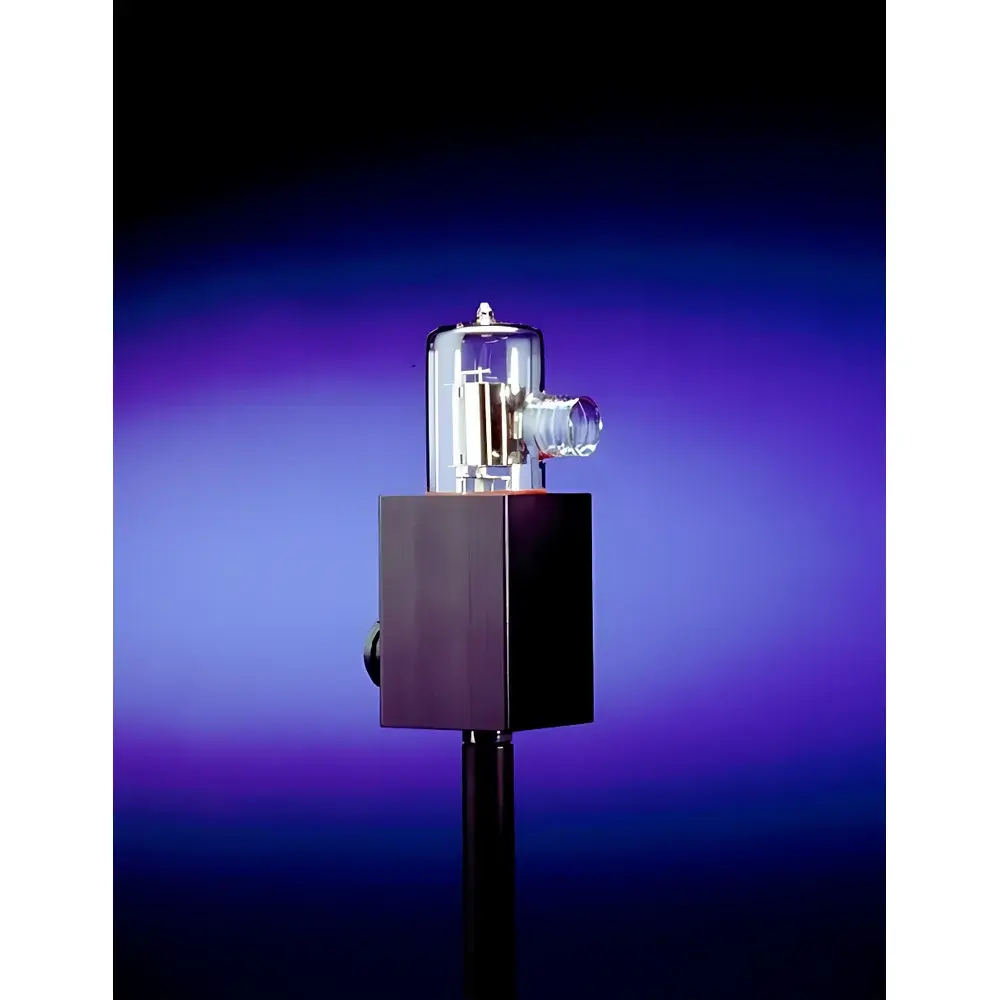
OL UV-40 Spectral Irradiance Standard Lamp (Deuterium-Based, NIST-Traceable, 200–400 nm)
| Brand | Optronic Laboratories |
|---|---|
| Origin | USA |
| Model | OL UV-40 |
| Calibration Traceability | NIST |
| Spectral Range | 200–400 nm |
| Calibration Interval | 10 nm |
| Uncertainty | ±3–5% (250–400 nm), ±10% (200–250 nm) |
| Operating Current | 300 mA DC |
| Pre-Aging Duration | 24 h |
| Irradiance Stability | ±2% over 50 h |
| Calibration Area Diameter | ~0.3 mm |
| Typical Spectral Irradiance at 250 nm | ~5× that of a 1000 W tungsten standard |
| Optional Radiance Calibration | e.g., 12 W/(m²·nm·sr) at 250 nm |
Overview
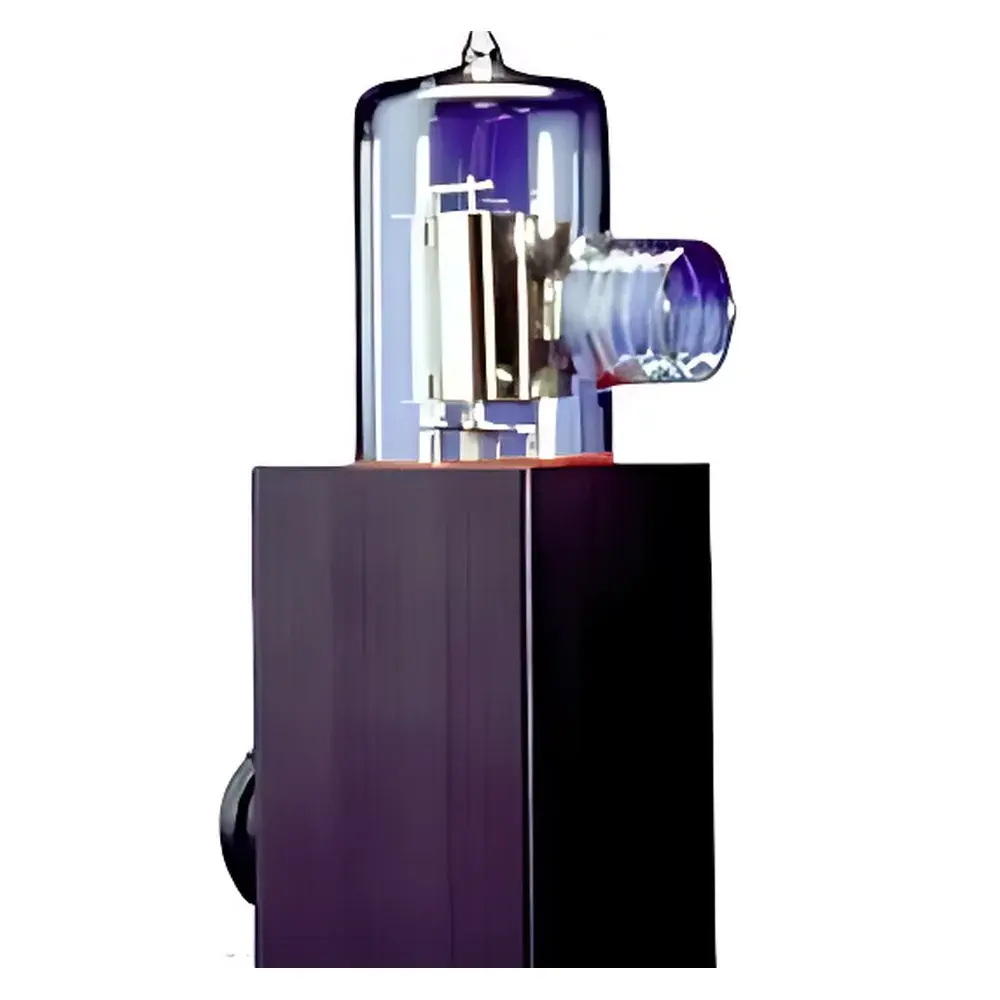
The OL UV-40 Spectral Irradiance Standard Lamp is a primary-level, deuterium-based reference source engineered for high-fidelity calibration of ultraviolet (UV) optical measurement systems across the 200–400 nm spectral band. It operates on the fundamental principle of stabilized continuum emission from a low-pressure deuterium discharge lamp—delivering spectrally smooth, reproducible irradiance without discrete line structure. Unlike thermal sources (e.g., tungsten-halogen lamps), which exhibit steeply declining output below 350 nm and strong infrared leakage, the OL UV-40 maximizes radiant flux in the deep and near-UV while minimizing out-of-band emission—thereby reducing stray-light-induced errors in spectroradiometric and broadband UV radiometer calibrations. Its quartz envelope ensures high transmission down to 185 nm, and its precisely defined 0.3 mm calibration aperture enables spatially resolved irradiance assignment traceable to NIST’s spectral irradiance scale.
Key Features
- NIST-traceable spectral irradiance calibration from 200 nm to 400 nm at 10 nm intervals, with full uncertainty budget documentation per ISO/IEC 17025 requirements
- Stabilized 30 W deuterium lamp operated at constant 300 mA DC current, ensuring minimal temporal drift during calibration sessions
- Pre-aged for 24 hours prior to calibration to mitigate early-life spectral shift; verified stability of ±2% irradiance over 50 h of continuous operation
- Low stray-light profile: dominant emission confined to UV region; negligible output above 400 nm reduces visible/IR detector crosstalk in UV-optimized instruments
- Calibration report includes tabulated spectral irradiance values (W·m⁻²·nm⁻¹) and optional spectral radiance data (W·m⁻²·nm⁻¹·sr⁻¹), such as 12 W/(m²·nm·sr) at 250 nm
- Compact, collimated beam geometry with nominal 0.3 mm effective source diameter—compatible with integrating sphere input ports, monochromator slits, and fiber-coupled spectroradiometers
Sample Compatibility & Compliance
The OL UV-40 is compatible with all UV-sensitive detectors, including silicon photodiodes with UV-enhanced coatings, GaP and SiC photodetectors, and CCD/CMOS-based array spectroradiometers equipped with UV-transmissive optics. It meets the functional requirements of ASTM E1318 (Standard Specification for Spectral Irradiance Standards for Use in Testing Solar Simulators), ISO 17166:2019 (Erythema reference action spectrum), and IEC 62471 (Photobiological safety of lamps). Each unit ships with a NIST-traceable calibration certificate compliant with ISO/IEC 17025, including measurement uncertainty analysis, environmental correction factors (temperature, pressure), and evidence of compliance with NIST SRM 2032 and SRM 2034 reference scales. The lamp is suitable for use in GLP- and GMP-regulated environments where audit-ready calibration records and instrument history tracking are required.
Software & Data Management
While the OL UV-40 is a passive physical standard and requires no embedded firmware or drivers, its calibration dataset is delivered in machine-readable ASCII format (.csv), fully compatible with common metrology software platforms—including Ocean Insight OceanView, StellarNet SpectraWiz, and custom Python/Matlab-based radiometric analysis workflows. Users may import spectral irradiance tables directly into calibration routines for UV radiometers, hyperspectral imagers, or UV-curing process monitors. All calibration reports include metadata fields compliant with ASTM E2758 (Standard Guide for Documentation of Spectral Irradiance Calibration Data) and support long-term archival under FDA 21 CFR Part 11-compliant electronic record systems when paired with validated laboratory information management systems (LIMS).
Applications
- Primary calibration of UV broadband radiometers (e.g., UV-A, UV-B, UV-C meters) used in phototherapy, disinfection validation, and material weathering testing
- Reference source for spectral responsivity characterization of UV spectroradiometers and imaging sensors (e.g., UV fluorescence detection, solar UV monitoring)
- Verification and intercomparison of UV irradiance measurement chains in accredited calibration laboratories (ISO/IEC 17025)
- Source standard for validating UV optical attenuation measurements in filter characterization and optical coating performance assessment
- Supporting traceability for UV exposure dose reporting in ISO 4892-3 (Plastics—Weathering—Part 3: Fluorescent UV lamps) and ASTM G154 (Standard Practice for Operating Fluorescent Light Apparatus)
FAQ
What is the recommended warm-up time before using the OL UV-40 for calibration?
A minimum 30-minute stabilization period is advised after initial power-on to ensure thermal equilibrium and spectral output convergence.
Can the OL UV-40 be used for spectral radiance calibration?
Yes—radiance calibration is available as an optional service, with typical values reported at defined viewing angles and source diameters (e.g., 12 W/(m²·nm·sr) at 250 nm for a 0.3 mm aperture).
How often should the OL UV-40 be recalibrated?
Optronic Laboratories recommends recalibration every 12 months or after 500 operating hours, whichever occurs first, to maintain stated uncertainty levels.
Is the OL UV-40 compatible with fiber-optic spectroradiometers?
Yes—when coupled via UV-grade fiber (e.g., Solarization-Resistant fused silica) and appropriate focusing optics, it serves as a stable, repeatable input source for system-level spectral responsivity mapping.
Does the calibration include corrections for atmospheric absorption?
No—the reported spectral irradiance values are vacuum-referenced; users must apply standard air-path corrections (e.g., HITRAN-based models) if operating in ambient atmosphere at non-standard pressure/temperature conditions.