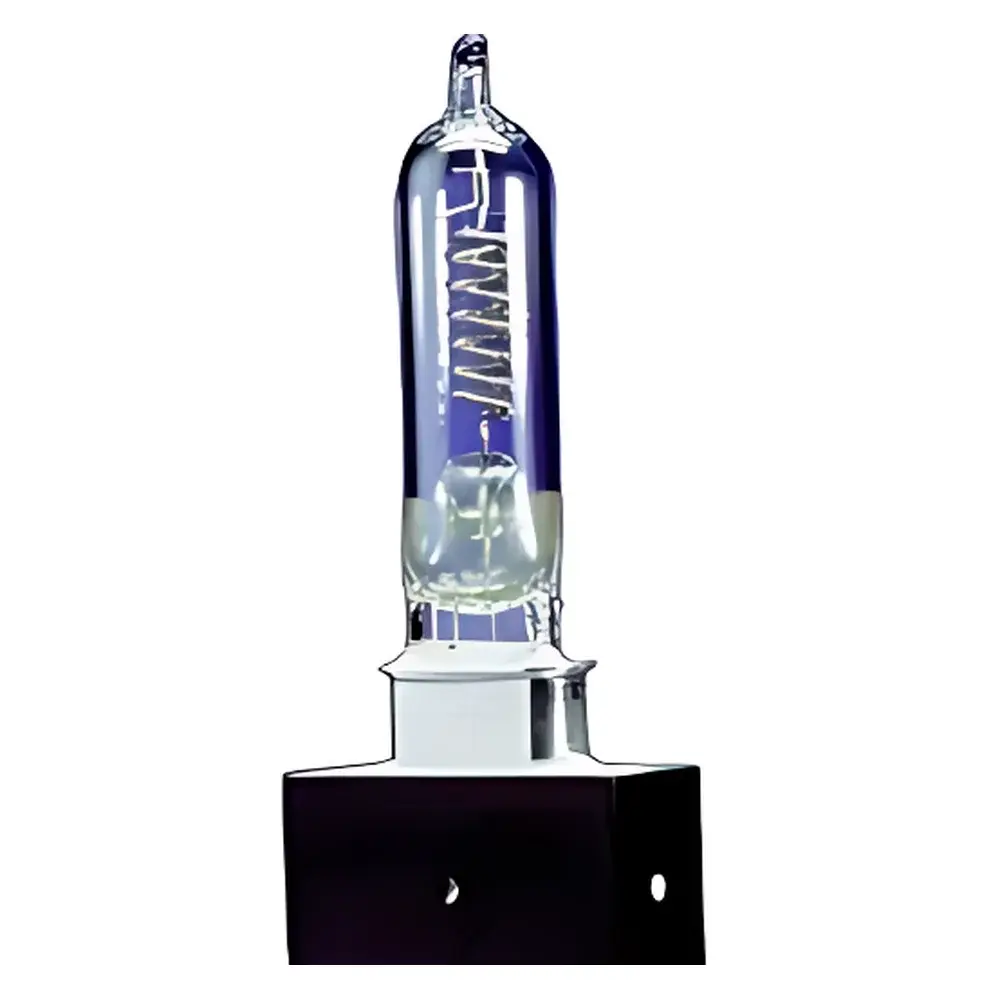
OL FEL High-Accuracy Spectral Irradiance Standard Lamp
| Brand | Optronic Laboratories |
|---|---|
| Origin | USA |
| Model | OL FEL |
| Spectral Range | 250–4500 nm |
| Nominal Total Irradiance | 32 mW/cm² |
| Nominal Illuminance | 800 fc |
| Transfer Uncertainty (vs. NIST) | ±1.0% (High-Accuracy), ±0.5% (Super High-Accuracy) |
| Operating Current | 8.00 A DC |
| Long-Term Stability | <0.06%/hour (standard) |
| Calibration Method | Wavelength-by-wavelength radiometric transfer from NIST primary standard lamps using OL750D double monochromator system |
| Mounting | NIST-traceable 6-axis adjustable mount with crosshair target alignment accessory |
Overview
The OL FEL High-Accuracy Spectral Irradiance Standard Lamp is a primary-level, NIST-traceable tungsten-halogen source engineered for radiometric and photometric calibration across ultraviolet, visible, and near- to mid-infrared spectral regions (250–4500 nm). Designed and manufactured by Optronic Laboratories (USA), the OL FEL lamp operates at 1000 W with a stabilized DC current of 8.00 A, delivering exceptional spectral continuity and thermal stability under controlled power conditions. Its fundamental metrological function is to serve as a transfer standard in irradiance-based calibration chains—enabling traceable dissemination of spectral irradiance (μW/cm²·nm), total irradiance (mW/cm²), and illuminance (fc) from NIST’s primary scale. Unlike broadband sources with undefined spectral shape, the OL FEL is characterized via wavelength-by-wavelength comparison against NIST reference lamps using the OL750D double monochromator system, ensuring rigorous adherence to ISO/IEC 17025-compliant calibration protocols and supporting compliance with ASTM E308, CIE S 026, and USP analytical instrument qualification requirements.
Key Features
- Full-spectrum coverage from 250 nm to 4500 nm, supporting UV-VIS-NIR-MIR applications including spectroradiometer validation, solar simulator characterization, and remote sensing sensor calibration.
- Two certified uncertainty tiers: ±1.0% relative uncertainty for high-accuracy applications and ±0.5% for super high-accuracy metrology labs requiring minimal transfer error in critical inter-laboratory comparisons.
- NIST-traceable 6-axis precision adjustment mount enabling sub-milliradian angular alignment, lateral centering, and focal plane positioning—critical for collimated beam alignment and optical axis registration in integrating sphere or goniophotometer setups.
- Integrated crosshair target accessory for visual verification of optical axis coincidence during setup and routine re-alignment.
- Thermally optimized tungsten filament geometry and quartz envelope design ensure long-term radiometric stability (<0.06%/hour drift under constant-current operation), with optional high-stability configuration available for extended-duration calibrations.
- Multiple spectral calibration variants (FEL-A through FEL-U) allow users to select the optimal spectral range and data format (radiometric vs. photometric) aligned with their instrument’s detector response and application scope.
Sample Compatibility & Compliance
The OL FEL lamp is compatible with all major classes of optical measurement systems requiring calibrated irradiance input—including imaging spectroradiometers (e.g., Ocean Insight QE Pro, Avantes AvaSpec), non-imaging spectrometers (e.g., Bentham DMc series), integrating sphere-based systems, and goniophotometers. Its spectral irradiance data are provided in standardized SI units (μW/cm²·nm) and photometric units (fc), fully compliant with CIE 15:2018 and ISO/CIE 11664-3:2019 definitions. All calibrations are performed in accordance with NIST SP 250-96 and NIST Technical Note 1902, and include full uncertainty budgets per GUM (JCGM 100:2008). The lamp meets requirements for GLP and GMP environments where audit-ready documentation—including calibration certificate with traceability statement, measurement uncertainty analysis, and raw spectral data files—is mandatory.
Software & Data Management
Spectral irradiance data for each OL FEL variant are delivered in ASCII-compatible .csv and .txt formats, structured for direct import into common radiometric analysis platforms (e.g., MATLAB, Python SciPy, LightTools, TracePro). Optronic Laboratories provides optional access to the OL-CalSuite software suite, which supports automated spectral interpolation, uncertainty propagation modeling, and generation of custom calibration reports compliant with FDA 21 CFR Part 11 electronic record requirements. All calibration certificates include digital signatures, unique serial identifiers, and revision-controlled metadata to support laboratory information management systems (LIMS) integration and ISO/IEC 17025 document control workflows.
Applications
- Primary calibration of spectroradiometers and hyperspectral imagers used in environmental monitoring, aerospace EO/IR testing, and agricultural remote sensing.
- Validation of solar simulator spectral match (per IEC 60904-9 Class AAA requirements) and UV aging chamber irradiance uniformity.
- Reference source for radiometric intercomparisons among national metrology institutes (NMIs) and accredited calibration laboratories.
- Traceable irradiance input for optical material transmittance/reflectance measurements in UV-VIS-NIR spectrophotometers.
- Photometric calibration of luminance meters, lux meters, and display measurement systems under CIE 1931 colorimetric observer conditions.
FAQ
What is the difference between FEL-A and FEL-IR spectral variants?
FEL-A covers 250–750 nm and is optimized for UV-VIS applications; FEL-IR extends to 4500 nm and is intended for NIR/MIR spectrometer calibration where extended infrared response is required.
Can the OL FEL lamp be used for absolute irradiance calibration without additional hardware?
Yes—when operated within its specified current tolerance (8.00 A ±0.01 A) and mounted on the NIST-traceable 6-axis fixture, the OL FEL delivers absolute spectral irradiance values traceable to NIST without intermediate transfer standards.
Is long-term stability verified during calibration?
Yes—stability testing is conducted over ≥4 hours prior to certification, and the reported <0.06%/hour drift value is included in the uncertainty budget per GUM Clause 4.3.3.
Does the calibration include photometric weighting (e.g., V(λ))?
Standard FEL-P variants include CIE 1931 photopic luminosity function weighting; unweighted radiometric data are provided for all FEL-A/B/C/IR/N/M variants.
How often should the OL FEL lamp be recalibrated?
Optronic Laboratories recommends recalibration every 12 months or after 200 operating hours—whichever occurs first—to maintain stated uncertainty performance and comply with ISO/IEC 17025 clause 5.10.4.