
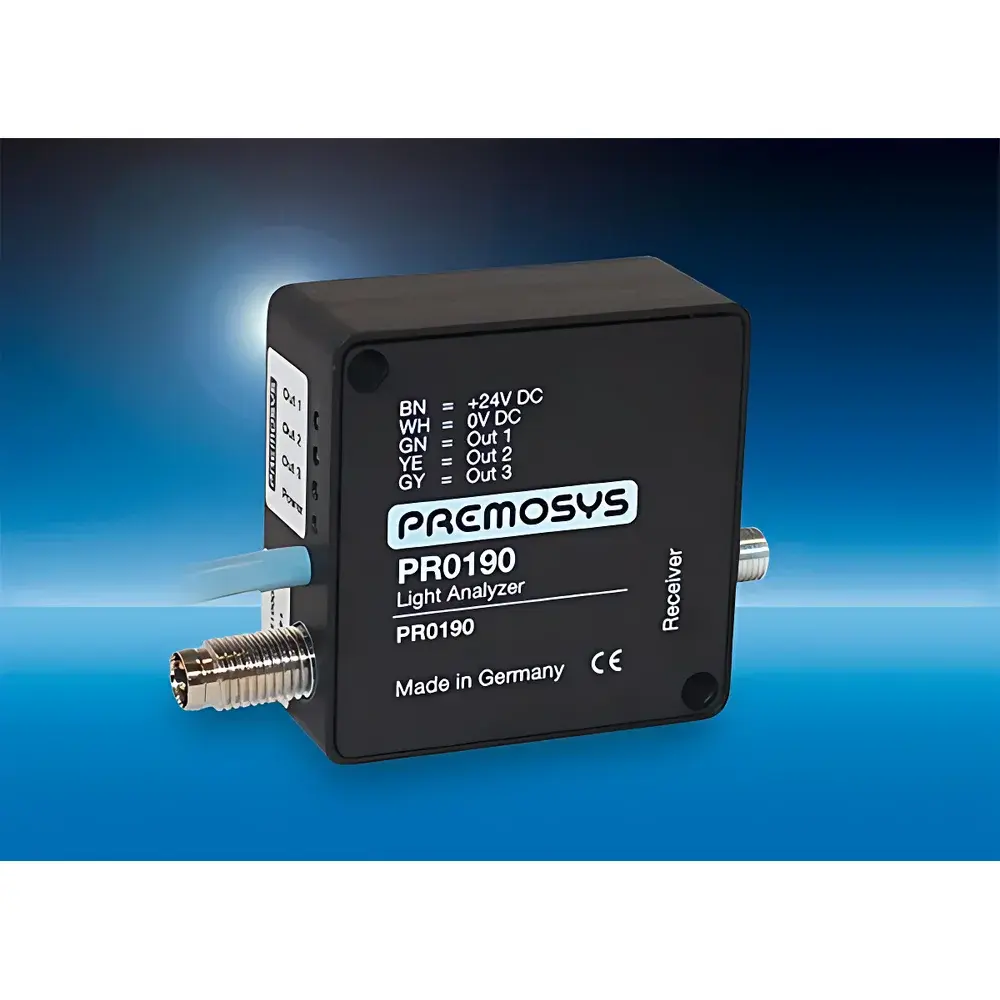
PREMOSYS PR190 Light Analyzer
| Brand | PREMOSYS |
|---|---|
| Origin | Germany |
| Model | PR190 |
| Sensitivity Range | 3.5–10,000,000 lux |
| Measurement Wavelength Range | 400–700 nm |
| Resolution | xy < 0.001, Dominant Wavelength: 1 nm, Correlated Color Temperature (CCT): 1 K |
| Measurement Time | ~25 ms per cycle |
| Gain Stages | 8 auto-ranging levels |
| ADC Resolution | 12-bit |
| Stored Configurations | 3 product profiles |
| Input Voltage | 12–27 VDC (≤3 A at 12 V) |
| Interface | Onboard serial and digital I/O |
| Calibration | User-executable illuminance & white-point calibration |
| Accuracy (White Reference) | xy ±0.0015, Relative Intensity ±2%, CCT ±100 K, Monochromatic LED Dominant Wavelength ±4 nm |
Overview
The PREMOSYS PR190 Light Analyzer is a compact, single-channel photometric measurement instrument engineered for high-reproducibility luminance and colorimetric characterization of LEDs and broad-spectrum light sources in industrial production environments. Based on calibrated silicon photodiode detection with spectral response weighted to the CIE 1931 photopic luminosity function (V(λ)), the PR190 delivers traceable photometric and colorimetric data—including tristimulus values (x, y, Y), correlated color temperature (CCT), and dominant wavelength—without requiring external spectrometers. Its optical architecture incorporates precision interference filters and temperature-stabilized signal conditioning to ensure long-term stability under continuous operation. Designed for integration into automated test stations or inline quality control workflows, the PR190 operates across an exceptionally wide dynamic range (3.5–107 lux), enabling consistent evaluation of both low-intensity indicator LEDs and high-brightness lighting-grade emitters.
Key Features
- Single-channel photometric platform optimized for rapid, repeatable LED binning and sorting in manufacturing settings
- Auto-ranging 8-stage gain control with 12-bit analog-to-digital conversion ensures linear response across seven orders of magnitude
- Real-time calculation of CIE 1931 chromaticity coordinates (x, y), luminance (Y), CCT, and dominant wavelength per measurement cycle (~25 ms)
- Onboard user calibration capability for both illuminance (lux) and white-point reference, supporting traceability to NIST-traceable standards
- Three configurable product profiles stored in non-volatile memory—each defining unique measurement parameters, thresholds, and pass/fail logic
- Flexible power input (12–27 VDC) and dual interface support (RS-232/RS-485 serial + TTL-level digital I/O) enable seamless integration with PLCs, vision systems, and MES platforms
- Compliant with CIE S 014-2/E:2022 (Photometry) and aligned with ISO/CIE 11664 series for colorimetry fundamentals
Sample Compatibility & Compliance
The PR190 accommodates standard LED packages (e.g., 0402 to 5050 SMD, T-1¾ through TO-220 through-hole), COB modules, and small-area lighting panels when positioned within its defined field-of-view geometry (±5° half-angle). It does not require integrating spheres or diffusers for routine production testing but supports optional cosine-corrected input optics for irradiance-based measurements. The instrument conforms to IEC 62471:2006 (Photobiological Safety) measurement prerequisites for radiant flux assessment and satisfies the photometric requirements outlined in LM-79-19 (IESNA) for total luminous flux estimation when used with calibrated reference lamps. All firmware and calibration records are structured to support GLP/GMP audit readiness, including timestamped calibration logs and user-accessible audit trails.
Software & Data Management
A Windows-native WIN32 application provides configuration, real-time visualization, and batch data export (CSV, TXT). Low-level access is enabled via a documented DLL interface for custom integration into LabVIEW, Python (PySerial), or C++ test automation frameworks. Each measurement includes embedded metadata: timestamp, gain stage, configuration ID, and calibration epoch. Data integrity is preserved through CRC-16 checksums on all serial transmissions. While the PR190 itself does not implement FDA 21 CFR Part 11 electronic signature controls, its output format and logging structure are compatible with validated third-party LIMS or MES systems that enforce such regulatory requirements.
Applications
- High-speed LED parametric screening during final test (FT) in semiconductor packaging lines
- Color consistency verification for backlight units (BLUs) in LCD manufacturing
- In-process monitoring of phosphor-converted white LED batches prior to binning
- Quality gate validation for automotive interior lighting modules (e.g., dashboard indicators, ambient strips)
- Reference-grade photometric verification of calibration standards in metrology labs
- Energy-efficient lighting product development where luminous efficacy (lm/W) correlation requires stable Y-value tracking
FAQ
What spectral range does the PR190 cover, and how is it weighted?
The PR190 uses a silicon photodiode with factory-applied spectral correction filters to approximate the CIE 1931 V(λ) luminous efficiency function across 400–700 nm. It is not a spectroradiometer and does not resolve individual wavelengths.
Can the PR190 measure pulsed or PWM-driven LEDs?
Yes—the 25 ms measurement cycle allows averaging over multiple drive periods; however, users must ensure pulse repetition frequency exceeds 40 Hz to avoid aliasing effects.
Is external calibration required after initial setup?
No. The PR190 supports user-performed illuminance and white-point calibrations using NIST-traceable reference sources; no annual recalibration service is mandated unless environmental exposure or mechanical shock occurs.
Does the device comply with ISO/IEC 17025 requirements?
While the PR190 itself is not accredited, its measurement uncertainty budget, documented calibration procedures, and traceable reference chain meet foundational criteria for inclusion in ISO/IEC 17025-compliant laboratory scopes when operated under controlled conditions.
How many devices can be daisy-chained on a single serial bus?
Up to 32 units may be addressed individually via RS-485 multidrop configuration using configurable node IDs; RS-232 supports point-to-point only.



