
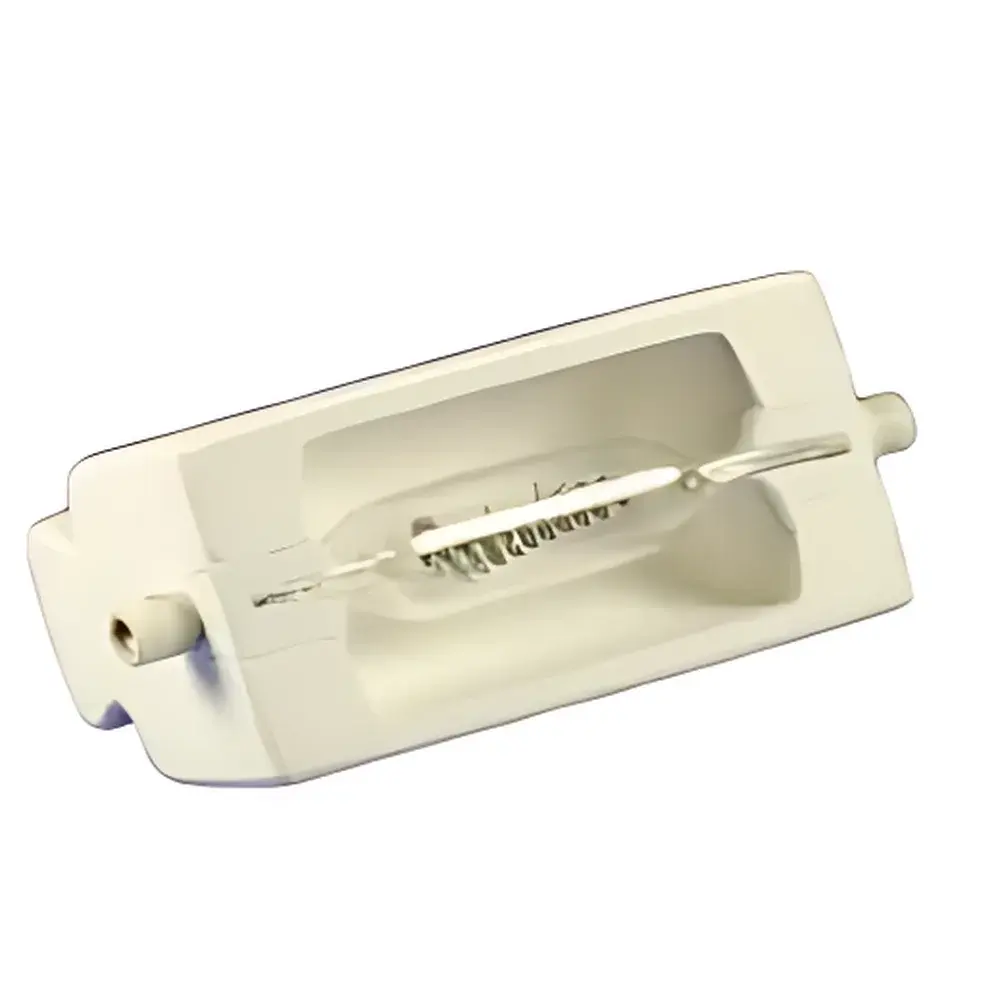
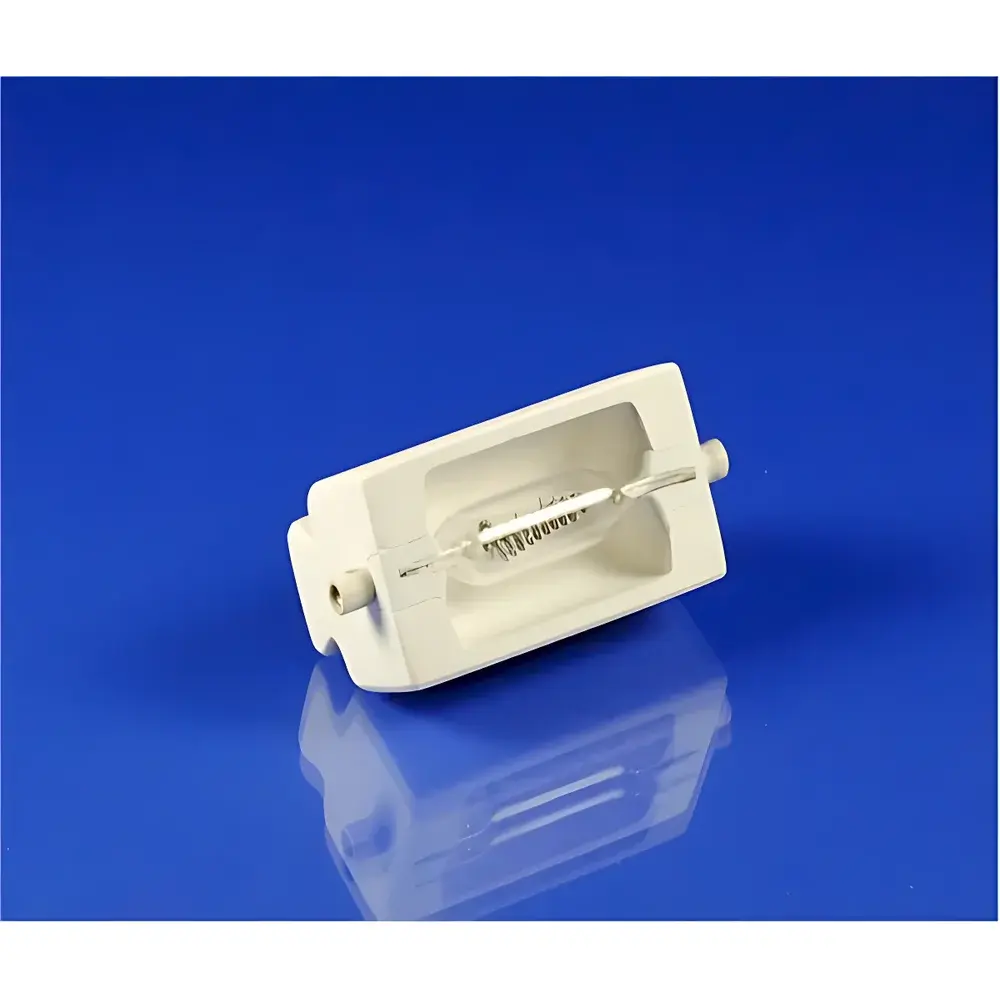
Optronic Laboratories OL 100 Solar Constant Radiometric Standard Lamp
| Brand | Optronic Laboratories |
|---|---|
| Origin | USA |
| Manufacturer Type | Authorized Distributor |
| Import Status | Imported |
| Model | OL 100 |
| Trigger Mode | Steady-State |
| Total Irradiance (Nominal) | 136 mW/cm² |
| Irradiance at 1000 nm | 100 µW/cm²·nm |
| Luminous Exitance (Nominal) | 3 lm/cm² (3000 fc) |
| Long-Term Stability | 0.06% / hour |
| Spectral Irradiance Uncertainty | ±1–2% |
| Total Irradiance Uncertainty | ±1.5% |
| Luminous Exitance Uncertainty | ±1.5% |
| Effective Radiating Area | 3 cm × 5 cm |
| Uniformity (Central Region) | ±0.25% |
| Spectral Calibration Options | OL-100A (300–750 nm), OL-100B (750–2500 nm), OL-100C (300–2500 nm), OL-100P (Photometric), OL-100U (Uncalibrated, Seasoned) |
Overview
The Optronic Laboratories OL 100 Solar Constant Radiometric Standard Lamp is a traceable, NIST-calibrated broadband source engineered to replicate the extraterrestrial solar spectral irradiance distribution at 1 AU (astronomical unit) — commonly defined as the solar constant of 136 mW/cm². Designed for use in solar simulator validation, radiometric calibration laboratories, and photovoltaic (PV) device testing facilities, the OL 100 employs a stabilized 1000 W tungsten-halogen lamp coupled with a precision-engineered reflective cavity. Its optical architecture delivers spatially uniform irradiance over a 3 cm × 5 cm effective emitting area at a working distance of 40 cm, achieving central-field non-uniformity of ±0.25%. The lamp operates exclusively in steady-state mode, eliminating transient thermal artifacts and ensuring stable output for extended-duration calibration protocols required under ISO 9022, IEC 60904-9, and ASTM E927-22.
Key Features
- Stable 1000 W tungsten-halogen source with integrated high-reflectivity cavity optimized for broadband UV-VIS-NIR emission (300–2500 nm)
- NIST-traceable spectral irradiance calibration available across multiple configurations: OL-100A (300–750 nm), OL-100B (750–2500 nm), OL-100C (full 300–2500 nm range), OL-100P (photometric luminous exitance), and OL-100U (uncalibrated, pre-aged unit)
- Verified long-term stability of ≤0.06% per hour under constant power supply and thermal management conditions
- Defined total irradiance of 136 mW/cm² at 40 cm — aligned with the internationally accepted solar constant value per ISO 21348 and ASTM G173-03 reference spectra
- Center-weighted irradiance uniformity of ±0.25%, validated via calibrated scanning radiometer per ISO/IEC 17025-compliant procedures
- Integrated thermal shielding and forced-air cooling interface compatible with Class A solar simulator integration requirements
Sample Compatibility & Compliance
The OL 100 is routinely deployed in accredited calibration laboratories performing radiometric intercomparisons for solar simulators used in PV cell certification (IEC 61215, IEC 61646), space environment simulation chambers, and optical sensor characterization. Its spectral coverage supports compliance verification for spectral match classes (A, B, C) per IEC 60904-9 Ed. 3. The lamp’s uncertainty budget — ±1–2% for spectral irradiance, ±1.5% for total irradiance and photometric exitance — meets the metrological requirements for secondary standard sources under ISO/IEC 17025 Clause 6.5. All calibrations are issued with full uncertainty statements, traceability documentation to NIST SRM 2250 and SRM 2251, and validity periods aligned with manufacturer-recommended re-calibration intervals (typically every 12 months or after 200 operating hours).
Software & Data Management
While the OL 100 operates as a passive radiometric standard without embedded electronics, its calibration data files are delivered in standardized ASCII format (.txt) and compliant CSV structures, supporting direct import into common laboratory data acquisition platforms including LabVIEW, MATLAB, Python-based radiometric analysis suites (e.g., PyRadiomics), and commercial PV test software (e.g., PVsyst, PVMetrics). Each unit ships with a digital certificate containing wavelength-indexed spectral irradiance values (in µW/cm²·nm), expanded uncertainties (k=2), environmental test conditions (ambient temperature, humidity, atmospheric pressure), and operator identification. Audit trails comply with FDA 21 CFR Part 11 requirements when stored within validated electronic lab notebook (ELN) systems meeting ALCOA+ principles.
Applications
- Primary reference source for absolute calibration of spectroradiometers, broadband radiometers, and pyranometers
- Validation and class verification of Class AAA, AA, and A solar simulators per IEC 60904-9
- Reference irradiance source in accelerated aging test chambers for polymer degradation and coating stability studies
- Traceable irradiance anchor for outdoor PV performance ratio (PR) correction algorithms
- Inter-laboratory comparison reference in CCPR Key Comparison CCM.K4.a (Solar Irradiance)
- Supporting GLP/GMP-compliant photobiological safety testing (IEC 62471) where broadband UV exposure quantification is required
FAQ
Is the OL 100 suitable for continuous operation during qualification testing?
Yes — the OL 100 is rated for continuous steady-state operation up to 8 hours per session, provided ambient temperature remains below 30°C and airflow meets Optronic Laboratories’ minimum cooling specifications.
What recalibration interval does Optronic Laboratories recommend?
Annual recalibration is recommended, or after 200 accumulated operating hours — whichever occurs first — to maintain stated uncertainty performance.
Can the OL 100 be used for spectral mismatch correction in multi-junction PV testing?
Yes, when configured with the OL-100C full-spectrum calibration (300–2500 nm), it provides the requisite spectral resolution and uncertainty profile for Jsc mismatch factor derivation per IEC 60904-7.
Does the OL 100 require external power regulation?
Yes — operation requires a stable, low-ripple DC power supply with voltage regulation within ±0.1% and current stability better than ±0.05% to preserve long-term irradiance stability.
Is the OL 100 compatible with automated solar simulator alignment systems?
Yes — its mechanical footprint and mounting interface conform to ANSI Z80.10 and IEC 60904-9 mechanical reference planes, enabling repeatable integration with robotic stage positioning and beam profiling tools.






