
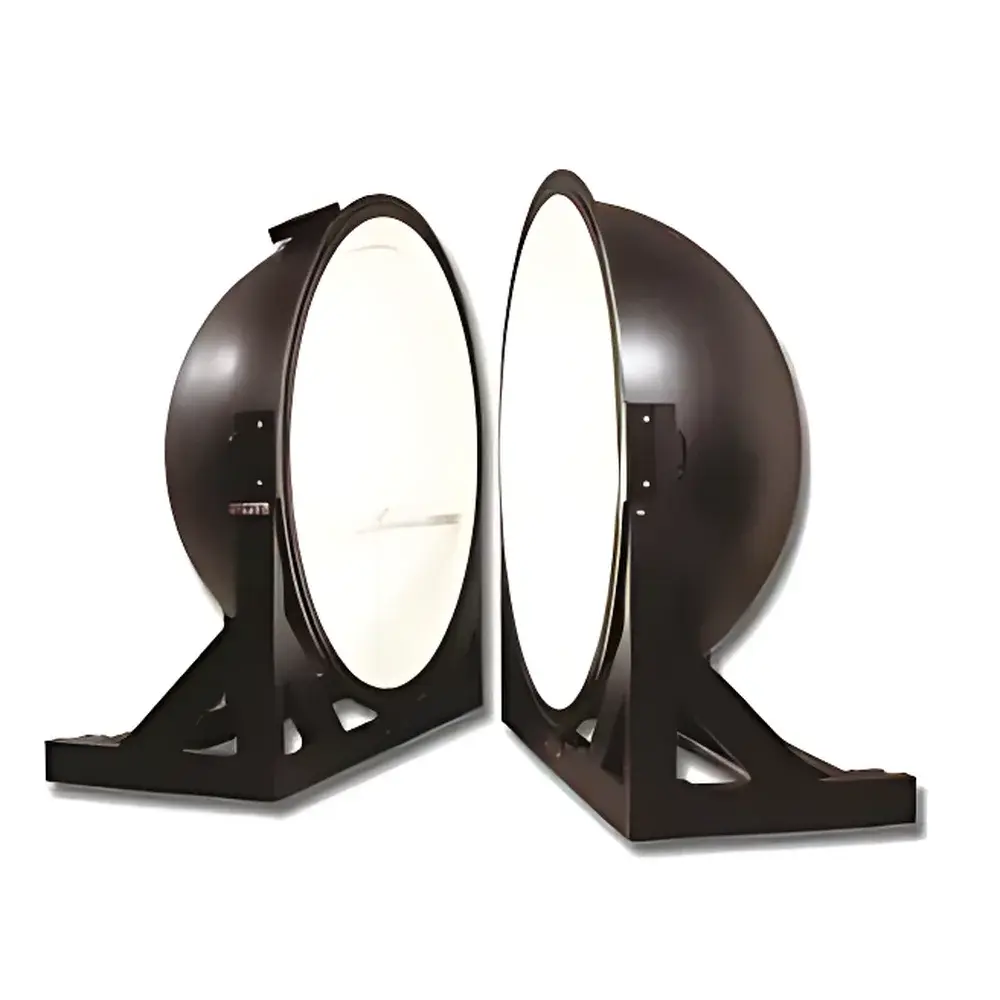
Optronic Laboratories OL-3m Integrating Sphere for Luminous Flux Measurement
| Brand | Optronic Laboratories |
|---|---|
| Origin | USA |
| Model | OL-3m |
| Sphere Diameter | 3 meters (customizable from 0.5 m to 3 m) |
| Coating Options | PTFE (for small spheres), Optolon 2 (standard for mid-to-large spheres), Avian-D (domestic housing + imported coating variant) |
| Mounting | Motorized lid actuation available for spheres ≥2 m |
| Compliance | Designed to meet ASTM E1337, CIE S 025/E:2015, and ISO/CIE 19476:2014 requirements for photometric calibration and luminous flux measurement |
Overview
The Optronic Laboratories OL-3m Integrating Sphere is a precision-engineered optical measurement platform designed specifically for absolute luminous flux (lumens) characterization of lamps, LEDs, OLEDs, and other light-emitting devices under controlled photometric conditions. Based on the fundamental principle of spatial integration—where incident light undergoes multiple diffuse reflections within a highly reflective, Lambertian inner surface—the OL-3m achieves exceptional uniformity and signal stability essential for high-accuracy photometry. Its 3-meter internal diameter provides sufficient volume to accommodate large-area sources and minimize self-absorption and vignetting errors common in smaller spheres. The sphere’s geometry and coating performance are validated per CIE S 025/E:2015, ensuring traceable, reproducible measurements aligned with national metrology institute (NMI) practices.
Key Features
- Ultra-high diffuse reflectance coating: Optolon 2 coating delivers >98.6% average reflectance across 350–1000 nm, exceeding standard BaSO₄-based coatings (98.4%) and improving sphere efficiency by up to 15% relative to legacy materials.
- Robust, maintenance-friendly surface: Hydrophobic and abrasion-resistant formulation enables repeated cleaning with deionized water without degradation; no powder shedding or micro-cracking observed after long-term thermal cycling (−10°C to +50°C).
- Modular mechanical architecture: Motorized lid mechanism (standard for spheres ≥2 m) ensures repeatable port closure and eliminates operator-induced alignment variability during sequential measurements.
- Configurable substrate options: Available as fully imported OEM sphere (aluminum alloy housing with integrated Optolon 2) or hybrid configuration (domestic aluminum/carbon steel housing + imported Optolon 2 or Avian-D coating).
- Scalable design: Standard production range spans 4 inch (10 cm) to 76 inch (193 cm); custom 3 m (300 cm) spheres are manufactured to order with full dimensional QA documentation and reflectance mapping reports.
Sample Compatibility & Compliance
The OL-3m supports full-spectrum photometric evaluation of directional and omnidirectional sources—including high-power LED modules, automotive headlamps, horticultural lighting arrays, and UV-C germicidal emitters—without requiring auxiliary baffles or auxiliary lamps in most configurations. Its port layout (standard 4-port: input, detector, auxiliary lamp, and sample access) conforms to IES LM-79-19 Annex A and CIE Publication 127:2007 recommendations. All spheres are supplied with NIST-traceable reflectance calibration certificates and comply with ISO/IEC 17025:2017 laboratory accreditation requirements when operated with OL-series spectroradiometers (e.g., OL 750, OL 770). Optional GLP-compliant audit trails and 21 CFR Part 11–enabled software logging are supported via OL SpectraSuite™ v5.x.
Software & Data Management
When paired with Optronic Laboratories’ OL SpectraSuite™ software suite, the OL-3m enables automated luminous flux calculation per CIE 13.3-1995 and IES TM-21, including spectral correction, thermal drift compensation, and uncertainty propagation per GUM (JCGM 100:2008). Raw spectral irradiance data is exported in standardized .jdx and .csv formats compatible with MATLAB, Python (NumPy/Pandas), and industry-standard photometric reporting tools (e.g., LightTools, ASAP). All measurement sessions include timestamped metadata (ambient temperature, humidity, integration time, detector gain), supporting full traceability for ISO 9001 and FDA-regulated quality systems.
Applications
- Luminous flux calibration of reference standards in NMI and third-party test labs
- LM-79 and LM-80 compliance testing for solid-state lighting products
- Photobiological safety assessment (IEC 62471) requiring total radiant and luminous output
- Colorimetric validation (CIE 1931 xy, u’v’, CCT, Duv) of tunable white and multi-channel LED systems
- R&D characterization of next-generation micro-LED arrays and laser-based illumination sources
FAQ
Can the OL-3m be used with non-Optronic spectroradiometers?
Yes—provided the detector has calibrated responsivity across 350–1000 nm and supports external trigger synchronization; however, full uncertainty budgeting requires OL-specific calibration files.
Is re-coating supported after extended use?
Yes—Optolon 2 can be locally re-applied following proprietary surface preparation protocols; Optronic Laboratories offers certified recoating services with post-application reflectance verification.
What environmental conditions are required for optimal operation?
Ambient temperature stability ±0.5°C over measurement duration and relative humidity <60% RH (non-condensing) are recommended to minimize thermal drift and coating hygroscopic effects.
Does the OL-3m meet FDA or EU CE requirements for medical device photometry?
While the sphere itself is not a medical device, its configuration with OL-770 spectroradiometer and SpectraSuite™ satisfies 21 CFR Part 11 and MDR Annex I §17.3 for photometric verification of surgical lighting and diagnostic illuminators.



