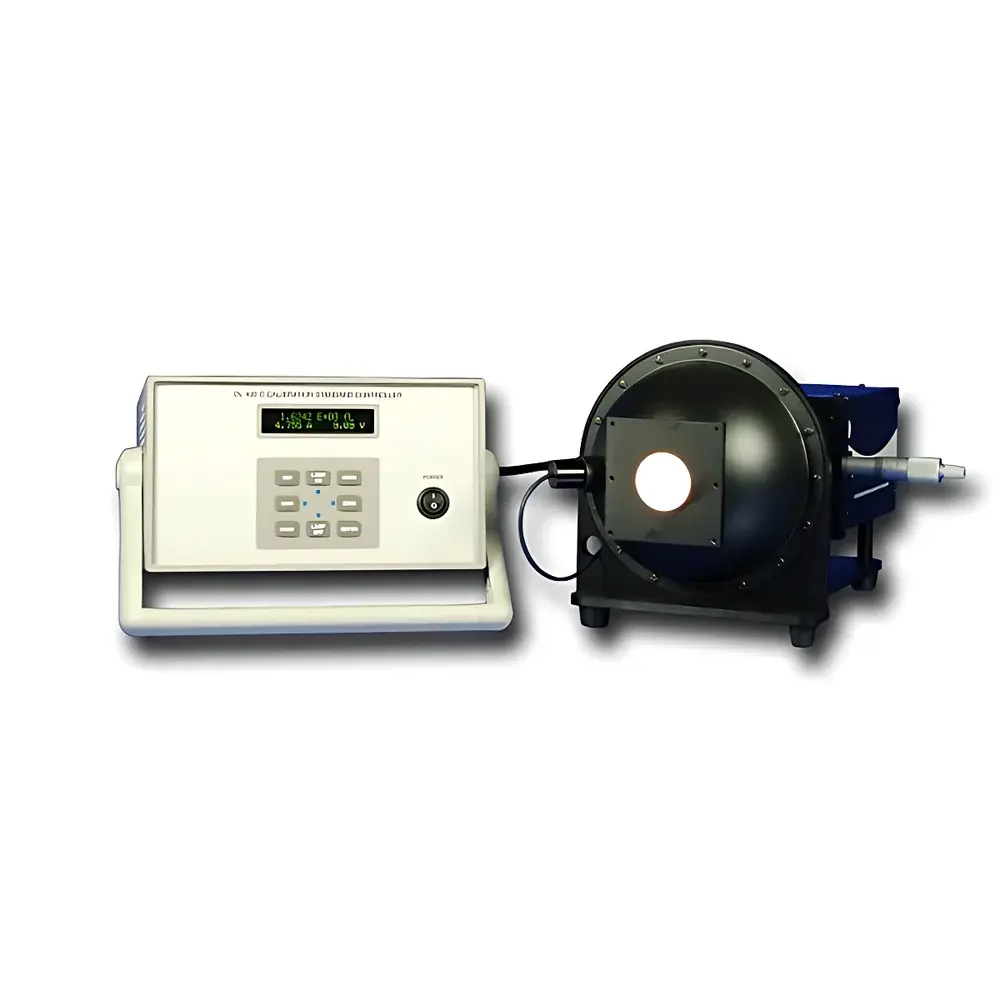
OL 455 High-Luminance Uniform Integrating Sphere Source
| Brand | Optronic Laboratories |
|---|---|
| Origin | USA |
| Manufacturer Type | Authorized Distributor |
| Origin Category | Imported |
| Model | OL 455 |
| Pricing | Upon Request |
| Sphere Diameters Available | 6", 8", 12", 18" |
| Light Source | 150 W Quartz Halogen Tungsten Lamp with Ellipsoidal Reflector |
| Brightness Control | Manual (OL 455-XA) or Motorized Aperture (OL 455-XSA) |
| Spectral Options | Standard Illuminants A, B, C, D65 via Interchangeable Bandpass Filters |
| Color Temperature Stability | Maintained Across Full Brightness Range |
Overview
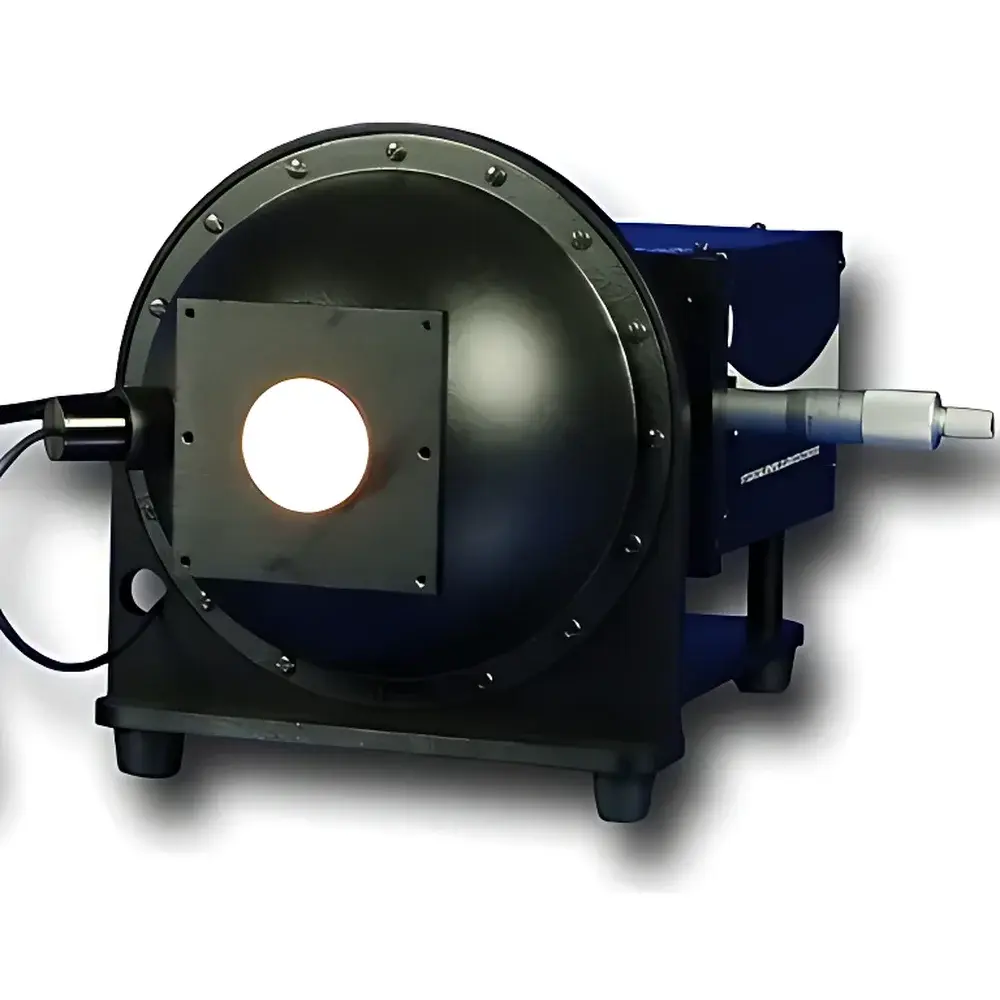
The OL 455 High-Luminance Uniform Integrating Sphere Source is a precision-engineered radiometric standard designed for primary and secondary calibration of photometric and spectroradiometric instruments. Based on the fundamental principle of Lambertian emission from a diffusely reflecting integrating sphere cavity, the OL 455 generates spatially uniform radiance across its exit port—enabling traceable, repeatable characterization of luminance meters, spectroradiometers, microphotometers, image intensifiers, low-light night vision devices, telescopic photometers, and hyperspectral radiance sensors. Developed by Optronic Laboratories—a U.S.-based leader in NIST-traceable optical radiation standards since 1970—the OL 455 series embodies decades of metrological rigor in radiometric source design. Its core architecture integrates a stabilized 150 W quartz halogen tungsten lamp with an ellipsoidal reflector to maximize coupling efficiency into the sphere cavity, while minimizing thermal drift and spectral shift during operation.
Key Features
- Four standard sphere diameters (6″, 8″, 12″, and 18″) optimized for varying field-of-view requirements, étendue matching, and radiance output density.
- Continuous, stepless brightness adjustment over a wide dynamic range—without altering correlated color temperature (CCT)—achieved via precision mechanical aperture control between the lamp and sphere entrance port.
- Motorized aperture option (OL 455-XSA) enables programmable, closed-loop luminance control integrated with optional feedback from the built-in monitoring detector.
- Integrated silicon photodiode-based luminance monitor provides real-time stability tracking and supports automated recalibration routines.
- Interchangeable spectral filter sets allow rapid configuration for standardized illuminants including Illuminant A (2856 K), B (4874 K), C (6774 K), and D65 (6504 K), all compliant with CIE S 005/E:2015 and ISO/CIE 11664-2:2019.
- Thermally stabilized sphere housing and lamp power supply minimize temporal drift; typical short-term stability ≤ ±0.2% over 30 minutes at constant setpoint.
Sample Compatibility & Compliance
The OL 455 is compatible with instruments requiring calibrated radiance input within the visible spectrum (380–780 nm) and near-UV/near-IR extensions (upon filter selection). It meets the geometric and radiometric requirements specified in ASTM E308-22 (Computing Instrumental Color Using CIE Systems), ISO 11664-2:2019 (Colorimetry — Part 2: CIE Standard Illuminants), and CIE Publication 15:2018 (Colorimetry). All factory calibrations are directly traceable to NIST through Optronic Laboratories’ accredited calibration laboratory (ISO/IEC 17025:2017 accredited for spectral irradiance and radiance), ensuring compliance with GLP, GMP, and FDA 21 CFR Part 11 data integrity requirements when used with validated software workflows.
Software & Data Management
Optronic Laboratories provides the OL-SW Suite, a Windows-based application supporting instrument configuration, motorized aperture control (XSA models), luminance logging, and spectral filter selection. The software records timestamped measurements with full audit trail functionality—including user ID, parameter changes, and calibration certificate references—meeting ALCOA+ principles for data reliability. Export formats include CSV, XML, and NIST-compatible .rad files. Integration with third-party DAQ systems (e.g., LabVIEW, Python via USB/RS-232) is supported through documented SCPI command sets and DLL libraries.
Applications
- Primary calibration of luminance meters per CIE TN 003:2015 and DIN 5032-7.
- Verification and linearity assessment of imaging radiometers and scientific CCD/CMOS-based photometers.
- Characterization of night vision device (NVD) sensitivity and signal-to-noise performance under controlled photopic/mesopic conditions.
- Validation of hyperspectral sensor responsivity and stray-light correction algorithms.
- Development and testing of automotive head-up display (HUD) and augmented reality (AR) optical combiners requiring high-uniformity, high-dynamic-range radiance sources.
- Supporting ISO/CIE-compliant visual perception studies where spectral and spatial uniformity are critical.
FAQ
Is NIST-traceable calibration included with the OL 455?
Yes—each unit ships with a NIST-traceable calibration certificate for luminance and spectral radiance at specified wavelengths and apertures. Optional re-calibration services are available annually.
Can the OL 455 be used for UV or IR spectral work?
With appropriate bandpass filters and detector upgrades (e.g., extended-range Si or InGaAs monitors), the system supports operation from 250 nm to 1100 nm. Consult Optronic Laboratories for spectral range validation reports.
What is the expected lifetime of the 150 W halogen lamp?
Rated average life is 2,000 hours at nominal voltage; lamp replacement kits and alignment fixtures are supplied to maintain metrological continuity.
Does the OL 455-XSA support remote scripting via Ethernet or USB?
Yes—both USB virtual COM port and RS-232 interfaces support SCPI commands for aperture position, filter wheel control, and luminance readback in automated test environments.
How is thermal equilibrium managed during extended calibration sessions?
The sphere housing incorporates passive thermal mass stabilization and forced-air cooling channels; ambient temperature should be maintained at 23 ± 2 °C with <50% RH for optimal long-term stability.