
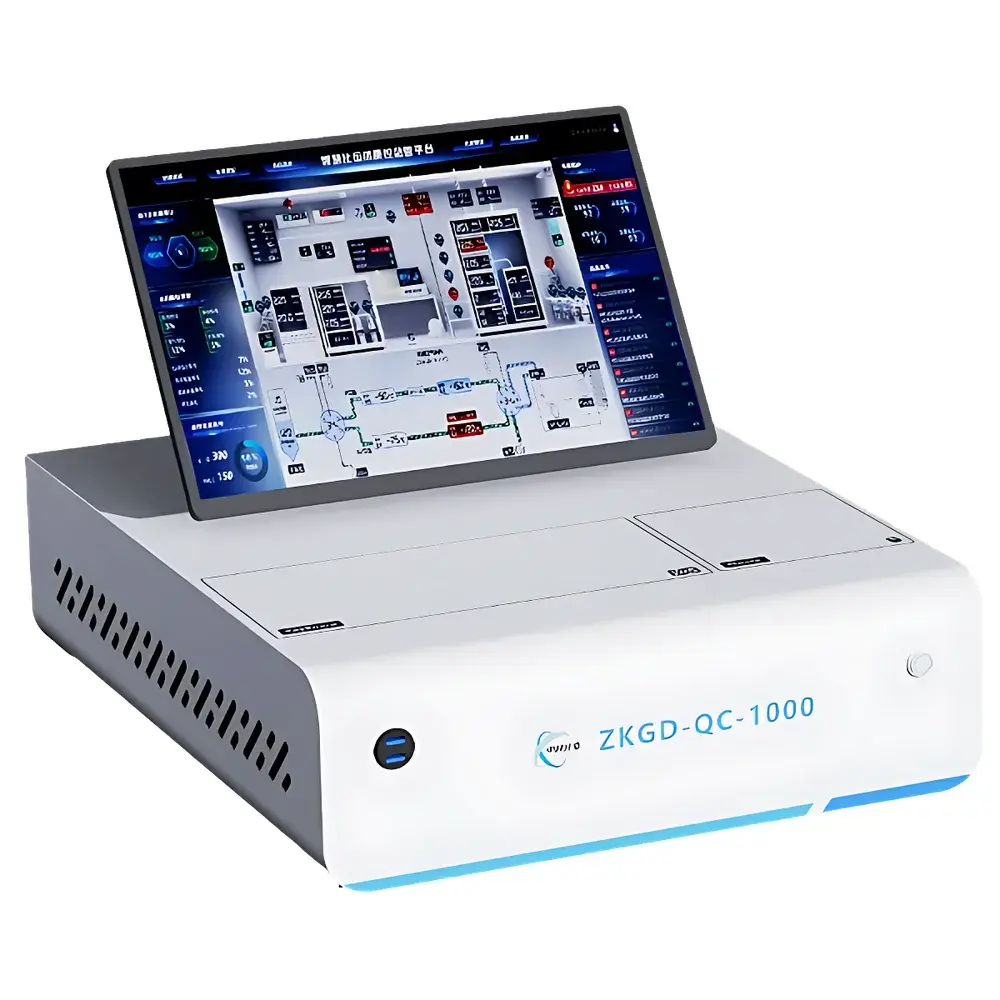
CASP ZKGD-QC-1000 Intelligent Quality Control System
| Brand | CASP |
|---|---|
| Origin | Jiangsu, China |
| Manufacturer Type | Original Equipment Manufacturer (OEM) |
| Country of Origin | China |
| Model | ZKGD-QC-1000 |
| Net Weight | 11.7 kg |
| Operating Temperature Range | 0–60 °C |
Overview
The CASP ZKGD-QC-1000 Intelligent Quality Control System is an integrated hardware-software platform engineered for continuous, automated quality assurance of environmental air monitoring instruments. It operates as a centralized digital control node within ambient air quality monitoring networks—supporting fixed-site stations including routine monitoring stations, photochemical component stations, industrial park stations, traffic-oriented stations, and superstations. Unlike conventional QC checkers that perform periodic manual calibration verification, the ZKGD-QC-1000 implements real-time, algorithm-driven quality control through synchronized instrument telemetry, embedded diagnostic logic, and cloud-connected audit trails. Its core architecture leverages deterministic state modeling and time-series anomaly detection to assess instrument health, data integrity, and measurement consistency—enabling early identification of sensor drift, flow deviation, optical attenuation, or electronic instability before they compromise regulatory-grade data output.
Key Features
- Digital Twin Integration: Mirrors physical station infrastructure—including analyzers (e.g., NOx, SO2, O3, PM2.5/PM10, VOCs), calibration gas delivery modules, and meteorological sensors—within a secure web-based visualization layer for cross-parameter correlation analysis.
- Predictive Anomaly Detection: Applies supervised machine learning models trained on historical maintenance logs and failure mode databases to forecast potential deviations in zero/span response, pressure drop across filters, or photometric baseline shifts up to 72 hours in advance.
- Automated Data Review & Flagging: Performs real-time chromatographic peak integration (for GC-based VOC systems), spectral deconvolution (for DOAS/FTIR), and statistical outlier detection using robust regression (RANSAC) and inter-instrument consensus scoring.
- End-to-End Traceability: Maintains immutable electronic maintenance logs compliant with ISO/IEC 17025:2017 Clause 7.9, recording every remote QC event—including timestamped gas cylinder lot numbers, operator ID, instrument firmware version, and environmental context (temperature, humidity, barometric pressure).
- Remote QC Execution: Supports standardized protocol-driven challenges—such as multi-point span checks, zero-air interference tests, and dynamic dilution verification—via secure TLS 1.3 communication with field-deployed analyzers equipped with RS-485/Modbus or Ethernet/IP interfaces.
Sample Compatibility & Compliance
The ZKGD-QC-1000 interfaces with a broad spectrum of EPA-equivalent and CNEMC-certified ambient air analyzers, including but not limited to chemiluminescence NOx analyzers, UV fluorescence SO2 analyzers, UV photometric O3 analyzers, beta-attenuation PM monitors, and proton-transfer-reaction mass spectrometers (PTR-MS). It adheres to data integrity requirements outlined in China’s HJ 653–2013 and HJ 817–2018 technical specifications for air quality monitoring equipment, and supports metadata tagging aligned with ISO 14064-1 greenhouse gas quantification frameworks. All remote operations are executed under role-based access control (RBAC) and generate audit-ready records satisfying GLP-compliant QA/QC documentation workflows.
Software & Data Management
The system runs on a hardened Linux-based edge controller with dual redundant storage (RAID 1) and integrates with CASP’s proprietary QC-Cloud™ platform via MQTT over TLS. Software modules include: (1) QC Scheduler—configurable by station type, pollutant priority, and regulatory cycle (e.g., daily zero checks, weekly multi-gas spans); (2) Integrated Diagnostics Engine—correlating analyzer raw signals with environmental variables to isolate instrument-specific faults; (3) e-Logbook—generating PDF reports signed with SHA-256 digital certificates, exportable in CSV/JSON for third-party LIMS ingestion; (4) API Gateway—enabling interoperability with national air quality data centers (e.g., CNEMC Data Platform) and municipal smart-city operation centers.
Applications
The ZKGD-QC-1000 is deployed across heterogeneous monitoring infrastructures where regulatory compliance, operational scalability, and metrological traceability converge. Typical use cases include: automated validation of hourly averaged PM2.5 data prior to submission to provincial environmental authorities; cross-station bias correction for regional ozone modeling; real-time QC flagging during high-pollution episodes to prevent false exceedance declarations; and long-term stability trending for instrument lifetime assessment per ISO 5725-2 precision studies. Its modular design allows phased integration into legacy networks without requiring full analyzer replacement.
FAQ
Does the ZKGD-QC-1000 support FDA 21 CFR Part 11 compliance for electronic records?
Yes—when deployed with optional PKI certificate enrollment and biometric authentication modules, it meets signature, audit trail, and record retention requirements for regulated environments.
Can it interface with non-CASP analyzers?
Yes—it supports Modbus TCP, OPC UA, and custom ASCII protocol parsing for third-party devices, subject to protocol documentation and factory configuration.
What is the maximum number of analyzers per ZKGD-QC-1000 node?
Up to 16 analyzers per node, scalable to 256 devices via hierarchical cluster deployment with load-balanced QC-Cloud™ orchestration.
Is local data processing performed on-device?
Yes—all anomaly detection, integration, and flagging logic executes on the onboard ARM Cortex-A53 processor; cloud connectivity is optional for reporting and fleet-wide analytics.
How frequently is firmware updated, and what validation process applies?
Firmware releases follow IEC 62443-3-3 SL2 security guidelines and undergo regression testing against NIST-traceable reference standards prior to over-the-air deployment.
Related Products







