
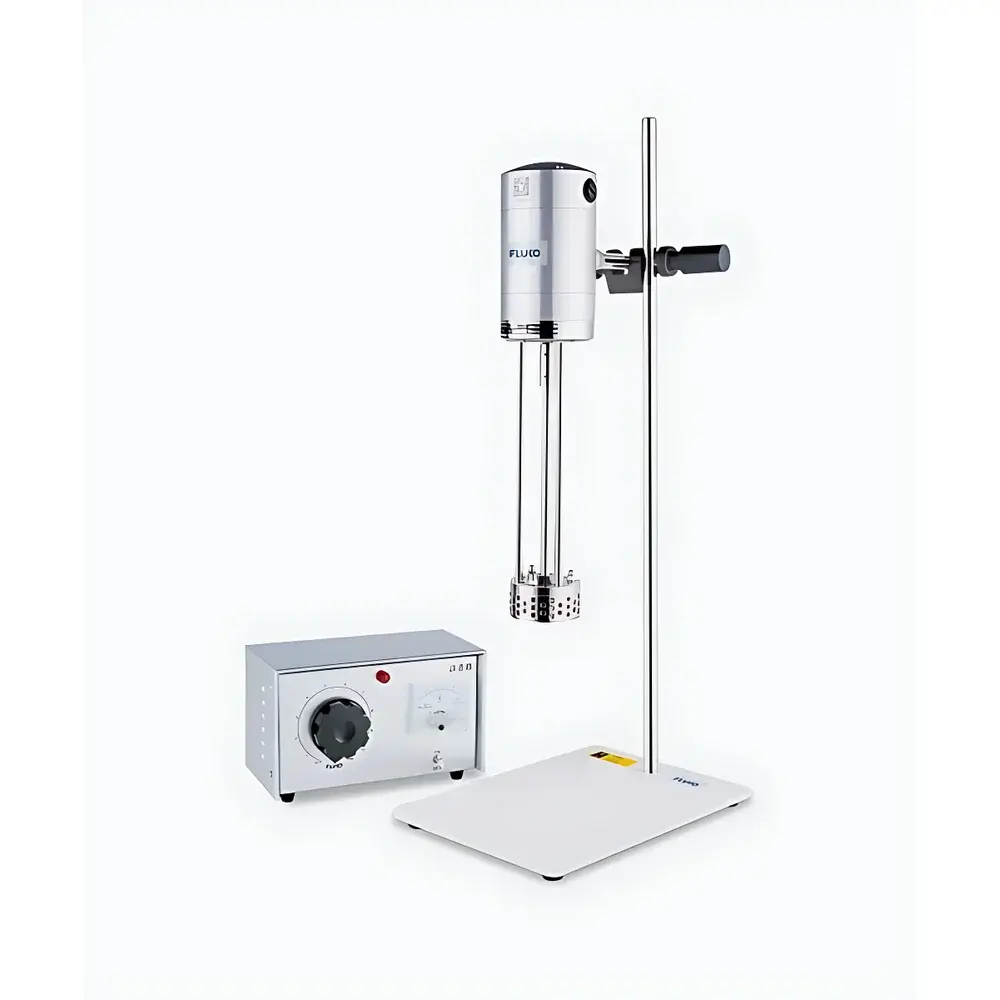
FLUKO FM300 High-Shear Dispersing and Emulsifying Homogenizer
| Brand | FLUKO |
|---|---|
| Origin | Germany |
| Model | FM300 |
| Power | 300 W |
| Voltage/Frequency | 220 V, 50 Hz |
| Processing Volume (H₂O) | 200–10,000 mL |
| Max. Viscosity | 5,000 cP |
| Speed Range | 300–11,000 rpm |
| Speed Display | Analog Scale |
| Speed Control | Continuously Variable |
| Rotor-Stator Configurations | Round-Orifice, Slotted, Mesh-Type |
| Wetted Materials | AISI 304 Stainless Steel |
| Shaft Sleeve Material | Copper Alloy |
| Operating Ambient Temperature | 5–40 °C |
| Max. Relative Humidity | ≤80% |
| Process Mode | Batch |
| Base & Stand | Included |
| Independent Speed Controller | Included |
| Dimensions (W×D×H) | 210 × 290 × 675 mm |
| Weight | ~13 kg |
Overview
The FLUKO FM300 is a benchtop high-shear dispersing and emulsifying homogenizer engineered for precision batch processing in research laboratories and quality control environments. It operates on the principle of rotor-stator mechanical shear: a rapidly rotating rotor draws material into a narrow gap between itself and a stationary stator, subjecting the fluid to intense hydrodynamic stress—including turbulent flow, cavitation, and extensional deformation—resulting in efficient particle size reduction, droplet breakup, and interfacial stabilization. Designed for applications requiring consistent microstructural control in low-to-medium throughput scenarios, the FM300 delivers reproducible dispersion, emulsification, and homogenization across a broad viscosity range (up to 5,000 cP), making it suitable for formulations involving polymers, pigments, pharmaceutical suspensions, cosmetic emulsions, and functional food matrices.
Key Features
- 300 W brushless motor with high torque output at low speeds, ensuring stable operation during startup and under load
- Continuously variable speed control via integrated analog dial, enabling precise adjustment from 300 to 11,000 rpm without stepwise increments
- Three interchangeable stator geometries—round-orifice, slotted, and mesh-type—each optimized for distinct process objectives: coarse dispersion, fine emulsification, or ultra-fine homogenization
- AISI 304 stainless steel wetted components compliant with general laboratory corrosion resistance requirements and compatible with common solvents and aqueous systems
- Copper alloy shaft sleeve providing thermal conductivity and wear resistance under sustained mechanical loading
- Integrated analog tachometer with calibrated scale for real-time rotational speed verification—no external sensor required
- Modular stand-and-clamp assembly with adjustable height and lateral stability, supporting vessels from 50 mL beakers to 10 L jacketed reactors
Sample Compatibility & Compliance
The FM300 accommodates batch volumes from 200 mL to 10,000 mL (water-equivalent), with optimal performance observed between 500–5,000 mL depending on rheology and air entrainment sensitivity. It handles Newtonian and moderately shear-thinning fluids up to 5,000 cP; for higher-viscosity or viscoelastic materials, pre-dilution or staged addition is recommended. While not certified to ISO 13485 or FDA 21 CFR Part 11 out-of-the-box, its construction supports GLP-compliant documentation when paired with validated SOPs and manual logbook entries. All electrical components meet CE marking requirements per EN 61000-6-2 (immunity) and EN 61000-6-4 (emission) standards. The device is intended for indoor laboratory use only, within ambient conditions of 5–40 °C and ≤80% RH (non-condensing).
Software & Data Management
The FM300 operates as a standalone analog instrument with no embedded digital controller or data logging capability. Speed settings are manually selected and visually confirmed via the analog tachometer; no software interface, USB port, or remote connectivity is provided. This architecture ensures operational simplicity, electromagnetic compatibility in sensitive instrumentation environments, and minimal validation burden in regulated workflows where electronic records are not mandated. For laboratories requiring traceable speed history, integration with external RPM sensors (e.g., optical tachometers) and time-stamped manual logs satisfies basic audit trail needs aligned with ISO/IEC 17025 clause 7.7.
Applications
- Preparation of stable oil-in-water and water-in-oil emulsions for dermatological formulations and agrochemical concentrates
- Dispersion of nanomaterials (e.g., carbon nanotubes, metal oxides) into polymer melts and solvent-based coatings
- Homogenization of cell lysates and tissue homogenates prior to centrifugation or chromatographic analysis
- Deagglomeration of pigment pastes and ceramic slurries in R&D-scale ink and glaze development
- Viscosity-controlled mixing of thermosensitive biopolymers (e.g., alginate, chitosan) without thermal degradation
- Process simulation for scale-up studies in pilot-plant emulsification lines using geometrically similar rotor-stator ratios
FAQ
Is the FM300 suitable for continuous processing?
No—it is designed exclusively for batch operation. Continuous flow requires dedicated in-line homogenizers with pump coupling and pressure-rated housings.
Can the FM300 be used with corrosive solvents such as chlorinated hydrocarbons?
AISI 304 stainless steel offers limited resistance to halogenated solvents; extended exposure may cause pitting. For aggressive chemistries, consult FLUKO’s chemical compatibility chart and consider optional Hastelloy C-276 stator upgrades.
Does the unit include overload protection?
Yes—the motor incorporates thermal cut-off circuitry that interrupts power if internal temperature exceeds safe thresholds during prolonged high-torque operation.
What maintenance intervals are recommended?
Inspect rotor-stator clearance and bearing play every 200 operating hours; lubricate shaft sleeve annually with food-grade silicone grease if used in humid environments.
Is calibration of the speed display traceable to national standards?
The analog tachometer is factory-adjusted but not NIST-traceable. Users requiring metrological assurance should verify readings periodically with an independent optical tachometer certified to ISO/IEC 17025.



