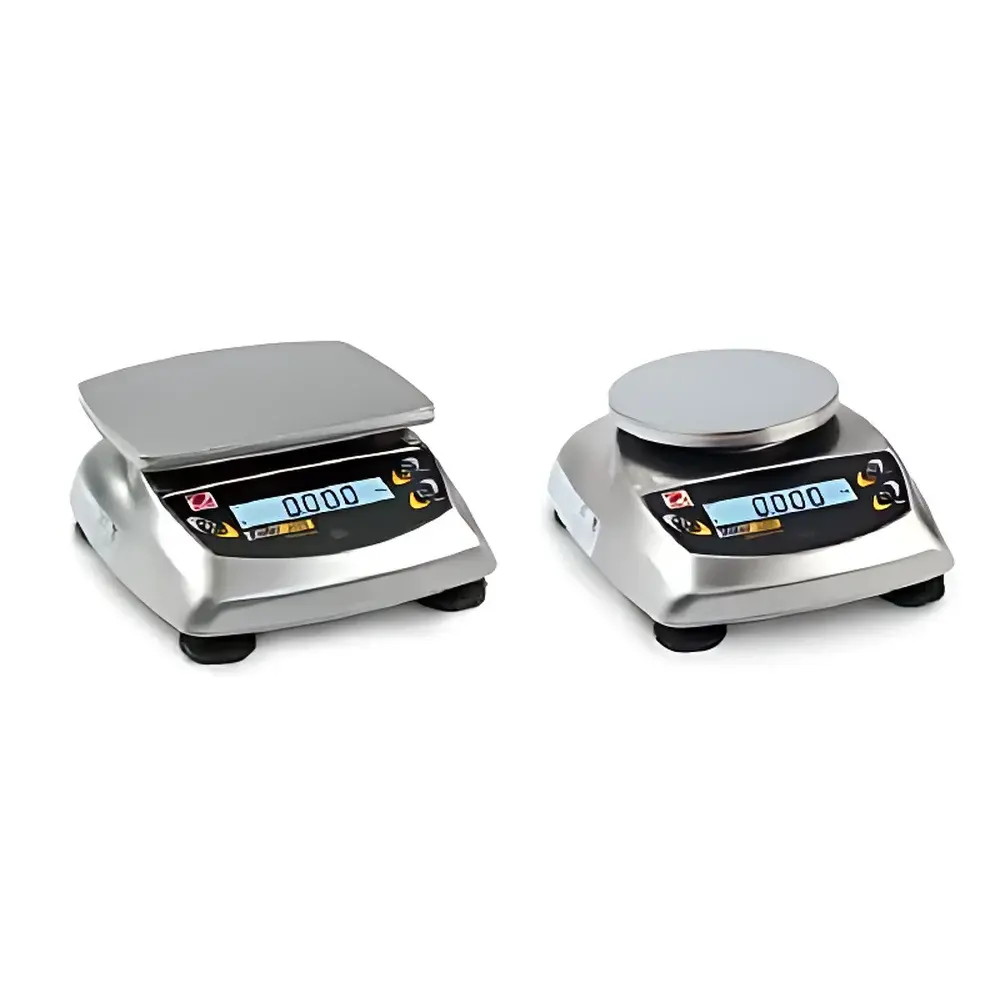
OHAUS Valor 3000 V31XH202CN Industrial Precision Balance
| Brand | OHAUS |
|---|---|
| Origin | USA |
| Model | V31XH202CN |
| Capacity | 200 g |
| Readability | 0.01 g |
| Construction | Stainless Steel Housing & Pan |
| Overload Protection | Up to 10× Rated Capacity |
| Display | Backlit LCD with SmartText™ Interface |
| Compliance | ISO/IEC 17025-compatible operation, NTEP-certified (Class III), meets ASTM E898 and USP <41> general requirements for analytical weighing |
Overview
The OHAUS Valor 3000 V31XH202CN is a high-reliability industrial precision balance engineered for demanding production, quality control, and laboratory environments where consistent accuracy, structural robustness, and operational longevity are non-negotiable. Built upon OHAUS’s proven Valor 3000 platform, this model employs electromagnetic force restoration (EMFR) technology — a closed-loop feedback system that delivers high reproducibility and minimal drift under variable thermal or mechanical stress. With a 200 g capacity and 0.01 g readability, the V31XH202CN bridges the functional gap between analytical and industrial-grade instrumentation, supporting both routine QC checks and regulated process weighing tasks. Its design philosophy centers on environmental resilience: the fully stainless steel housing and corrosion-resistant weighing pan resist degradation from cleaning agents, humidity, and incidental chemical exposure — critical for pharmaceutical manufacturing floors, food processing lines, and metalworking facilities.
Key Features
- 10× overload protection: Reinforced load cell architecture withstands transient loads up to 2,000 g without calibration shift or mechanical damage — essential in fast-paced industrial settings where accidental overloading occurs.
- Adaptive environmental filtering: Programmable digital filters (fast/standard/slow) and stability thresholds allow dynamic optimization of response time and noise rejection across varying air currents, floor vibrations, or temperature gradients.
- SmartText™ user interface: Context-sensitive prompts guide operators through setup, calibration, and application mode selection — reducing training time and minimizing procedural errors in multi-shift operations.
- Backlit monochrome LCD: High-contrast 6-digit display ensures legibility under low-light conditions or when wearing protective eyewear; character height exceeds 12 mm for ergonomic viewing at standard bench height.
- IP54-rated enclosure: Dust-protected and splash-resistant housing enables safe operation near wet processing zones or in environments subject to periodic sanitation protocols.
Sample Compatibility & Compliance
The V31XH202CN accommodates a wide range of sample types — from bulk powders and granular solids to packaged components and viscous semi-solids — via its 120 mm diameter stainless steel pan and optional draft shield compatibility. It supports GLP/GMP-aligned workflows through traceable internal calibration logs, operator ID entry (via optional keypad), and audit-ready event history (power cycles, calibration events, configuration changes). The balance complies with NTEP Class III certification for commercial weighing applications in the U.S., satisfies ASTM E898 for laboratory balance performance testing, and aligns with USP “Weights and Balances” requirements for pharmaceutical dosage uniformity testing. While not inherently 21 CFR Part 11 compliant, its data export functionality (RS232/USB) enables integration into validated LIMS or MES systems with appropriate electronic signature and audit trail layers.
Software & Data Management
Data output is supported via RS232 serial and USB virtual COM port interfaces, enabling direct transmission to Excel, LabWare LIMS, or custom SCADA platforms. Optional OHAUS ACAS software provides real-time data logging, statistical process control (SPC) charting, and customizable report templates (PDF/CSV). All weight records include timestamp, net/gross/tare values, stability flag, and user-defined ID fields. Internal memory retains up to 1,000 weighments with metadata — retrievable via connected PC or exported manually. Firmware updates are performed via USB drive, ensuring long-term maintainability without hardware modification.
Applications
- Pharmaceutical: Raw material receipt inspection, blend uniformity verification, tablet weight checking per USP , and excipient dispensing in non-sterile manufacturing.
- Food & Beverage: Batch formulation verification, dough yield analysis, foam density assessment (via specific gravity mode), and HACCP-mandated ingredient reconciliation.
- Chemicals & Plastics: Catalyst dosing, polymer additive blending, and moisture content estimation using loss-on-drying pre-weighing protocols.
- Electronics Manufacturing: PCB component counting, solder paste volume validation, and ESD-safe component sorting by mass threshold.
- Education & Vocational Training: Hands-on instruction in metrology fundamentals, uncertainty budgeting, and regulatory documentation practices aligned with ISO/IEC 17025 Clause 6.4.
FAQ
What calibration standards are recommended for routine verification?
OHAUS recommends Class M2 or better certified weights traceable to NIST or equivalent national metrology institutes. Daily verification should use a weight equal to 30–50% of full scale; full recalibration is required after relocation, temperature shifts >5°C, or after any physical impact.
Can the balance be used in a humid or washdown environment?
The IP54 rating permits operation in high-humidity areas and occasional splashes, but it is not submersible or suitable for direct high-pressure cleaning. For continuous washdown duty, consider the OHAUS Defender 5000 series with IP65/IP66 enclosures.
Does the specific gravity mode require external reference materials?
No — the built-in specific gravity function uses only the balance’s internal density calculation algorithm and requires only two sequential weighings: first in air, then submerged (with optional density kit). No manual computation or third-party software is needed.
Is internal calibration motorized or manual?
The V31XH202CN features motorized internal calibration driven by a precision internal weight; no external calibrator is required for routine adjustment. Calibration frequency is configurable based on usage intensity and environmental stability.
How is traceability maintained during data export?
Each exported record includes embedded metadata: date/time stamp, instrument serial number, firmware version, operator ID (if entered), and measurement status flags — satisfying baseline ALCOA+ principles for raw data integrity in regulated industries.