
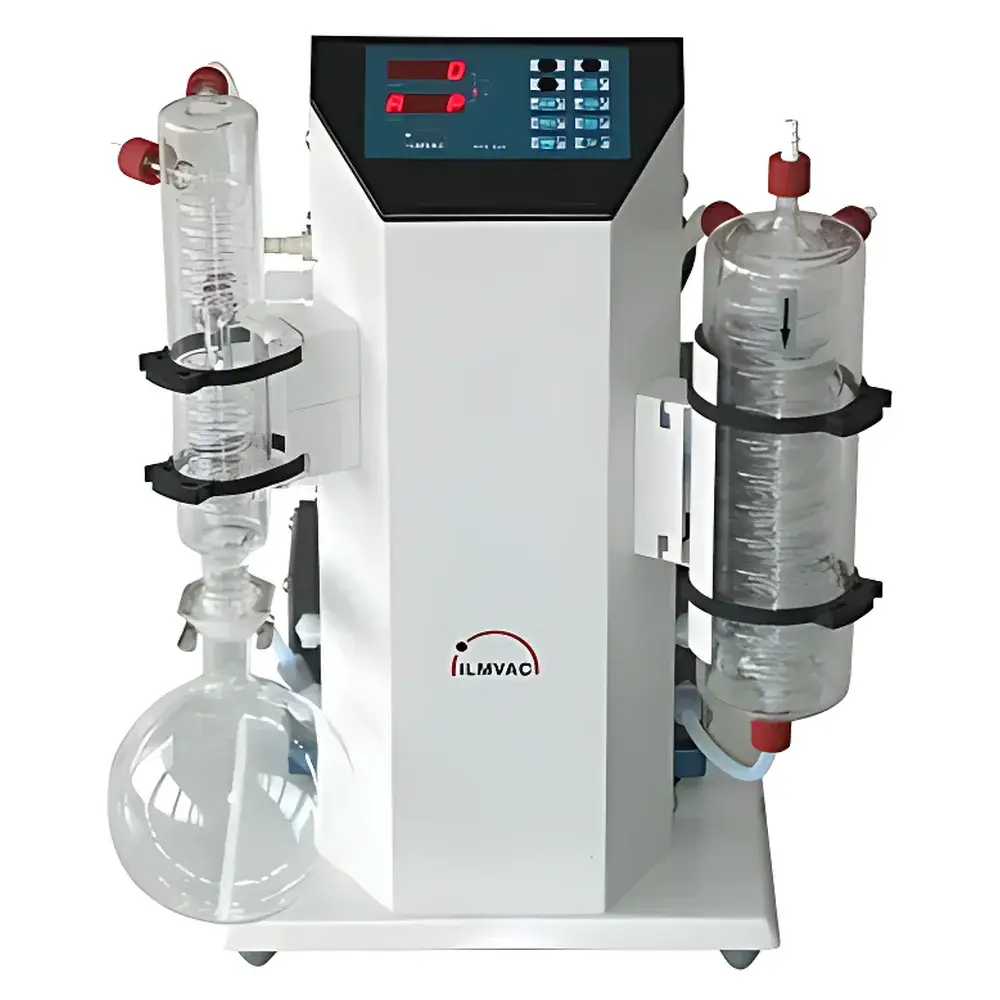
ILMVAC HPB101 Solvent Recovery Diaphragm Pump
| Origin | Germany |
|---|---|
| Manufacturer Type | Authorized Distributor |
| Origin Category | Imported |
| Model | HPB101 |
| Pricing | Available Upon Request |
| Ultimate Pressure | 15 mbar |
| Suction Speed (50/60 Hz) | 2.3 / 2.5 m³/h |
| Dimensions (W/D/H) | 310 × 270 × 490 mm |
| Weight | 18.8 kg |
| Maximum Overpressure | 2 bar (abs) |
| Noise Level | 45 dB(A) |
| Exhaust Port | Clamp-type Ø8 mm, Hose Ø8/6×1 mm |
| Cooling Water Connection | DN 8 hose, ID 8 mm |
| Receiver Bottle Capacity (Pressure Side) | 1000 mL |
| Optional Pressure Sensor Kit | Part No. 112036 |
Overview
The ILMVAC HPB101 is an intelligent, fully automated solvent recovery diaphragm pump engineered for seamless integration with rotary evaporators in analytical, pharmaceutical, and synthetic chemistry laboratories. Unlike conventional vacuum pumps requiring manual pressure setpoints and iterative optimization, the HPB101 employs adaptive boiling-point detection technology—leveraging real-time vapor pressure feedback and thermal dynamics to autonomously identify and maintain optimal distillation conditions across multi-component solvent mixtures. Its core architecture follows a dry, oil-free diaphragm principle, eliminating contamination risks associated with lubricated systems and ensuring compliance with ISO 8573-1 Class 0 air purity requirements for solvent-sensitive applications. Designed and assembled in Germany, the unit meets CE directives (2014/30/EU EMC & 2014/35/EU LVD), and its sealed motor housing conforms to IP54 ingress protection for stable operation in humid or solvent-vapor-rich environments.
Key Features
- Fully autonomous boiling-point recognition: No user-defined pressure or temperature parameters required; system self-calibrates during startup based on condensate formation kinetics and vapor saturation curves.
- Integrated pressure-side solvent receiver (1000 mL standard): Chemically resistant borosilicate glass vessel with integrated level sensor and overfill protection, rated for continuous operation up to 2 bar absolute pressure.
- Low-noise operation (45 dB(A) at 1 m): Achieved via precision-balanced dual-head diaphragm mechanism, vibration-damped mounting, and acoustic enclosure design—suitable for shared lab spaces and GLP-compliant facilities.
- Modular cooling interface: Standard DN 8 quick-connect port for chilled water circulation (recommended 10–15 °C inlet), enabling efficient condensation of high-boiling solvents (e.g., DMSO, NMP, ethylene glycol).
- Overpressure safety architecture: Built-in mechanical pressure relief valve (set at 2 bar abs) and electronic cut-off logic prevent exceedance of receiver bottle pressure rating, satisfying EN 13445-1 requirements for simple pressure vessels.
- Optional digital pressure monitoring: Plug-and-play sensor module (Part No. 112036) delivers 0–2 bar absolute pressure readings with ±0.02 bar repeatability, compatible with external data loggers via 4–20 mA analog output.
Sample Compatibility & Compliance
The HPB101 supports recovery of common organic solvents—including acetone, methanol, dichloromethane, ethyl acetate, toluene, and THF—as well as aqueous-organic mixtures encountered in extraction, purification, and concentration workflows. Its PTFE-coated diaphragms, EPDM seals, and stainless-steel wetted parts (AISI 316L) ensure chemical resistance per ASTM D471 and compatibility with USP Class VI materials. The system complies with GMP Annex 11 principles for automated equipment: all operational states (startup, stabilization, shutdown) are logged with timestamped event records, and optional sensor integration supports 21 CFR Part 11 audit trails when paired with validated laboratory information management systems (LIMS).
Software & Data Management
While the HPB101 operates stand-alone without firmware or touchscreen dependency, its analog pressure sensor interface enables traceable data acquisition. When connected to third-party controllers or SCADA platforms, it provides continuous pressure trend logging, cycle duration metrics, and fault-code diagnostics (e.g., “cooling flow insufficient”, “receiver full”). All firmware-independent operation ensures long-term validation stability—no software updates required for regulatory requalification. Device configuration remains immutable post-installation, aligning with ALCOA+ data integrity principles (Attributable, Legible, Contemporaneous, Original, Accurate, Complete, Consistent, Enduring, Available).
Applications
- High-yield solvent recovery in parallel synthesis platforms (e.g., automated reaction workup following Suzuki or Heck couplings).
- Green chemistry initiatives targeting >95% solvent reuse in API manufacturing per ICH Q5C guidelines.
- Environmental testing labs performing EPA Method 502.2 (halogenated organics) where residual solvent carryover must be minimized.
- Academic teaching labs requiring robust, low-maintenance vacuum sources for undergraduate organic chemistry instruction.
- QC/QA release testing of excipients per Ph. Eur. 2.2.47, where consistent evaporation profiles impact assay accuracy.
FAQ
Does the HPB101 require calibration prior to first use?
No. The system performs automatic self-checks during power-on sequence, including diaphragm travel verification and pressure transducer zeroing. Annual verification against NIST-traceable reference gauges is recommended for GxP environments.
Can it handle corrosive vapors such as HCl or HF?
Not without optional corrosion-resistant upgrade kit (PTFE-lined receiver + Kalrez® seals). Standard configuration is rated for non-oxidizing, non-halogenated organics only.
Is remote monitoring supported out-of-the-box?
No built-in Ethernet or Wi-Fi; however, the 4–20 mA pressure output allows connection to PLCs, LabVIEW, or cloud-based IIoT gateways using standard industrial protocols.
What maintenance intervals are specified?
Diaphragm replacement every 6,000 operating hours or 24 months (whichever occurs first); cooling hose inspection quarterly; receiver bottle cleaning after each batch per SOP-VR-017.
Does it meet explosion-proof requirements for Zone 1 areas?
No. It is rated for general-purpose laboratory use (non-hazardous location). For ATEX/IECEx environments, consult ILMVAC’s certified HPB-Ex series variants.



