
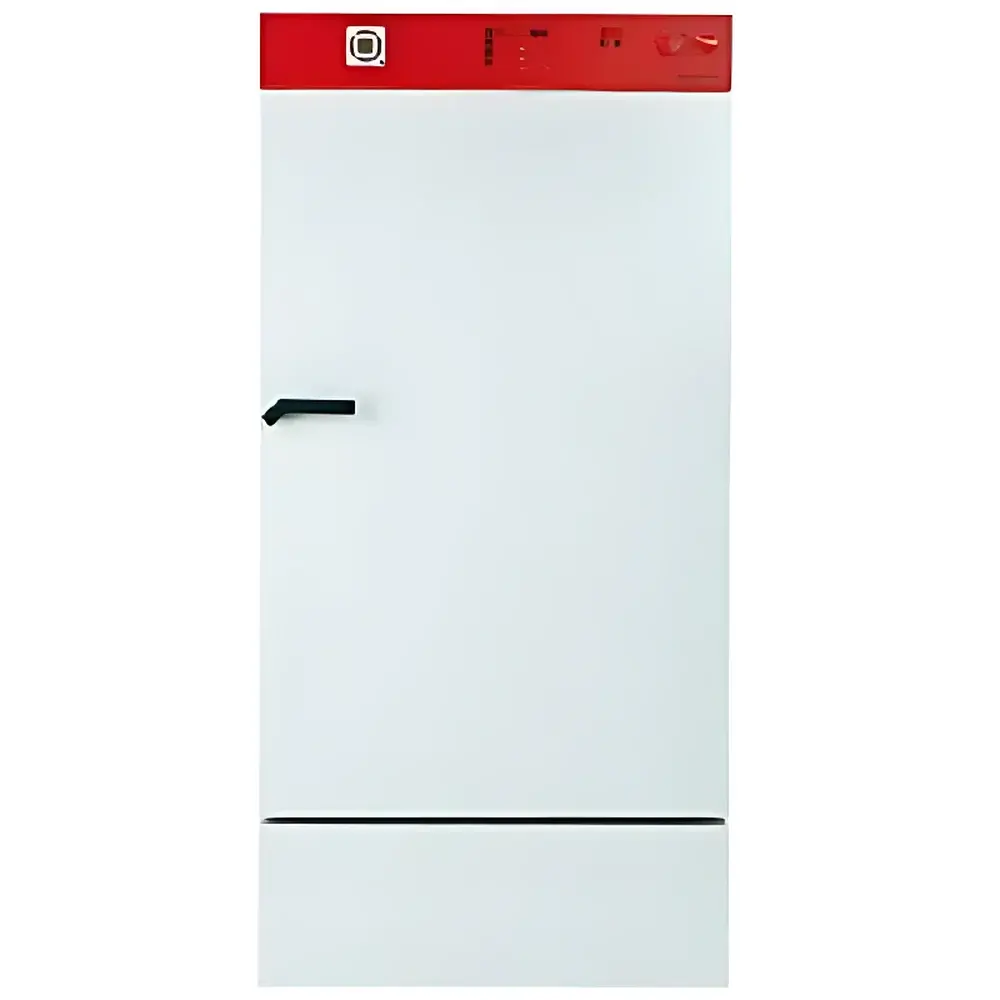
Binder M/MK/MKT/MKF Environmental Test Chambers
| Brand | BINDER |
|---|---|
| Origin | Germany |
| Model Series | M / MK / MKT / MKF |
| Chamber Volumes (L) | M53, M115, M240, M400, M720 |
| Temperature Range | M series: +5 °C to 300 °C (above ambient) |
| MK series | −40 °C to +180 °C |
| MKF series | −40 °C to +180 °C (dry), 10 °C to 95 °C (humid) |
| MKT series | −70 °C to +180 °C |
| Humidity Range (MKF only) | 10–98 % rH |
| Control System | MB1 four-channel touchscreen controller, 25 programmable profiles, up to 100 segments per profile |
| Cooling Technology | DCT® Direct Cooling Technology |
| Preheating Technology | APT-Line® preheating chamber |
| Air Circulation | High-power adjustable-speed air turbine |
| Insulation | High-efficiency multilayer vacuum-insulated walls |
| Interface | RS422 for APT-COM software integration |
| Compliance | Designed and manufactured in accordance with ISO 17025-relevant environmental control requirements, supports GLP/GMP audit trails when paired with validated APT-COM software |
Overview
The BINDER M/MK/MKT/MKF series of environmental test chambers are precision-engineered climate simulation systems designed for demanding physical property testing, material stability assessment, and accelerated aging studies in R&D laboratories, quality control departments, and regulatory-compliant production environments. These chambers operate on a dual-principle architecture: precise thermodynamic control via APT-Line® preheating cavity technology ensures uniform thermal distribution across the entire working volume, while DCT® (Direct Cooling Technology) enables rapid, stable, and repeatable temperature transitions—critical for thermal cycling protocols defined in ASTM E1545, ISO 16750-4, and IEC 60068-2 standards. Unlike conventional forced-air chambers, the M/MK/MKT/MKF series integrates a high-torque, digitally speed-controlled air turbine that delivers laminar, turbulence-free airflow—minimizing thermal gradients and ensuring ≤ ±0.3 °C temperature homogeneity (measured at 100 °C, per DIN EN 60068-3-5). The chamber’s vacuum-insulated stainless-steel construction eliminates thermal bridging, contributing to energy efficiency and long-term calibration stability.
Key Features
- APT-Line® Preheating Chamber Technology: A dedicated outer heating zone maintains consistent wall temperature, eliminating cold spots during ramp-down and ensuring reproducible thermal profiles across repeated cycles.
- DCT® Direct Cooling Technology: Refrigerant circuit bypasses conventional evaporator staging—enabling sub-zero cooling from ambient in under 25 minutes (MKT720 model, −70 °C target) without compressor overload or condensation risk.
- Four-Channel MB1 Touchscreen Controller: Supports up to 25 independent test programs, each with 100 definable segments (ramp/soak/humidity hold), real-time deviation alarms, and password-protected user levels (Operator, Engineer, Administrator).
- High-Efficiency Multilayer Vacuum Insulation: Triple-wall construction with evacuated interstitial layers reduces heat transfer coefficient to < 0.15 W/m²·K—significantly lowering operational energy demand versus standard polyurethane-filled chambers.
- RS422 Serial Interface with APT-COM Software Compatibility: Enables full remote monitoring, data logging (timestamped, CSV-exportable), electronic signature support, and 21 CFR Part 11–compliant audit trail generation when used with validated APT-COM v4.2+.
Sample Compatibility & Compliance
The M/MK/MKT/MKF series accommodates diverse sample geometries—from PCB assemblies and polymer films to pharmaceutical blister packs and automotive gaskets—via standardized interior dimensions and removable shelf supports (stainless steel, load-rated to 25 kg per shelf). All models comply with electromagnetic compatibility (EMC) per EN 61326-1 and safety requirements per EN 61010-1. Humidity-capable MKF variants meet ISO 17025 clause 5.4.2 for environmental condition monitoring traceability when operated with NIST-traceable hygrometers. The system architecture supports IQ/OQ/PQ validation documentation packages aligned with GMP Annex 15 and FDA guidance on computerized system validation.
Software & Data Management
APT-COM software (included) provides centralized management of multi-chamber networks, automated report generation (PDF/Excel), and configurable alarm escalation (email/SNMP). Raw sensor data—including Pt100 temperature readings, capacitive humidity values, and turbine RPM—is logged at user-defined intervals (1 s to 60 min) with microsecond timestamp resolution. Audit trails record all parameter changes, user logins, program starts/stops, and calibration events—retained for ≥ 36 months unless manually purged under administrator authority. Optional APT-COM Connect enables secure cloud-based access via TLS 1.2–encrypted HTTPS, supporting remote troubleshooting and cross-site protocol harmonization.
Applications
- Thermal shock testing of electronic components per MIL-STD-810H Method 503.7
- Long-term stability studies of active pharmaceutical ingredients (APIs) under ICH Q1A(R3) conditions
- Accelerated corrosion testing of coated metals using cyclic humidity/temperature profiles (ASTM D2247)
- Material glass transition (Tg) mapping via controlled-rate DSC correlation studies
- Validation of packaging integrity under extreme climatic conditions (ISTA 3A, ISTA 7E)
- Automotive component qualification per VW 80101 and GMW14872 thermal cycling specifications
FAQ
What is the difference between the MK and MKT series?
The MKT series extends low-temperature capability to −70 °C using a cascade refrigeration system, whereas the MK series operates down to −40 °C with a single-stage compressor. Both share identical controller architecture, insulation design, and humidity compatibility (MKT models do not support humidification).
Can the MKF series maintain humidity at sub-zero temperatures?
No. Humidity control (10–98 % rH) is only available within the 10 °C to 95 °C operating range. Below 10 °C, the MKF functions as a dry thermal chamber with the same −40 °C to +180 °C temperature envelope.
Is APT-COM software validated for 21 CFR Part 11 compliance?
Yes—when deployed with electronic signatures, audit trail retention, and role-based access controls enabled, APT-COM v4.2+ meets all technical requirements for Part 11 compliance. Full validation documentation (URS, FRS, IQ/OQ protocols) is available upon request.
How is temperature uniformity verified during factory calibration?
Each chamber undergoes 9-point uniformity mapping (per DIN EN 60068-3-5) at three setpoints (−40 °C, 23 °C, +150 °C) using calibrated Pt100 sensors traceable to DKD/DAkkS standards. A certificate of calibration is supplied with shipment.



