
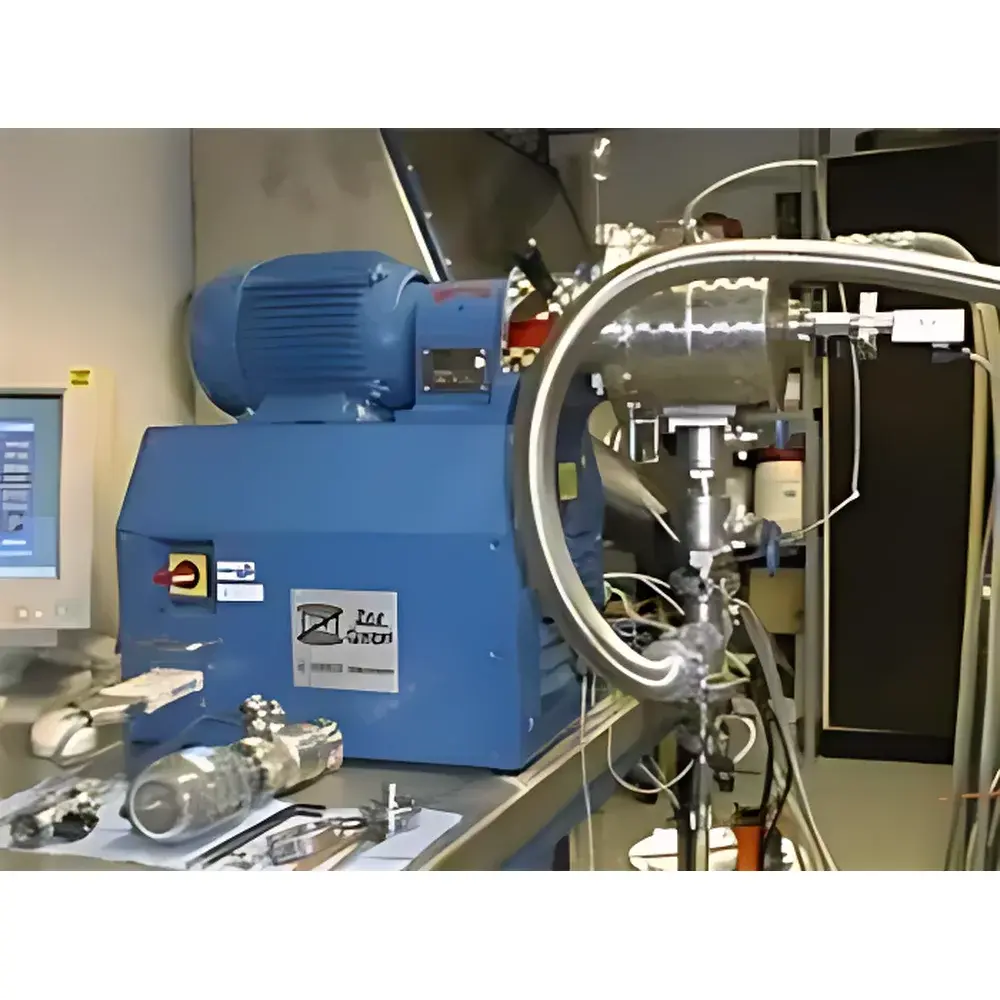
Zoz Simoloyer® Series High-Energy Ball Mill
| Brand | Zoz |
|---|---|
| Origin | Germany |
| Model | Simoloyer® |
| Instrument Type | High-Energy Ball Mill |
| Sample Applicability | Hard & Brittle Materials |
| Final Particle Size | < 0.01 mm |
| Feed Particle Size | Model-Dependent |
| Batch Processing Capacity | Model-Dependent |
| Grinding Principle | Impact-Dominated Mechanical Alloying |
| Operation Environment | Inert Gas (Ar, H₂), Air, or Vacuum |
| Cooling Capability | Integrated Optional Cooling |
| Scalability | Lab-Scale to Pilot/Industrial Scale |
| Compliance Framework | Designed for GLP/GMP-Aligned R&D Environments |
Overview
The Zoz Simoloyer® Series High-Energy Ball Mill is an engineered solution for mechanical alloying, reactive milling, and nanostructure synthesis under precisely controlled atmospheres. Unlike conventional planetary or attritor mills relying primarily on shear and friction, the Simoloyer® employs a high-velocity impact principle—achieved through optimized rotor-stator geometry and rotational speeds exceeding 1,500 rpm—enabling rapid energy transfer directly to the powder bed. This design facilitates true kinetic control over solid-state reactions, crystallite refinement, and amorphization processes. Its fully sealed, pressure-rated grinding chamber allows uninterrupted operation in argon, hydrogen, nitrogen, air, or high vacuum (<10⁻² mbar), eliminating the need for post-milling glovebox transfer—a critical advantage for oxygen- and moisture-sensitive systems such as Mg-based hydrides, Al–Ti–C nanocomposites, or Fe–Cr–Y₂O₃ oxide dispersion strengthened (ODS) alloys.
Key Features
- Impact-dominated grinding mechanism delivering up to 1,000× faster kinetics versus planetary ball mills in selected mechanochemical syntheses
- Modular, interchangeable grinding units (e.g., disc-type, ring-type, and dual-chamber configurations) tailored to material reactivity and thermal management requirements
- Integrated environmental control: real-time gas flow regulation, pressure monitoring, and optional cryogenic jacketing for exothermic reaction suppression
- Full system sealing certified to ISO 10648-2 (leak rate ≤1×10⁻⁶ mbar·L/s), enabling reproducible processing of pyrophoric or air-sensitive powders
- Automated batch cycling with programmable sequence logic—including inert gas purging, milling, cooling, and discharge—reducing operator intervention and cross-contamination risk
- Direct coupling with Zoz’s Maltoz® process data acquisition system for timestamped torque, temperature, pressure, and rotational speed logging compliant with ALCOA+ principles
Sample Compatibility & Compliance
The Simoloyer® accommodates hard, brittle, and ductile feedstocks—including elemental metals (Ti, Mg, Al), intermetallics, ceramics (SiC, Al₂O₃), and polymer-coated precursors—without pre-crushing. Final particle size distribution typically achieves D₉₀ < 10 µm (≤0.01 mm), with crystallite sizes down to 5–15 nm confirmed by XRD line-broadening analysis. All wet- and dry-milling variants conform to ASTM E2904-21 (Standard Guide for Mechanical Alloying) and support ISO/IEC 17025-compliant method validation. The system architecture supports 21 CFR Part 11 audit trails when paired with validated Maltoz® software, meeting documentation requirements for GMP-aligned battery cathode development or ODS fuel cladding qualification.
Software & Data Management
Maltoz® v5.3 provides deterministic control over all operational parameters—including ramp profiles, dwell times, atmosphere composition, and emergency shutdown triggers. Raw sensor data (torque, chamber temperature, bearing vibration, gas partial pressures) are stored in vendor-agnostic HDF5 format with embedded metadata (ISO/IEC 11179-compliant). Export modules generate CSV reports compatible with JMP, Python (pandas), or MATLAB for statistical process control (SPC) and DoE modeling. Audit logs record user actions, parameter changes, and calibration events with digital signatures—fully traceable for internal QA reviews or regulatory inspections.
Applications
- Mechanical alloying of ODS steels (e.g., Fe–14Cr–0.3Y₂O₃) with minimized Y₂O₃ agglomeration and uniform oxide dispersion
- Synthesis of complex hydrides (e.g., Mg₂FeH₆, NaAlH₄–TiCl₃) under dynamic H₂ pressure (up to 50 bar)
- Production of flake-shaped conductive powders (e.g., Zn–Ni, Cu–Ag) for anti-corrosion coatings (ZN-CP301 grade)
- Top-down fabrication of nanocrystalline Ni–W, Co–P, or Fe–B magnetic powders with coercivity tunability via milling time
- Reactive milling of Al–SiC, Cu–graphene, or Ti–HA composites without interfacial oxidation or carbon segregation
- Scale-up pathway from 50 g lab batches (Simoloyer® CM01) to 5 kg pilot runs (CM10) using identical process maps
FAQ
Can the Simoloyer® operate under hydrogen pressure for hydride synthesis?
Yes—certified variants support continuous H₂ circulation at pressures up to 50 bar with integrated leak detection and automatic purge-to-safe protocols.
Is cross-contamination between batches preventable?
The fully drainable grinding chamber and CIP-compatible internal surfaces enable >99.9% powder recovery; residual mass per cycle is routinely verified gravimetrically per ASTM E2904 Annex A3.
How does it compare to planetary ball mills in terms of contamination?
Wear debris from Simoloyer®’s hardened steel or WC–Co liners is reduced by ≥70% versus planetary systems due to absence of jar-wall impacts and lower cumulative shear exposure.
Does Zoz provide method development support?
Yes—application engineers supply DOE templates, kinetic modeling tools, and comparative milling efficiency benchmarks (kWh/kg vs. d₅₀ reduction) for technology transfer.
Are spare parts and service covered under international warranty?
All Simoloyer® systems include 24-month comprehensive warranty with remote diagnostics; on-site service is available in EU, US, Japan, and China via authorized technical partners.



