
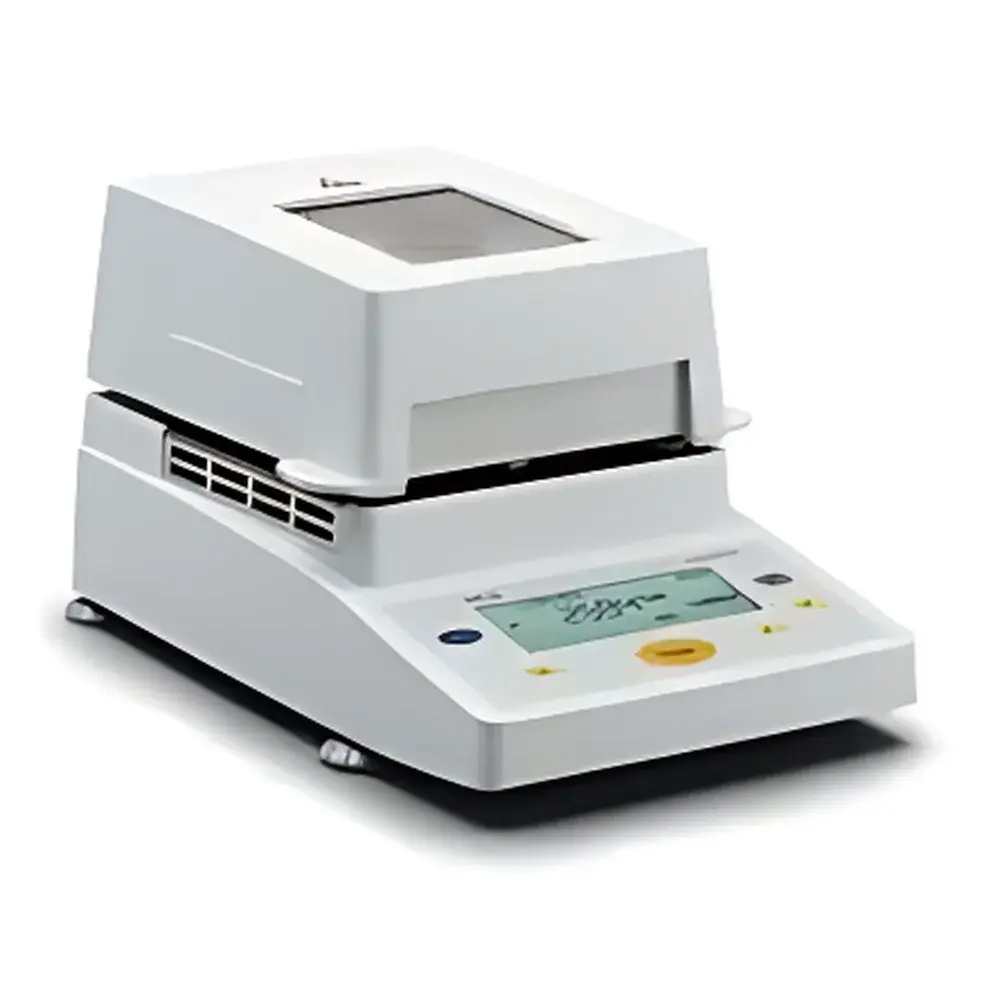
Sartorius MA35/MA150/MA100 Infrared Moisture Analyzer
| Brand | Sartorius |
|---|---|
| Origin | France |
| Model Series | MA Series |
| Maximum Capacity | 35 g / 150 g / 100 g |
| Readability | 1 mg / 1 mg / 0.1 mg |
| Repeatability | ±0.05 % / ±0.05 % / ±0.02 % |
| Heating Range | 40–160 °C / 30–230 °C / 40–220 °C |
| Heating Technology | Infrared dark-field heating tubes / Ceramic IR or quartz CQR heaters / Ceramic IR, quartz CQR, or halogen lamp |
| Display Modes | % moisture, % dry weight, % ratio, final mass (g), evaporation mass (mg), calculated value |
| Data Storage | On-device retention until next measurement / Statistical storage for up to 9999 results |
| Compliance | FDA/HACCP-compliant configuration available (glass-free variant), GLP/GMP-ready output |
Overview
The Sartorius MA35, MA150, and MA100 Infrared Moisture Analyzers are precision thermal gravimetric instruments engineered for rapid, reliable determination of moisture content in solid and semi-solid samples across pharmaceutical, food, chemical, and materials science laboratories. These analyzers operate on the principle of loss-on-drying (LOD): a precisely weighed sample is heated under controlled conditions while mass loss is continuously monitored via high-resolution electromagnetic force compensation weighing technology. The integrated infrared heating system—configured as dark-field metal tube emitters (MA35), ceramic IR or quartz CQR elements (MA150), or halogen lamp plus IR options (MA100)—ensures uniform thermal energy distribution with minimal surface overheating, enabling reproducible drying kinetics without charring or decomposition artifacts. Each model conforms to ASTM E1447, ISO 1887, and USP <921> guidelines for moisture analysis, supporting method validation and regulatory documentation requirements.
Key Features
- Three scalable platform variants: MA35 (35 g capacity, 1 mg readability), MA150 (150 g, 1 mg), and MA100 (100 g, 0.1 mg) — optimized for diverse sample volumes and precision needs.
- Programmable heating profiles with ±1 °C temperature control accuracy across wide operational ranges (30–230 °C depending on model), enabling method-specific optimization for thermally sensitive or refractory matrices.
- Intuitive icon-driven user interface with three-step guided workflow (tare → load → start), eliminating unnecessary menu navigation while preserving full method flexibility.
- FDA/HACCP-compliant hardware configuration available: aluminum front panel replaces glass components, minimizing breakage risk and easing cleaning in hygienic production environments.
- GLP/GMP-ready data handling: built-in audit trail support, timestamped results, and optional integrated thermal printer for traceable hardcopy output compliant with 21 CFR Part 11 requirements when paired with validated software protocols.
Sample Compatibility & Compliance
The MA series accommodates powders, granules, pellets, pastes, films, and filter cakes—provided they do not volatilize non-aqueous components below the selected drying temperature. Sample pans are compatible with standard aluminum or stainless-steel trays (diameter: 90 mm); optional ceramic-coated or PTFE-lined pans minimize adhesion for sticky or reactive materials. All models meet IEC 61010-1 safety standards for laboratory equipment. The glass-free MA variant satisfies FDA 21 CFR 113 and HACCP Principle 3 criteria for critical control point instrumentation. Calibration verification follows Sartorius’ certified internal reference mass protocol, traceable to NIST standards.
Software & Data Management
Each analyzer stores measurement metadata—including date/time stamp, operator ID (if enabled), method name, target temperature, drying time, final mass, and calculated moisture percentage—in non-volatile memory. The MA100 supports statistical evaluation of up to 9999 stored results, including mean, standard deviation, min/max, and trend visualization via optional PC connectivity (RS232/USB). When integrated into LIMS or ELN ecosystems using Sartorius LabX™ software (sold separately), full electronic signature capability, role-based access control, and automated report generation become available—fulfilling ALCOA+ data integrity principles and facilitating FDA or EMA inspection readiness.
Applications
- Pharmaceutical QC: moisture testing of active pharmaceutical ingredients (APIs), excipients, and finished dosage forms per USP <921> and Ph. Eur. 2.2.32.
- Food industry: routine monitoring of flour, dairy powders, coffee beans, pet food, and snack products to ensure shelf-life stability and compliance with Codex Alimentarius moisture limits.
- Chemical manufacturing: verification of drying endpoints for catalysts, pigments, and polymer resins prior to packaging or downstream processing.
- Academic research: kinetic studies of dehydration mechanisms, comparative evaluation of drying efficiency across heating technologies, and method development for novel biomaterials.
FAQ
What distinguishes the MA35, MA150, and MA100 models beyond capacity and readability?
The MA35 uses dual infrared dark-field heating tubes for rapid, low-inertia thermal response ideal for small-volume, high-value samples. The MA150 integrates ceramic IR or quartz CQR heating for broader temperature range and improved thermal stability in larger chambers. The MA100 combines halogen lamp and IR sources for fastest ramp rates and highest resolution—suited for R&D labs requiring fine-grained process optimization.
Can the MA series perform method validation per ICH Q2(R2)?
Yes—when operated with documented SOPs, calibrated reference standards, and verified environmental controls, the MA series supports specificity, accuracy, precision, linearity, range, and robustness assessments required by ICH Q2(R2). Full validation kits and IQ/OQ/PQ documentation templates are available from Sartorius Service.
Is external software required for GLP-compliant reporting?
Basic GLP features (time-stamped results, operator ID, method recall) are embedded. For full 21 CFR Part 11 compliance—including electronic signatures, audit trails, and secure user management—LabX software integration is recommended and validated.
How often must the instrument be recalibrated?
Daily performance verification using certified test weights is recommended. Full calibration by an accredited service technician is advised annually—or after mechanical shock, ambient temperature shifts >5 °C, or observed drift exceeding ±0.02 % moisture in replicate checks.
Are replacement heating modules field-serviceable?
Yes—ceramic IR, quartz CQR, and halogen lamp assemblies are modular and replaceable without specialized tools. Sartorius-certified field service technicians can perform hot-swap upgrades between heating technologies on MA150 and MA100 platforms.
Related Products





