
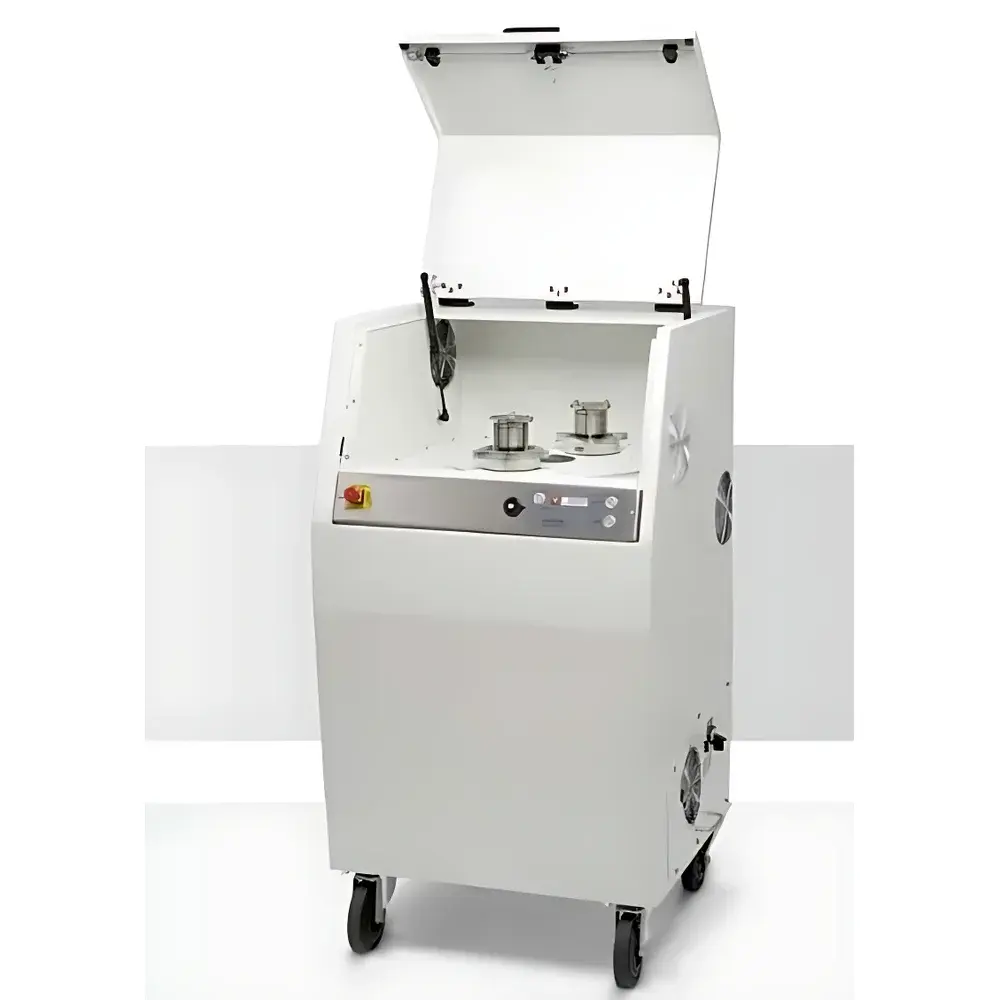
Fritsch Pulverisette 4 Variable-Speed Ratio Planetary High-Energy Ball Mill
| Brand | Fritsch |
|---|---|
| Origin | Germany |
| Model | Pulverisette 4 |
| Final Particle Size | < 1 µm |
| Max. Sample Volume | 450 mL |
| Max. Feed Size | 10 mm |
| Main Drive Speed Range | 0–400 rpm |
| Grinding Mode | Dry & Wet |
| Input Power | 9,000 W |
| Voltage/Frequency | 400 V / 3-phase, 50–60 Hz |
| Dimensions (W×D×H) | 60 × 80 × 110 cm |
| Net Weight | 320 kg |
| Gross Weight | 380 kg |
Overview
The Fritsch Pulverisette 4 is a precision-engineered planetary high-energy ball mill designed for advanced materials research requiring controlled mechanical activation, mechanochemical synthesis, and solid-state alloying. Unlike conventional planetary mills with fixed gear ratios, the Pulverisette 4 implements an independently adjustable speed ratio between the sun disk (support plate) and grinding bowls—enabling precise modulation of kinetic energy transfer mechanisms: impact, shear, and centrifugal forces. This variable-speed ratio architecture allows users to replicate the operational signatures of diverse milling systems—including shaker mills, vibratory mills, and standard planetary mills—within a single instrument. The device operates on the principle of superimposed rotational motion: while the sun disk rotates at a defined speed, each grinding bowl rotates in the opposite direction at a separately controllable rate, generating tunable relative velocities and collision energies. This capability is essential for reproducible mechanochemical reactions, amorphization of crystalline phases, and nanostructure engineering under strictly defined energy input conditions.
Key Features
- Independent speed control of both the sun disk and grinding bowls (0–400 rpm each), enabling continuous adjustment of the speed ratio from 1:1 (pure centrifugation) to 4:1 (maximum impact energy)
- Programmable grinding protocols via Windows-based software with real-time monitoring and parameter logging via RS232 interface
- Dual grinding station configuration supporting either two large-volume bowls (up to 225 mL each) or four small-volume bowls (up to 80 mL each), with rapid-lock safety clamping mechanism compliant with DIN EN 61000-6-4
- Reversible rotation mode to minimize thermal gradients and improve homogeneity in temperature-sensitive or cohesive samples
- Modular bowl and grinding media selection: nine chemically inert and wear-resistant materials available (e.g., hardened steel, stainless steel, tungsten carbide, agate, zirconium oxide, silicon nitride), selected based on sample reactivity and contamination requirements
- Integrated digital display showing real-time rotational speeds of both drive axes, elapsed time, and active program status
- Robust cast-iron frame with vibration-damped mounting and IP20-rated electrical enclosure for stable long-term operation under high-power load (9 kW)
Sample Compatibility & Compliance
The Pulverisette 4 accommodates a broad spectrum of material classes without preprocessing: hard and brittle materials (e.g., ceramics, oxides), medium-hard metals and alloys, soft polymers, fibrous plant tissues, moist or hygroscopic powders, and composite feedstocks. Its dual-mode grinding (dry and wet) supports solvent-assisted mechanochemistry per ISO 13320:2020 guidelines for particle size analysis preparation. All mechanical and electrical subsystems conform to CE marking requirements (2014/30/EU EMC Directive, 2014/35/EU LVD Directive) and meet IEC 61000-4-3 immunity standards. For regulated environments, audit-trail-capable software configurations support 21 CFR Part 11-compliant electronic records when paired with validated third-party data acquisition platforms.
Software & Data Management
The included Fritsch MillSoft™ application provides full remote control and protocol automation. Users define multi-step sequences—including ramp-up profiles, dwell periods, speed transitions, directional reversals, and endpoint triggers—stored as encrypted .fms files. Real-time telemetry (speed deviation ±0.5 rpm, thermal drift < 1.2 K/min) is logged at user-selectable intervals and exportable in CSV or ASCII format for integration into LIMS or ELN systems. Optional API extensions enable interoperability with LabVIEW and Python-based process control frameworks. All software modules undergo annual functional verification per ISO/IEC 17025:2017 clause 5.9.2 for measurement traceability assurance.
Applications
- Mechanical alloying of immiscible metal systems (e.g., Al–Fe, Cu–Ti) and intermetallic compound synthesis
- Top-down nanomaterial production: crystallite size reduction to sub-1 µm with narrow PSD (verified by laser diffraction per ISO 13320)
- Activation of catalyst precursors (e.g., NiO, Co₃O₄) prior to thermal treatment
- Amorphization of pharmaceutical APIs to enhance dissolution kinetics (aligned with USP & Ph. Eur. grinding validation protocols)
- Preparation of homogeneous powder blends for additive manufacturing feedstock qualification
- Grinding of geological samples (rocks, ores) for XRF and ICP-MS analysis without elemental fractionation
FAQ
What distinguishes the Pulverisette 4 from conventional planetary mills?
It uniquely decouples the rotational speeds of the sun disk and grinding bowls—enabling independent control over impact energy, shear stress, and centrifugal force distribution, which is unattainable in fixed-ratio systems.
Can the instrument be integrated into automated lab workflows?
Yes—via RS232 or optional Ethernet module, it supports SCPI command sets and can be orchestrated through central laboratory automation controllers compliant with ASTM E1578-19.
Is wet grinding supported, and what sealing options exist?
Wet grinding is fully supported using vacuum-sealed or gas-tight bowls (e.g., stainless steel with Viton® O-rings), suitable for inert-atmosphere or solvent-based mechanochemical synthesis.
How is method reproducibility ensured across different operators?
All grinding parameters—including speed ratio, duration, reversal timing, and acceleration profiles—are stored as encrypted digital methods with operator ID and timestamp metadata, satisfying GLP documentation requirements.
What maintenance intervals are recommended for sustained performance?
Lubrication of the planetary gearbox every 1,000 operating hours and annual calibration of speed sensors against NIST-traceable tachometer standards are advised per Fritsch Service Bulletin SB-P4-2023.
Related Products



