
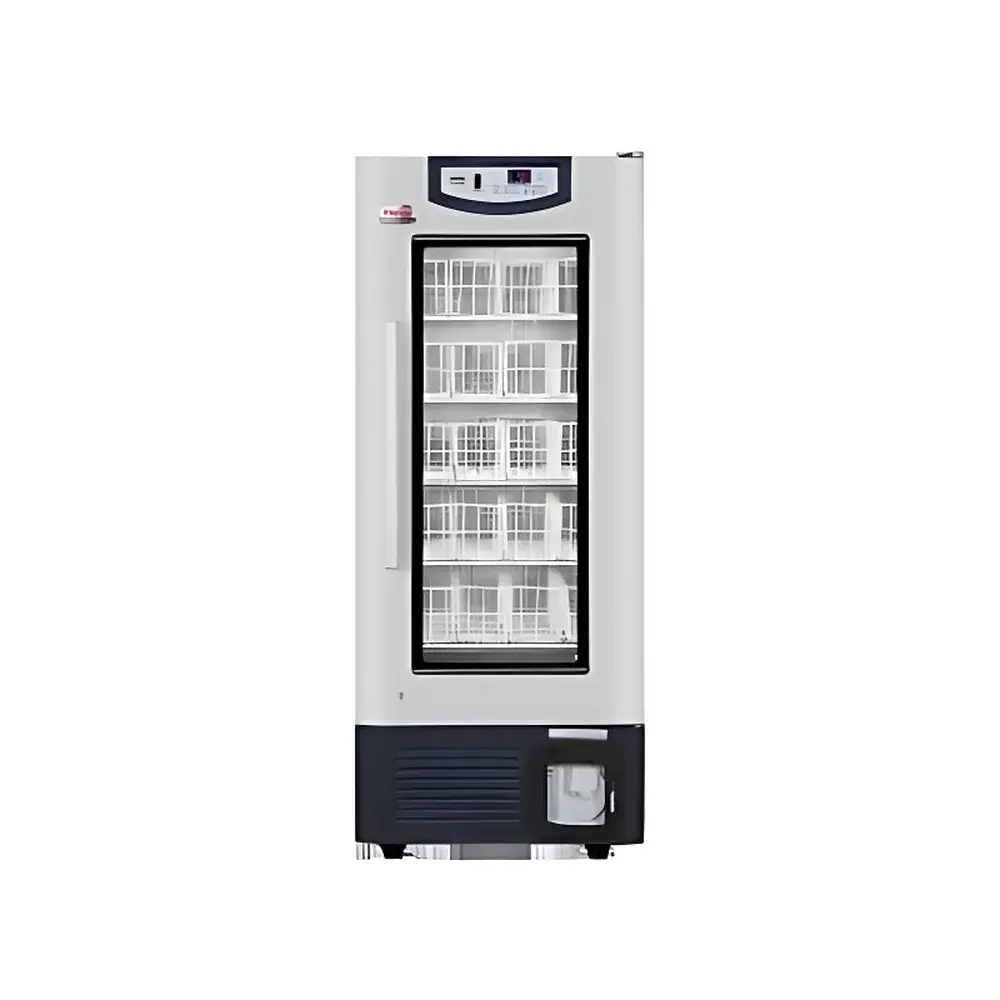
English Product Name
| Origin | Shandong, China |
|---|---|
| Manufacturer Type | Authorized Distributor |
| Country of Origin | China |
| Model | HXC-358 |
| Quotation | Upon Request |
| Climate Class | ST |
| Cooling Method | Forced-air (Fan-cooled) |
| Defrosting | Automatic |
| Refrigerant | CFC-free & HCFC-free eco-friendly refrigerant |
| Noise Level | 44 dB(A) |
| Power Consumption | 480 W |
| Input Voltage/Frequency | 220 V / 50 Hz |
| Temperature Range | 4 ± 2 °C |
| Internal Dimensions (W×D×H) | 620 × 470 × 1200 mm |
| External Dimensions (W×D×H) | 720 × 690 × 1730 mm |
| Net Capacity | 358 L |
| Weight | 103 kg |
| Compressor | Hermetic, 220 W, Brand-name International |
| Temperature Control | Microprocessor-based digital controller with 0.1 °C resolution |
| Display | LED digital |
| Interior Material | Stainless steel (AISI 304) |
| Exterior Material | Pre-painted steel sheet |
| Insulation | Non-CFC polyurethane foam |
| Door | Tempered glass with anti-condensation heating film (condensation-free at 32 °C / 80% RH) |
| Shelving | Adjustable powder-coated wire shelves (50 kg load capacity per shelf) |
| Blood Storage Capacity | Up to 200 × 400 mL blood bags |
| Data Logger | Built-in USB-enabled temperature recorder |
| Certifications | CE-marked, Registered Medical Device (China NMPA) |
Overview
The HXC-358 Blood Refrigerator is a purpose-engineered, upright medical-grade cold storage system designed exclusively for the safe, stable, and compliant preservation of whole blood, packed red blood cells (RBCs), platelet concentrates, and other temperature-sensitive biological specimens at +4 °C. Operating within the tightly controlled range of 4 ± 2 °C—strictly aligned with AABB, CLSI, and WHO guidelines for blood component storage—the unit employs forced-air circulation and high-efficiency hermetic compression cooling to ensure uniform temperature distribution (< ±0.5 °C spatial deviation across the chamber) and rapid thermal recovery after door openings. Its architecture integrates fail-safe redundancy in critical subsystems, including dual thermal sensors (primary and backup), real-time voltage monitoring, and battery-backed memory for alarm event logging. The cabinet meets ISO 13485 design control requirements for medical devices and is registered under China’s NMPA as a Class II medical device for in vitro diagnostic specimen storage.
Key Features
- Five-tiered intelligent alarm system: High/low temperature, power failure, door-open, sensor fault, and low backup battery alerts.
- Triple alert modalities: Audible buzzer (85 dB), visual LED indicators, and dry-contact remote alarm output (NO/NC configurable) compatible with BMS or hospital-wide alarm networks.
- Anti-condensation heated glass door: Electrically heated double-glazed door prevents surface fogging under ambient conditions up to 32 °C and 80% relative humidity—ensuring uninterrupted visual inventory access without compromising thermal integrity.
- Adjustable shelving system: Powder-coated wire shelves (50 kg static load rating) with vertical slotting allow infinite height positioning; optimized for modular blood bag organization using standardized stainless-steel or polymer blood storage baskets.
- Eco-compliant refrigeration: Uses non-ozone-depleting, low-GWP refrigerant with high COP (Coefficient of Performance); validated through 1,000-hour “Dual 85” reliability testing (85 °C / 85% RH accelerated stress).
- Integrated data logger: Onboard USB-accessible temperature recorder stores ≥30 days of 10-minute interval data with time-stamped events (door opens, alarms, setpoint changes)—supporting GLP/GMP audit readiness.
Sample Compatibility & Compliance
The HXC-358 accommodates standard clinical blood containers—including 200–400 mL CPDA-1 or EDTA anticoagulant bags, leukoreduced units, and cryoprecipitate vials—without thermal stratification risk. Its stainless-steel interior resists corrosion from saline or anticoagulant residue and complies with ISO 15189 pre-analytical requirements for specimen integrity. The unit satisfies EN 61000-6-3 (EMC), EN 61000-6-1 (immunity), and IEC 60601-1 (medical electrical equipment safety). CE marking confirms conformity with EU MDR 2017/745 Annex I essential requirements. All firmware and alarm logic are traceable to version-controlled release documentation, enabling full regulatory traceability for FDA 21 CFR Part 11–aligned environments when paired with validated third-party data management software.
Software & Data Management
While the HXC-358 operates via an embedded microcontroller without cloud connectivity, its built-in temperature logger exports CSV-formatted datasets via USB 2.0 interface. Logged parameters include chamber temperature (dual-sensor average), ambient temperature, door open duration, alarm timestamps, and compressor runtime. Data files support import into LIMS platforms (e.g., LabWare, STARLIMS) or Excel-based trending analysis. Audit trails retain all user-initiated actions—including setpoint modifications and alarm acknowledgments—with no editable timestamps. For facilities requiring electronic signature capability or automated report generation, integration with external validation-ready software (e.g., ValGenesis, TrackWise) is supported through documented API protocols and IQ/OQ documentation packages available upon request.
Applications
This refrigerator serves as a primary storage solution in blood banks, transfusion medicine departments, hospital core labs, and clinical research centers conducting hematological studies. It supports routine storage of RBCs (shelf life up to 42 days per AABB standards), fresh frozen plasma (FFP) prior to freezing, and platelet concentrates during short-term holding (≤4 hours at 20–24 °C is required prior to storage; the HXC-358 is not intended for platelet refrigeration). Its stability profile also enables use in biobanking for short-term holding of serum, plasma, and CSF samples awaiting downstream processing. The cabinet’s ST-class climate rating ensures consistent performance in uncontrolled laboratory corridors or satellite collection sites where ambient temperatures fluctuate between 16–32 °C.
FAQ
What is the recommended calibration frequency for the HXC-358’s temperature sensors?
Per CLSI GP35-A4 guidance, annual verification against NIST-traceable reference thermometers is advised; internal dual-sensor cross-checking occurs continuously every 30 seconds.
Can the unit be validated for GxP environments?
Yes—full IQ/OQ documentation kits, including protocol templates, test scripts, and acceptance criteria aligned with ASTM E2500 and ISPE Baseline Guide Vol. 5, are available for qualified users.
Is remote monitoring via Ethernet or Wi-Fi supported?
No native network interface is included; however, the dry-contact alarm output and USB data export enable integration with third-party building management systems (BMS) or IoT gateways.
Does the cabinet meet USP or environmental requirements for compounding areas?
While not classified as a cleanroom device, its sealed stainless interior, low particulate emission (<1000 particles/m³ ≥0.5 µm), and HEPA-filtered air intake (optional accessory) support ancillary use in ISO Class 7–8 buffer zones.
What is the warranty coverage and service response time?
Standard 24-month parts-and-labor warranty applies; certified field service engineers provide on-site response within 72 business hours for critical alarms in Tier-1 metropolitan regions.





