
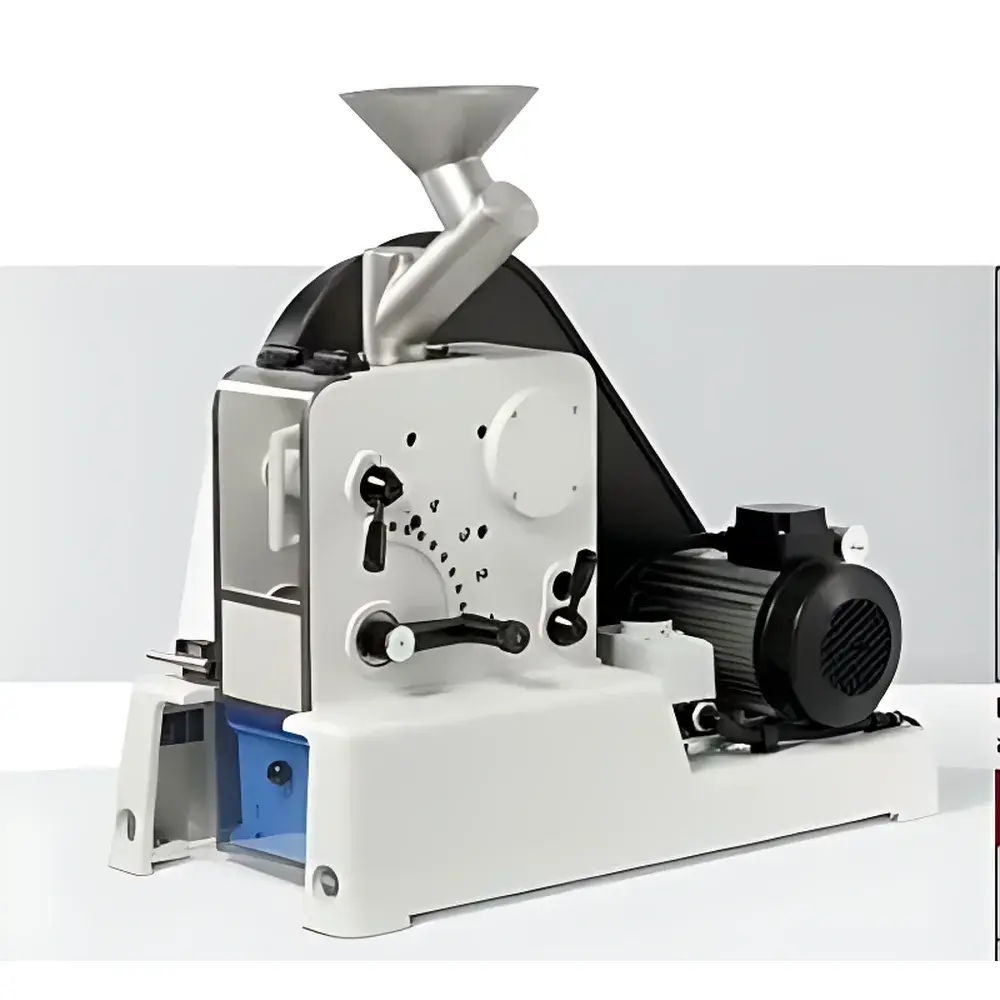
FRITSCH Pulverisette 1 Classic Jaw Crusher, Type I
| Brand | FRITSCH |
|---|---|
| Origin | Germany |
| Model | Pulverisette 1 Type I |
| Final Particle Size | 1–15 mm |
| Max. Feed Size | 60 mm |
| Throughput Capacity | up to 140 kg/h |
| Motor Speed | 1500 rpm |
| Vibration Frequency | 308 min⁻¹ |
| Input Power | 1450 W |
| Voltage/Frequency | 400 V / 3~ / 50–60 Hz |
| Net Weight | 177 kg |
| Gross Weight | 217 kg |
| Dimensions (W×D×H) | 40 × 80 × 80 cm |
| Grinding Chamber Material Options | Manganese Steel, Tungsten Carbide, Zirconium Oxide |
| Dust Extraction Interface | Integrated |
| Compliance | CE-marked |
| Warranty | 12 months |
Overview
The FRITSCH Pulverisette 1 Classic Jaw Crusher, Type I is a precision-engineered laboratory-scale primary crusher designed for reliable, reproducible pre-crushing of heterogeneous solid samples across a broad hardness and brittleness spectrum. Operating on the principle of compressive force generation between two opposing jaw plates — one fixed and one oscillating — the device subjects feed material to controlled mechanical stress within a fully enclosed crushing chamber. This classical jaw crushing mechanism enables consistent size reduction without thermal degradation or excessive fines generation, making it especially suitable for preparatory sample conditioning prior to downstream analytical steps such as X-ray fluorescence (XRF), X-ray diffraction (XRD), or chemical assay. Its robust cast-iron frame, high-torque induction motor, and precisely aligned jaw geometry ensure stable operation under intermittent or semi-continuous duty cycles typical in geological, metallurgical, and industrial quality control laboratories.
Key Features
- Enclosed grinding chamber with integrated dust extraction port compliant with ISO 13849-1 safety standards, minimizing operator exposure and enabling compliance with OSHA and EU workplace air quality directives.
- Interchangeable jaw plate assemblies fabricated from three chemically inert, wear-resistant materials: manganese steel (standard), tungsten carbide (for abrasive ores and refractory ceramics), and zirconium oxide (for ultra-low contamination applications involving trace-element analysis).
- Tool-free jaw plate replacement system with precision-machined mounting interfaces ensures repeatable alignment and eliminates downtime during maintenance or method switching.
- CE-certified safety architecture including dual-circuit emergency stop, mechanical overload protection, and interlocked access door with position monitoring.
- Modular design compatible with FRITSCH Pulverisette 13 Disc Mill for sequential coarse-to-fine comminution workflows — enabling seamless integration into standardized sample preparation protocols per ASTM D2974 or ISO 18332.
- Optimized eccentric drive mechanism delivering 308 oscillations per minute at constant 1500 rpm motor speed, ensuring uniform stress distribution and reduced vibration transmission to supporting infrastructure.
Sample Compatibility & Compliance
The Pulverisette 1 Type I accommodates diverse sample categories including hard rocks (e.g., granite, basalt), medium-hard minerals (e.g., limestone, dolomite), brittle ceramics and glass, soft clays, temperature-sensitive pharmaceutical excipients, and moderately moist aggregates — provided moisture content remains below 10 wt% to prevent clogging. It is routinely deployed in laboratories operating under GLP (Good Laboratory Practice) and ISO/IEC 17025-accredited environments. The instrument’s mechanical design and documentation package support audit readiness for regulatory frameworks including FDA 21 CFR Part 11 (when paired with validated data logging systems) and EU Regulation (EC) No 1907/2006 (REACH) material handling requirements.
Software & Data Management
While the Pulverisette 1 Type I operates as a standalone electromechanical unit without embedded firmware or touchscreen interface, its operational parameters are fully documentable via external process logs. Laboratories implementing digital quality management systems (QMS) may integrate runtime data — including batch timestamps, cumulative operating hours, and jaw plate usage cycles — using third-party SCADA or LIMS platforms. FRITSCH provides full technical documentation (including EC Declaration of Conformity, mechanical schematics, and preventive maintenance schedules) in English, facilitating traceability and compliance reporting. Optional accessories include calibrated feed hoppers with volumetric flow indicators and certified reference material (CRM) validation kits aligned with ISO Guide 35.
Applications
- Geological survey labs preparing rock core samples for geochemical fingerprinting and rare-earth element profiling.
- Metallurgical R&D facilities reducing slag, ferroalloys, and sintered metal powders prior to SEM-EDS or ICP-MS analysis.
- Cement and construction materials testing centers complying with EN 196-3 for fineness determination of hydraulic binders.
- Ceramic and refractory manufacturers qualifying raw material batches per ASTM C782 for particle size distribution consistency.
- Environmental laboratories processing soil and sediment composites under EPA Method 6010D for multi-element digestibility assessment.
- Academic research groups conducting comparative comminution energy studies across mineralogical phases using Bond Work Index methodology.
FAQ
What types of materials are unsuitable for the Pulverisette 1 Type I?
Materials with high elasticity (e.g., rubber, polymers), fibrous structure (e.g., wood chips, plant stems), or excessive moisture (>10%) may cause jamming or inconsistent size reduction and are not recommended.
Can the crusher be operated continuously for extended periods?
It is rated for intermittent duty; continuous operation exceeding 30 minutes requires mandatory cooling intervals to maintain thermal stability of the motor windings and bearing lubrication integrity.
Is calibration required before first use?
No factory calibration is needed — mechanical alignment and gap setting are pre-verified. However, users must perform initial gap verification using certified gauge blocks per FRITSCH Service Manual Section 4.2.
How does jaw plate material selection affect analytical accuracy?
Tungsten carbide and zirconium oxide jaws minimize elemental leaching during crushing of low-concentration samples, thereby preserving integrity for trace-metal analysis per ISO 17294-2 requirements.
What documentation accompanies the instrument for regulatory audits?
Each unit ships with CE certificate, EC Declaration of Conformity, Factory Test Report (vibration/noise/emission data), and complete spare parts catalog — all available in English and traceable to serial number.



