
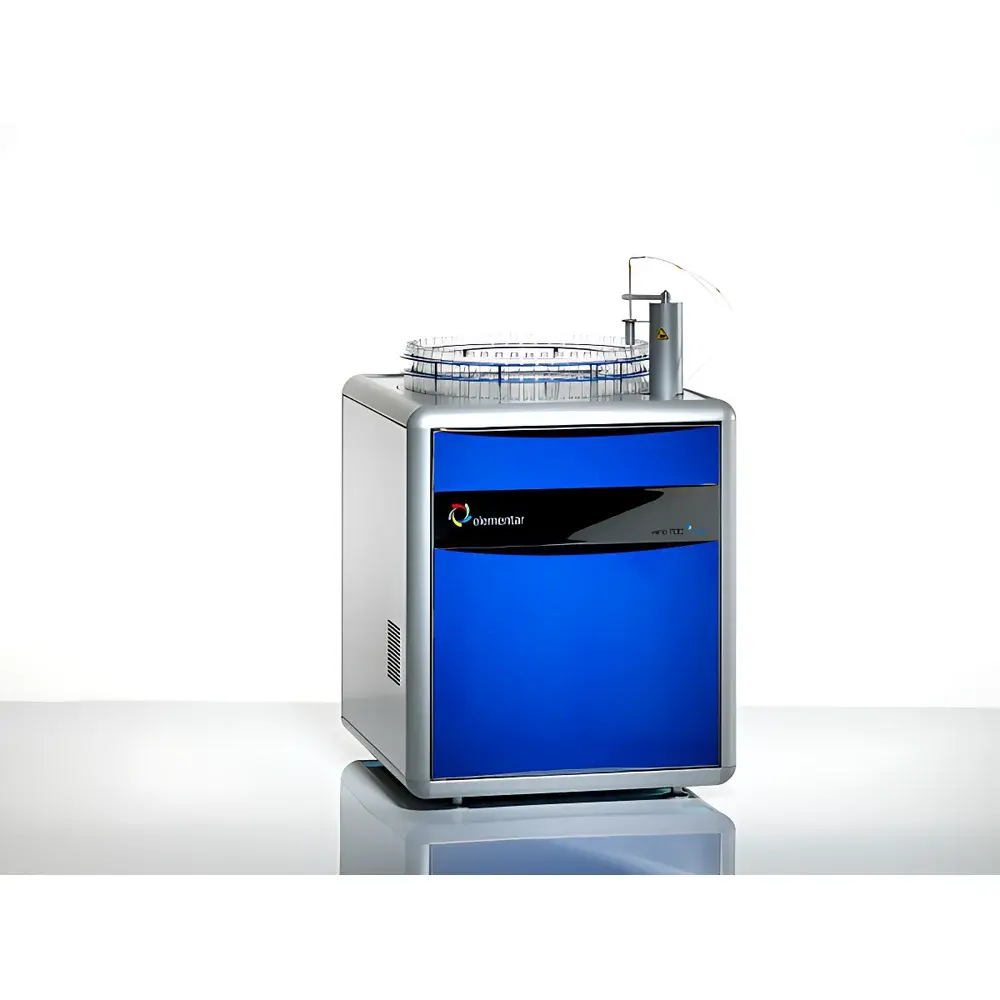
Elementar vario TOC cube Total Organic Carbon Analyzer
| Brand | Elementar |
|---|---|
| Origin | Germany |
| Model | vario TOC cube |
| Instrument Type | Laboratory TOC Analyzer |
| Detection Principle | Non-Dispersive Infrared (NDIR) Absorption |
| Oxidation Method | High-Temperature Catalytic Combustion |
| Measurement Range | 0–50,000 ppm C |
| Detection Limit | 3 ppb C |
| Repeatability | <1.5% RSD |
| Sample Forms | Liquid and Solid |
| Automation | Integrated 50-position Liquid Autosampler |
| Optional Detection Modes | NDIR, Chemiluminescence (CLD), Electrochemical (EC) for TOC or Total Bound Nitrogen (TNb) |
| Solid TIC Module | Available as add-on unit |
| Compliance | Designed for GLP/GMP environments |
Overview
The Elementar vario TOC cube is a high-performance, dual-mode laboratory total organic carbon (TOC) analyzer engineered for rigorous environmental and regulatory water quality testing. It employs high-temperature catalytic combustion (up to 1,200 °C) coupled with non-dispersive infrared (NDIR) detection — a reference-grade methodology standardized in ASTM D7573, ISO 8245, and USP . Unlike UV-persulfate or wet-chemical oxidation techniques, this thermal oxidation approach ensures complete mineralization of recalcitrant organic compounds — including humic substances, polyaromatic hydrocarbons, and chlorinated organics — delivering trace-level accuracy and method robustness across complex matrices. The instrument’s modular architecture enables seamless transition between liquid and solid sample analysis modes in under five minutes, eliminating cross-platform calibration drift and reducing method validation burden.
Key Features
- Ultra-low detection limit of 3 ppb C (as carbon), validated per EPA Method 415.3 and ISO 20674 requirements for ultrapure water monitoring.
- Dual-sample capability: fully automated liquid analysis via integrated 50-position autosampler; solid-sample analysis using programmable ceramic boat loader and optional TIC module for inorganic carbon quantification.
- Matrix separation technology: patented flow-path design isolates particulates and high-salinity interferences prior to combustion, enabling reliable large-volume injection (up to 1 mL) of seawater, brine, or wastewater without clogging or memory effects.
- Three detector options configurable on the same platform: NDIR (standard), chemiluminescence detection (CLD) for enhanced sensitivity in low-carbon matrices, and electrochemical detection (EC) for simultaneous TOC and total bound nitrogen (TNb) determination.
- Tool-free gas-tight sealing system using sliding ball-clamp joints; maintenance-accessible combustion furnace with linear slide mechanism reduces service downtime and improves thermal stability reproducibility.
- Compact base unit with field-upgradable modules — users select only required configurations (e.g., solid auto-sampler, CLD detector, TIC add-on), optimizing capital expenditure and footprint.
Sample Compatibility & Compliance
The vario TOC cube accommodates diverse sample types without dilution or pretreatment: ultrapure water (pharmaceutical grade), drinking water, surface water, municipal and industrial wastewater (influent/effluent), leachates, and solid environmental matrices (soils, sediments, sludges). Its oxidation efficiency exceeds 99% for >95% of IUPAC-listed organic compounds, satisfying ISO 20674 Annex A validation criteria. The system supports full compliance with GLP and GMP workflows through configurable user access levels, electronic signature support, and audit-trail-enabled software (when operated with Elementar’s UNICUBE Suite or third-party LIMS compliant with FDA 21 CFR Part 11).
Software & Data Management
Controlled via Elementar’s UNICUBE software, the vario TOC cube provides intuitive method setup, real-time signal visualization, and automated calibration verification (including multi-point linearity checks and blank drift monitoring). All raw data, metadata (sample ID, operator, timestamp, instrument status), and processing parameters are stored in encrypted SQLite databases with immutable timestamps. Export formats include CSV, PDF analytical reports, and XML for integration into enterprise QA/QC systems. Batch processing, custom report templates, and IQ/OQ/PQ documentation packages are available to accelerate laboratory accreditation (e.g., ISO/IEC 17025).
Applications
- Regulatory compliance testing for pharmaceutical water systems (WFI, PW) per USP and EU Ph. Eur. 2.2.44.
- Environmental monitoring of effluent discharge limits under EU WFD and U.S. Clean Water Act requirements.
- Research on carbon cycling in aquatic ecosystems, including DOC/DIC speciation and biodegradability assessment.
- Process water characterization in semiconductor manufacturing and power generation (boiler feedwater, condensate).
- Soil carbon sequestration studies requiring parallel TOC/TNb quantification in heterogeneous solid samples.
FAQ
Can the vario TOC cube analyze both liquid and solid samples on the same platform?
Yes — liquid analysis uses the built-in 50-position autosampler; solid analysis is enabled via optional ceramic boat loader and combustion tube configuration. Switching between modes requires no hardware reconfiguration.
Is high-salinity wastewater compatible with the system?
Yes — the matrix separation module allows direct injection of samples with salinity up to 300 g/L NaCl without performance degradation or carryover.
What regulatory standards does the instrument support?
ASTM D7573, ISO 8245, ISO 20674, USP , EP 2.2.44, and EPA Method 415.3. Full 21 CFR Part 11 compliance is achievable with validated software deployment.
How is calibration verified during routine operation?
Automated daily calibration verification using certified sucrose and inorganic carbon standards; software logs all verification events with pass/fail flags and residual error reporting.
Does the system require external cooling water or compressed air?
No — it operates with ambient air cooling and integrated zero-air generator; no external utilities beyond standard 230 V/50 Hz power supply are needed.
Related Products







