
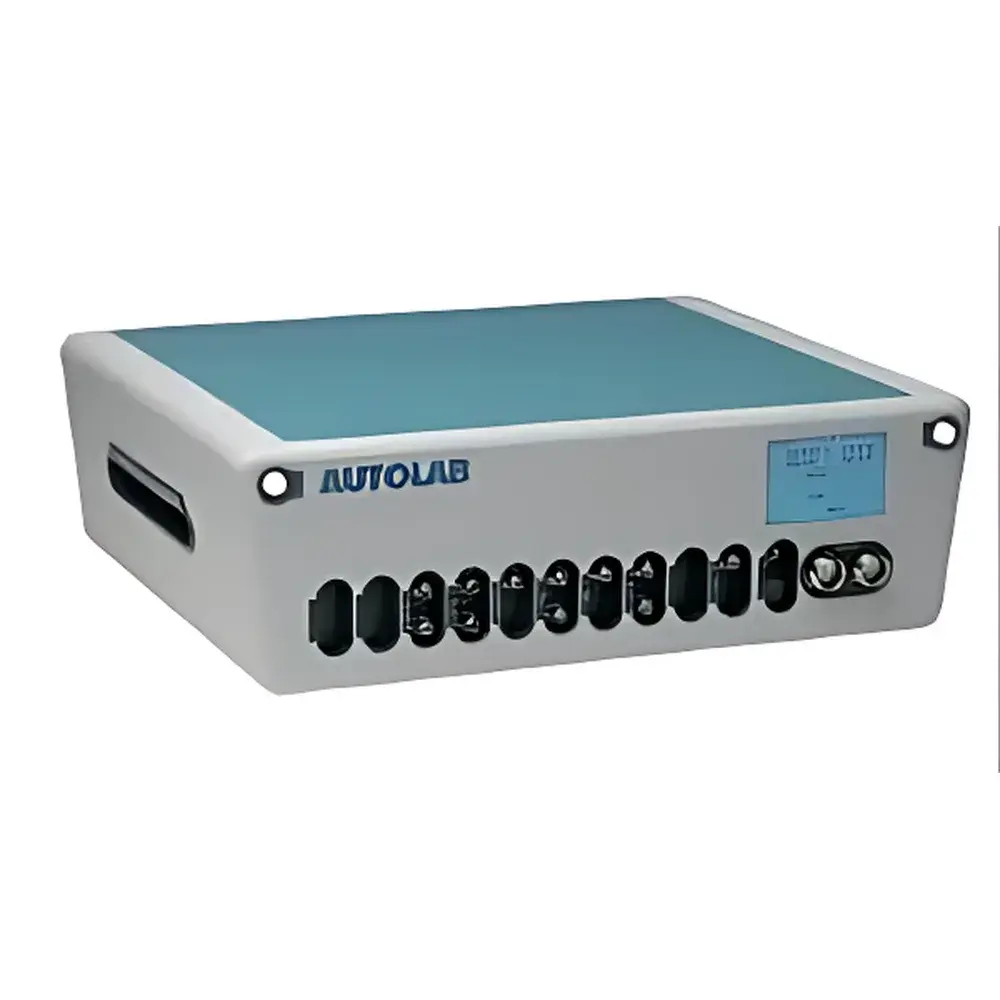
Metrohm PGSTAT302N Electrochemical Workstation
| Brand | Metrohm |
|---|---|
| Origin | Switzerland |
| Model | PGSTAT302N |
| Electrode Configuration | 2-/3-/4-electrode |
| Potential Range | ±10 V (extendable to ±30 V) |
| Max Output Voltage | ±30 V |
| Max Output Current | ±2 A (extendable to ±10 A or ±20 A with BSTR modules) |
| Current Ranges | 9 auto-ranging decades from 1 A to 10 nA |
| CV Scan Rate | 0.1 µV/s to 250 V/s (up to 250 kV/s with SCAN250) |
| Sampling Rate | 50 kHz (up to 10 MHz with ADC10M) |
| Potentiostat Bandwidth | >1 MHz |
| Software | GPES/FRA or NOVA |
| Supported Techniques | DC voltammetry, AC voltammetry, EIS (with FRA), dynamic iR compensation, chronoamperometry, chronopotentiometry, impedance spectroscopy, pulse techniques, and more |
Overview
The Metrohm PGSTAT302N Electrochemical Workstation is a high-performance, modular potentiostat/galvanostat system engineered for precision electrochemical research and industrial R&D applications. Built upon Metrohm’s legacy of Swiss-engineered reliability and metrological traceability, the PGSTAT302N employs a dual-channel analog architecture with independent control loops for voltage and current, enabling simultaneous multi-technique operation and exceptional signal fidelity. Its core design follows the principles of four-quadrant operation—supporting both cathodic and anodic polarization under potentiostatic or galvanostatic control—with ultra-low noise floor (120 dB). The system operates on a true analog feedback loop with digital supervision, minimizing phase lag and ensuring stability during fast transient measurements such as microsecond-scale pulse experiments or high-frequency EIS (up to 10 MHz with optional ADC10M). Designed for integration into regulated environments, the hardware architecture complies with IEC 61010-1 safety standards and supports audit-ready data acquisition when paired with NOVA software under GLP/GMP workflows.
Key Features
- Modular expandability: Accepts up to 12 external function modules—including FRA (Frequency Response Analyzer), BSTR10A/20A (high-current booster), SCAN250 (ultrafast scanning), ADC10M (10 MHz sampling), EQCM (electrochemical quartz crystal microbalance), and DYNIR (dynamic iR compensation)—enabling configuration-specific optimization.
- Wide operational envelope: ±30 V compliance voltage and ±2 A output current (scalable to ±20 A via BSTR20A), supporting demanding applications such as battery formation cycling, fuel cell stack testing, and large-area electrode characterization.
- Ultra-broad current resolution: Nine auto-ranging decades (1 A to 10 nA), with sub-picoampere sensitivity achievable using the ECD (Electrochemical Detector) module—critical for low-conductivity media, ultramicroelectrode studies, and trace-level redox detection.
- High-speed temporal resolution: Standard 50 kHz sampling rate; enhanced to 10 MHz with ADC10M for resolving rapid nucleation events, double-layer charging dynamics, or fast catalytic turnover kinetics.
- Dual-software ecosystem: Fully compatible with both legacy GPES/FRA (for standardized protocol execution) and modern NOVA 2.x (for script-driven automation, real-time FFT analysis, and multi-parameter synchronization).
Sample Compatibility & Compliance
The PGSTAT302N accommodates standard three-electrode cells (working, counter, reference), two-electrode configurations (e.g., symmetric supercapacitor testing), and four-electrode setups for uncompensated resistance correction in high-resistivity electrolytes (e.g., organic solvents, polymer electrolytes, or solid-state ionics). It interfaces seamlessly with commercial and custom electrochemical cells—including Swagelok-type, H-cell, rotating disk electrodes (RDE), and flow-through reactors—via shielded BNC and banana-jack connectors conforming to IEEE 488.2 and USB 2.0 (Hi-Speed) protocols. Hardware firmware and NOVA software support 21 CFR Part 11-compliant electronic signatures, full audit trails, user access levels, and encrypted raw-data storage—meeting requirements for ISO/IEC 17025-accredited laboratories and pharmaceutical electrochemical QC/QA procedures.
Software & Data Management
NOVA software provides a unified platform for experiment design, real-time visualization, post-processing, and reporting. It includes built-in templates aligned with ASTM G5, G59, G102, and ISO 17475 for corrosion rate quantification; IEC 62660-1/2 for lithium-ion battery cycling; and USP <798> for electrochemical impurity profiling. All datasets are saved in open-format .DTA files with embedded metadata (timestamp, operator ID, instrument serial, calibration history), enabling traceability and third-party analysis in MATLAB, Python (via pyNOVA), or OriginLab. Batch processing scripts support automated parameter sweeps, EIS fitting (using Kramers–Kronig validation), and statistical outlier detection across replicate samples.
Applications
- Battery R&D: Formation cycling, SEI growth monitoring, Li plating/stripping quantification, and impedance evolution tracking under variable SoC and temperature.
- Fuel cells & electrolyzers: MEA degradation analysis, catalyst activity mapping, and mass-transport limitation identification via RDE/EIS coupling.
- Corrosion science: Polarization resistance (LPR), electrochemical noise analysis (ENA), and localized corrosion initiation detection in chloride-containing media.
- Materials electrochemistry: Redox behavior of conductive polymers, charge storage mechanisms in pseudocapacitive oxides, and interfacial charge transfer kinetics at semiconductor/electrolyte junctions.
- Electrocatalysis: Turnover frequency (TOF) determination, Tafel slope analysis, and reaction pathway discrimination via controlled-potential coulometry and differential electrochemical mass spectrometry (DEMS) synchronization.
FAQ
Is the PGSTAT302N compatible with rotating ring-disk electrode (RRDE) systems?
Yes—the instrument supports synchronized potential control of both ring and disk electrodes via its dual-channel architecture and optional MUX module, enabling collection efficiency calibration and reaction intermediate detection.
Can it perform electrochemical impedance spectroscopy (EIS) at frequencies above 1 MHz?
With the integrated FRA module and ADC10M high-speed digitizer, the system achieves stable EIS acquisition up to 10 MHz, suitable for double-layer capacitance analysis and solid-electrolyte interphase (SEI) dielectric characterization.
Does Metrohm provide calibration certificates traceable to NIST or PTB standards?
All PGSTAT302N units ship with factory calibration reports referencing primary standards maintained at Metrohm’s ISO/IEC 17025-accredited metrology lab in Herisau, Switzerland, with optional on-site recalibration services available globally.
How is data integrity ensured during long-term battery cycling experiments lasting >1000 hours?
NOVA implements cyclic redundancy check (CRC)-protected data streaming, automatic backup to network drives, and periodic checksum verification—ensuring zero data loss even during power interruptions or software restarts.




