
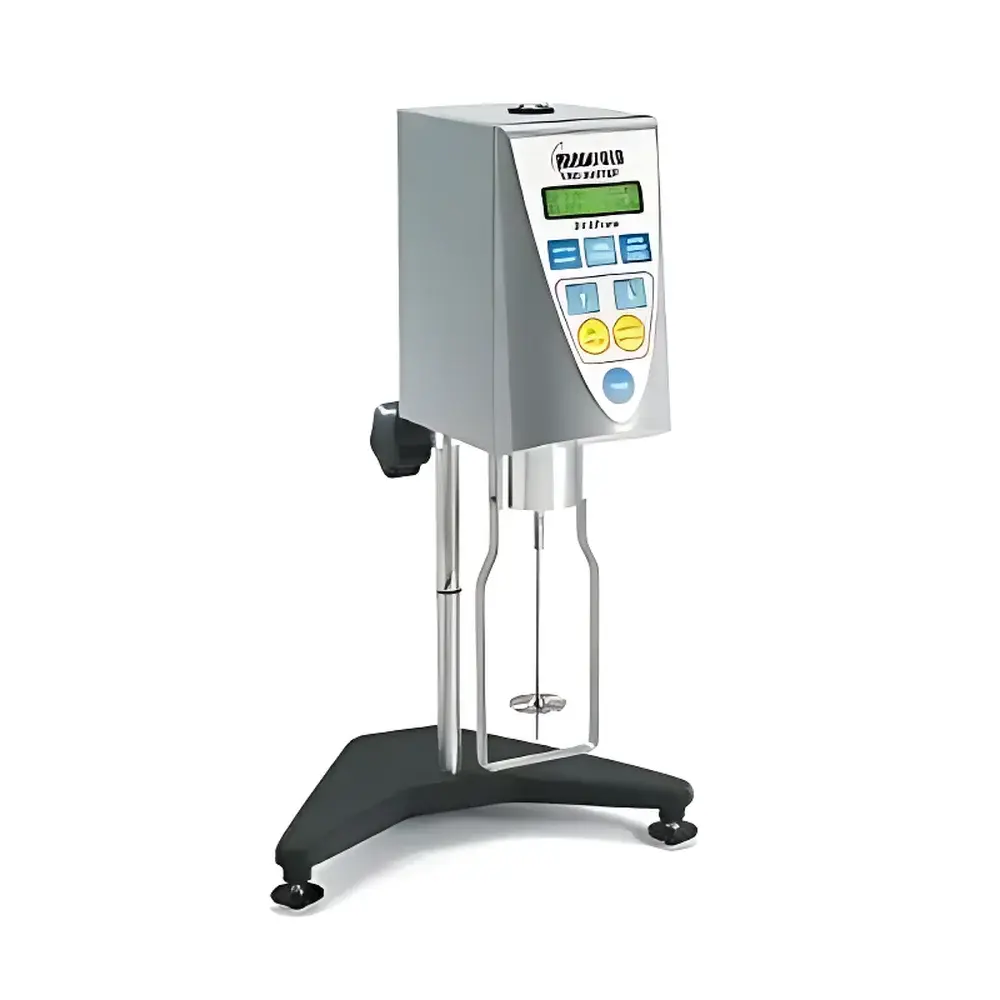
Brookfield HBDV-I Prime Digital Viscometer
| Brand | Brookfield |
|---|---|
| Origin | USA |
| Model | HBDV-I Prime |
| Viscosity Range | 800–1.04 × 10⁸ mPa·s |
| Speed Range | 0.3–100 rpm |
| Accuracy | ±1% of full-scale reading |
| Repeatability | ±0.2% |
| Temperature Compensation Range | ±5 °C |
| Interface | RS-232 serial port, printer port |
Overview
The Brookfield HBDV-I Prime Digital Viscometer is a high-precision rotational viscometer engineered for laboratory and quality control environments requiring reliable, repeatable viscosity measurements across a broad dynamic range. Based on the well-established Couette principle—where torque generated by a rotating spindle immersed in a fluid is proportional to its shear viscosity—the HBDV-I Prime delivers calibrated rheological data under controlled shear conditions. Designed for Newtonian and mildly non-Newtonian fluids, it operates within a defined shear rate regime determined by spindle geometry and rotational speed. Its fixed-spindle configuration (compatible with standard Brookfield spindles: LV, RV, HA, HB) ensures mechanical stability and minimizes axial misalignment errors. The instrument complies with ASTM D2196 and ISO 2555 standards for rotational viscosity measurement, supporting traceable calibration protocols required in regulated industries including pharmaceuticals, coatings, adhesives, and food manufacturing.
Key Features
- Digital continuous-sensing architecture with real-time torque and viscosity calculation—eliminating analog interpolation delays.
- Streamlined ergonomic housing with tactile membrane keypad interface for glove-compatible operation in controlled environments.
- 18 programmable rotational speeds (0.3–100 rpm), enabling precise shear rate selection to match sample behavior and avoid wall slip or turbulent artifacts.
- Integrated auto-ranging logic that dynamically selects optimal full-scale viscosity range based on measured torque—reducing manual range selection errors.
- Configurable auto-timing function: users may define either time-to-target-torque (e.g., time required to reach 50% full-scale torque) or fixed-duration measurement windows (e.g., 60 s dwell at constant speed).
- Real-time over/under-range detection with audible and on-screen alerts—preventing erroneous data capture outside validated operating limits.
- Adjustable temperature offset compensation (±5 °C) to correct for thermal drift when external temperature sensors are used but ambient calibration references differ from process conditions.
- Standard RS-232 serial interface compliant with EIA/TIA-232-F specifications, supporting bidirectional communication with LIMS or custom acquisition software.
Sample Compatibility & Compliance
The HBDV-I Prime accommodates samples ranging from low-viscosity solvents (e.g., ethanol, acetone) to highly structured gels and pastes (e.g., lithium greases, polymer melts, cosmetic bases). Spindle selection (LV, RV, HA, HB series) determines minimum measurable viscosity and maximum detectable value per speed setting. For temperature-sensitive materials, optional PT100 RTD probes (sold separately) integrate directly into the instrument’s analog input circuitry, providing 0.1 °C resolution and enabling synchronized viscosity–temperature profiling. All firmware and hardware configurations adhere to IEC 61000-4 electromagnetic compatibility standards. While not inherently 21 CFR Part 11 compliant, audit-trail-capable data export (via RS-232) supports integration into validated systems where electronic records are governed by GLP or GMP requirements.
Software & Data Management
Raw torque, speed, temperature (if equipped), and calculated viscosity values are transmitted in ASCII format via RS-232 at user-defined intervals (1–10 Hz). The instrument supports direct printing to ESC/P-compatible thermal or dot-matrix printers using standardized command sets. No proprietary software is bundled; however, third-party tools—including LabVIEW drivers, Python pySerial libraries, and Excel-based data loggers—are widely deployed in industrial QA labs for automated reporting and statistical process control (SPC). Exported datasets include timestamp, spindle ID, speed, torque %FS, and viscosity—enabling post-acquisition analysis of shear-thinning indices or thixotropic recovery profiles.
Applications
- QC release testing of lubricants, transformer oils, and hydraulic fluids per ASTM D445.
- Batch consistency verification of paints, inks, and architectural coatings during formulation and production.
- Rheological screening of topical pharmaceutical gels and ointments under USP guidelines.
- Stability assessment of food emulsions (mayonnaise, dressings) and dairy concentrates across storage temperatures.
- Process troubleshooting of polymer solutions prior to extrusion or fiber spinning.
- Educational use in undergraduate materials science laboratories for introducing fundamental rheological concepts.
FAQ
What spindle types are compatible with the HBDV-I Prime?
Standard Brookfield spindles—LV (low viscosity), RV (medium viscosity), HA (high viscosity), and HB (very high viscosity)—are mechanically and electrically compatible. Each spindle must be manually selected in the instrument’s setup menu to ensure correct full-scale calculation.
Does the HBDV-I Prime support automatic temperature correction during measurement?
Yes—when an optional RTD probe is connected, the instrument applies real-time temperature compensation using built-in viscosity–temperature coefficients (e.g., ASTM D341 reference curves) or user-defined polynomial offsets.
Can measurement data be exported to LIMS without intermediate PC storage?
Yes—via RS-232, the viscometer streams ASCII-formatted data packets that can be parsed directly by LIMS middleware supporting serial device integration, provided appropriate baud rate and framing parameters are configured.
Is calibration traceable to NIST standards?
Brookfield provides factory calibration certificates traceable to NIST through A2LA-accredited laboratories. End-users must perform periodic verification using certified viscosity standards (e.g., Cannon-Manning silicone oils) per ISO/IEC 17025 procedures.
What maintenance is required to sustain measurement accuracy?
Annual verification of torque sensor linearity and spindle concentricity is recommended. Cleaning spindles with solvent after each use and inspecting for nicks or corrosion prevents systematic error. The instrument’s internal EEPROM retains calibration constants across power cycles.



