
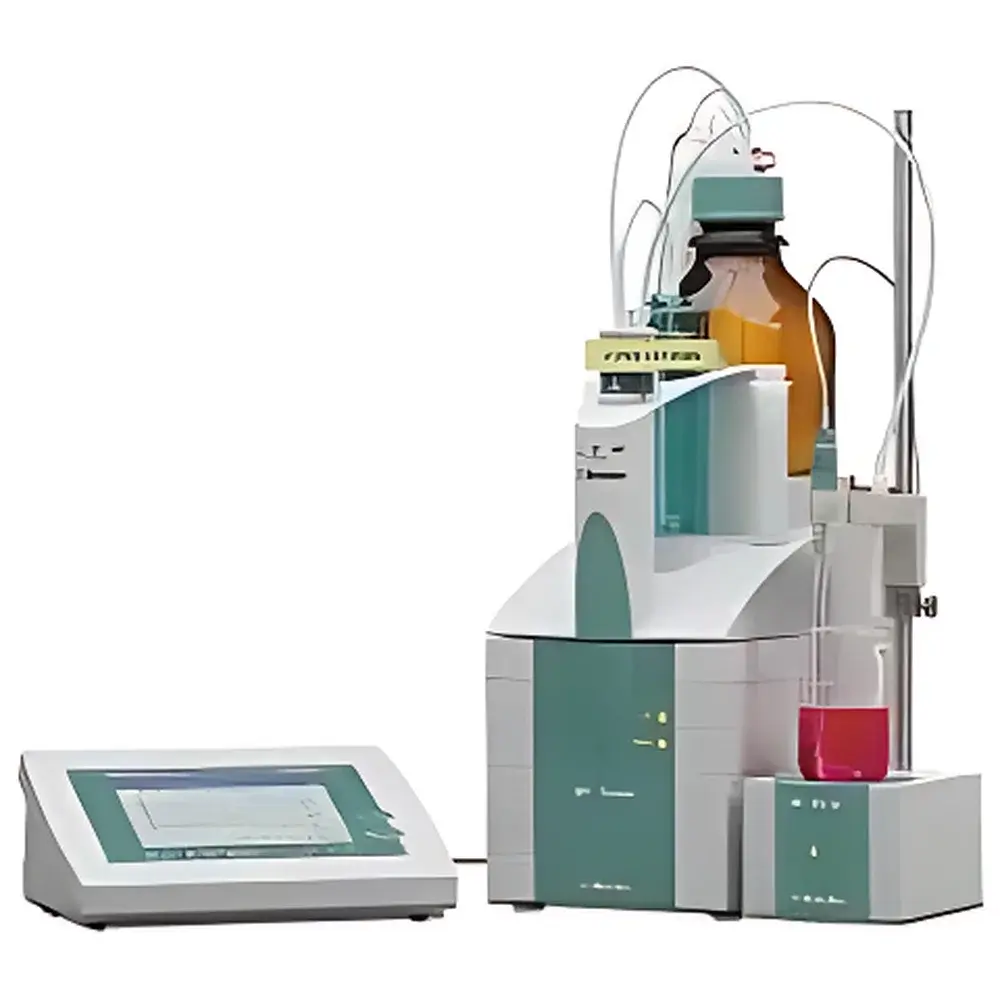
Metrohm 888 Titrando Professional Intelligent Potentiometric Titrator
| Brand | Metrohm |
|---|---|
| Origin | Switzerland |
| Model | 888 Titrando |
| Titration Modes | SET, MET, DET, MEAS pH, CAL, KFT, MANUAL TITRATION, LIQUID HANDLING, DOS |
| Electrode Interfaces | High-Impedance Input, Reference Electrode Input, Polarizable Electrode Input, Temperature Sensor Input, iTrode Digital Interface |
| Smart Exchange Unit | EEPROM-embedded, auto-identifies burette volume/resolution, titrant name/concentration/expiry/history |
| Burette Options | 1, 5, 10, 20, 50 mL |
| Burette Resolution | 1/20000 of full scale |
| Stirrer | 801 Magnetic Stirrer with fuzzy logic torque control, bidirectional rotation, 15-speed adjustment |
| Control | 320×240-pixel touchscreen (supports up to 3 instruments per unit) + tiamo software (Chinese GUI, GLP/GMP/FDA 21 CFR Part 11 compliant) |
| Compatibility | 805 Dosino or 800 Dosino (dead-volume-free) dosing units |
| Electrode Ecosystem | Full compatibility with Metrohm analog electrodes and digital iTrode (onboard memory for calibration history, serial number, electrode type, validity tracking, auto-alarm on expiry/out-of-spec calibration) |
Overview
The Metrohm 888 Titrando Professional Intelligent Potentiometric Titrator is an ISO/IEC 17025-aligned automated titration platform engineered for high-throughput, traceable, and auditable quantitative chemical analysis in regulated laboratory environments. Operating on the fundamental principle of potentiometric endpoint detection—measuring the potential difference between a working electrode and a reference electrode as a function of titrant addition—the 888 Titrando delivers precise stoichiometric determination of acid-base, redox, complexometric, precipitation, and non-aqueous reactions. Its architecture integrates electrochemical measurement, fluidic automation, and digital electrode intelligence into a single cohesive system. Unlike legacy titrators relying on manual calibration and static method execution, the 888 Titrando embeds metrological traceability at the hardware level: every smart exchange unit carries calibrated volumetric metadata in its onboard EEPROM, while each iTrode stores its full calibration lineage—including initial factory calibration, user-performed recalibrations, expiration timestamps, and deviation alerts—directly within the electrode housing. This design ensures method integrity across instrument swaps and supports unambiguous audit trails required under GLP, GMP, and FDA 21 CFR Part 11.
Key Features
- Intelligent Exchange Units with embedded EEPROM: Automatically registers burette volume (1–50 mL), resolution (1/20000), titrant identity, concentration, expiry date, and usage history upon installation—eliminating manual parameter entry errors.
- Digital iTrode ecosystem: First-generation Metrohm digital electrodes with non-volatile memory; store electrode type, serial number, calibration coefficients, historical calibration data, and validity status—enabling plug-and-play recognition and automatic alarm generation when calibration drifts beyond defined thresholds or expires.
- Modular fluidic architecture: Supports integration with 805 Dosino (for precision micro-dosing) or 800 Dosino (dead-volume-free dosing) units, enabling flexible configuration for KF coulometric/metrological water determination, back-titration, or multi-step sequential reagent addition.
- Adaptive 801 magnetic stirrer: Employs fuzzy logic control to dynamically adjust torque based on real-time solution viscosity changes during titration—ensuring homogeneous mixing without vortex formation or splashing, even in high-viscosity or low-surface-tension samples.
- Dual-control interface: Local operation via high-contrast 320×240-pixel resistive touchscreen (with multi-instrument pairing capability) and remote control via tiamo software—supporting method development, parallel instrument management, and centralized data archiving.
Sample Compatibility & Compliance
The 888 Titrando accommodates aqueous, non-aqueous, turbid, colored, and suspended-phase samples across pharmaceutical, environmental, food & beverage, petrochemical, and academic research applications. Its electrode interface suite—comprising high-impedance input (≥1012 Ω), reference, polarizable, temperature (Pt1000/NTC), and proprietary iTrode digital ports—ensures compatibility with all Metrohm analog electrodes (e.g., Ag/AgCl, glass pH, redox, ion-selective) and next-generation digital sensors. The system complies with ASTM E202–22 (standard test methods for water in organic liquids), ISO 8587:2021 (sensory analysis—methodology—ranking), USP (titrimetry), and EN ISO 9964–2 (determination of carbonate hardness). All electronic records generated via tiamo satisfy FDA 21 CFR Part 11 requirements through role-based access control, electronic signatures, immutable audit trails, and automatic timestamping of method edits, result exports, and calibration events.
Software & Data Management
tiamo software serves as the central analytical workflow engine—providing a graphical method editor with drag-and-drop templates for rapid protocol development, a customizable report generator supporting PDF/Excel export with embedded titration curves and statistical summaries (RSD, confidence intervals), and a relational database capable of indexing >100,000 results by sample ID, analyst, method version, instrument serial number, and timestamp. The software enforces electronic signature workflows for method validation and result release, maintains full revision history of all analytical methods, and logs all user actions—including failed login attempts, parameter overrides, and manual result edits—with cryptographic hashing for tamper evidence. Data backups are configurable to network drives or NAS devices with AES-256 encryption, and raw data files (.TIA format) retain native binary electrode signal traces, enabling retrospective reprocessing without loss of resolution.
Applications
- Pharmaceutical QC: Quantification of active pharmaceutical ingredients (APIs) via acid-base titration (e.g., amine content in antibiotics), chloride impurity testing per USP , and Karl Fischer water determination in lyophilized powders.
- Food & Beverage: Total acidity (TA) and pH profiling in wines and juices; salt (NaCl) content via argentometric titration; free fatty acid (FFA) analysis in edible oils using alcoholic KOH titration.
- Environmental Testing: Alkalinity and hardness measurements in wastewater per APHA 2320B; cyanide determination via silver nitrate titration after distillation; chloride analysis in drinking water per ISO 9297.
- Chemical Manufacturing: Assay of catalyst precursors (e.g., Pd/C loading verification), purity assessment of organic intermediates, and stoichiometric verification of chelating agents (EDTA, DTPA).
- Academic Research: Development of novel titration endpoints for metal-ligand equilibria; kinetic studies of slow-reacting systems using DET mode; and method validation under ISO/IEC 17025 clause 7.2.2 (validation of non-standard methods).
FAQ
Does the 888 Titrando support compliance with FDA 21 CFR Part 11?
Yes—tiamo software implements electronic signatures, audit trail logging, role-based permissions, and data integrity safeguards fully aligned with FDA 21 CFR Part 11 Subpart B requirements.
Can I use legacy Metrohm electrodes with the 888 Titrando?
Yes—all standard Metrohm analog electrodes (e.g., 6.0234.xxx series) are fully compatible via the high-impedance, reference, and polarizable inputs.
What happens if an iTrode’s calibration expires during analysis?
The system triggers an audible and visual alert on the touchscreen and halts titration progression until the electrode is recalibrated or replaced—preventing invalid results from entering the database.
Is remote monitoring of multiple 888 Titrando units possible?
Yes—tiamo supports concurrent control and real-time status visualization of up to 32 instruments across a LAN/WAN environment, with centralized method deployment and result aggregation.
How is traceability maintained when swapping a burette between instruments?
Each Smart Exchange Unit retains its full calibration metadata (including gravimetric verification logs) in EEPROM; this information transfers automatically upon installation, ensuring volumetric traceability independent of instrument identity.




