
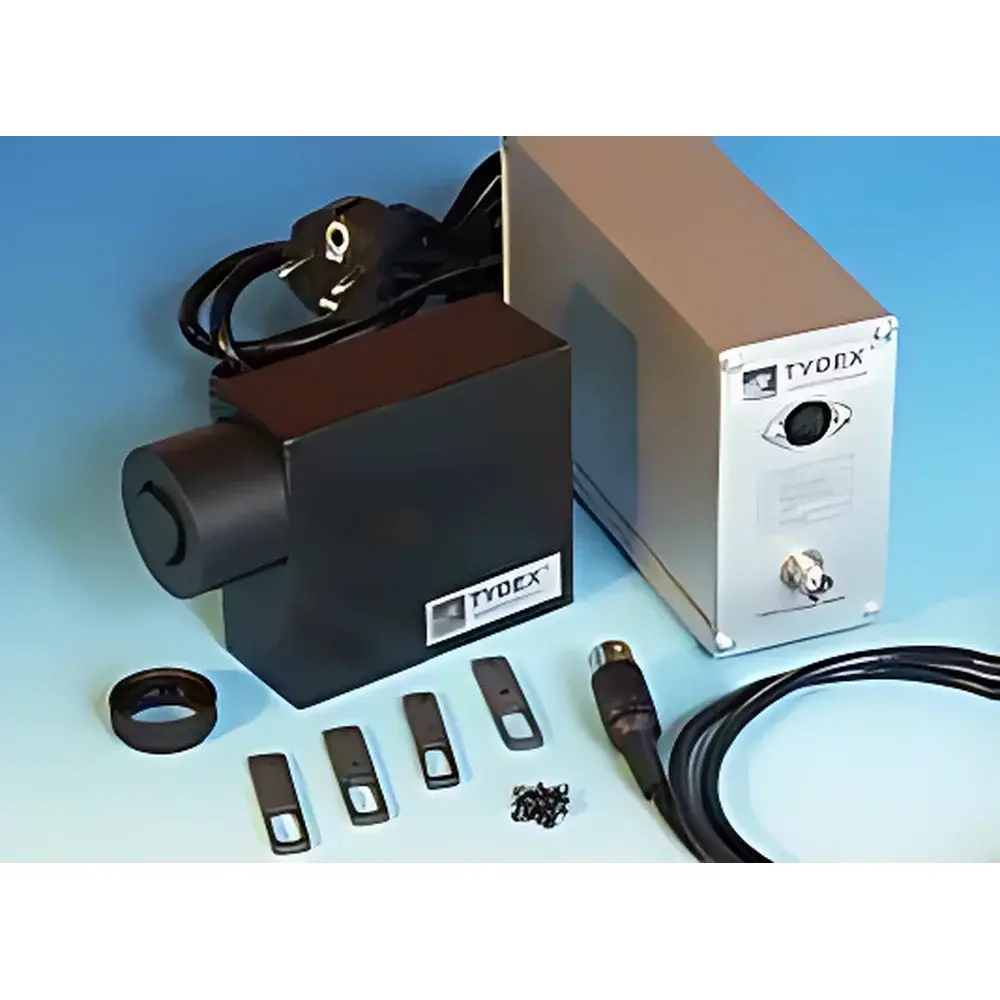
TYDEX Golay Cell THz Detector
| Origin | USA |
|---|---|
| Manufacturer Type | Distributor |
| Origin Category | Imported |
| Model | GC-1P / GC-1T / GC-1D |
| Component Category | Optical Element |
| Aperture Type | Conical (Ø11.0 mm) / Windowed (Ø6.0 mm) |
| Window Materials | HDPE, TPX, Diamond |
| Optimal Wavelength Range | 15–180,000 µm (0.017–20 THz) / 0.3–6.5 & 13–8000 µm (46–1000 THz & 37.5–23 THz) / 0.4–8000 µm (75–375 THz & 37.5–23 THz) |
| Max Detectable Power | 1×10⁻⁵ W |
| Modulation Frequency | 15 ± 5 Hz |
| NEP @ 20 Hz (typ.) | 1.4×10⁻¹⁰ W/Hz¹ᐟ² (GC-1P), 0.8×10⁻¹⁰ W/Hz¹ᐟ² (GC-1T) |
| Responsivity @ 20 Hz (typ.) | 1×10⁵ V/W (GC-1P), 1.5×10⁵ V/W (GC-1T) |
| Response Time (typ./min) | 30/25 ms |
| D* (typ./max, conical aperture) | 7.0×10⁹ / — cm·Hz¹ᐟ²/W (GC-1P), 11.0×10⁹ / — cm·Hz¹ᐟ²/W (GC-1T) |
| Operating Pressure | 760–1000 mmHg |
| Temp. Range (operating/storage) | 5–40 °C |
| Humidity | 45–80 % RH |
| Vibration Tolerance | 1–100 Hz |
| Supply Voltage | 100/115 VAC ±10% or 220/230 VAC ±10% |
| Line Frequency | 50–60 Hz |
| Dimensions (L×W×H) | 26×45×87 mm |
| Weight | 0.8 kg |
Overview
The TYDEX Golay Cell THz Detector is a high-sensitivity, room-temperature thermal detector engineered for broadband terahertz radiation measurement in research and industrial spectroscopy applications. Based on the principle of gas expansion thermometry, the Golay cell operates by detecting minute pressure changes induced in a sealed, light-absorbing gas chamber upon THz irradiation. Incident radiation heats the gas volume, causing diaphragm deflection that is measured via optical lever or capacitive transduction—enabling direct, wavelength-independent power detection across the 0.017–20 THz range (15–180,000 µm). Unlike cryogenic bolometers or semiconductor-based photoconductive antennas, the Golay cell requires no cooling, offers flat spectral response over ultra-broad bands, and delivers exceptional signal-to-noise performance for low-flux, modulated THz sources such as backward-wave oscillators (BWOs), quantum cascade lasers (QCLs), and Fourier-transform infrared (FTIR) synchrotron beamlines.
Key Features
- Three standardized configurations: GC-1P (polyethylene window), GC-1T (TPX window), and GC-1D (diamond window)—each optimized for distinct transmission windows and environmental robustness
- Conical aperture (Ø11.0 mm) and windowed aperture (Ø6.0 mm) options to accommodate divergent or collimated beam geometries in free-space THz setups
- Typical noise-equivalent power (NEP) as low as 0.8×10⁻¹⁰ W/Hz¹ᐟ² at 20 Hz modulation, enabling detection of sub-nanowatt THz signals under standard lab conditions
- High detectivity (D*) up to 1.1×10¹⁰ cm·Hz¹ᐟ²/W (GC-1T), reflecting superior sensitivity per unit area and bandwidth
- Fast thermal response time (25–30 ms typ.), compatible with mechanical chopper frequencies of 15 ± 5 Hz for lock-in amplification
- Integrated analog output with linear voltage responsivity (up to 1.5×10⁵ V/W), directly interfacing with standard lock-in amplifiers and DAQ systems
- Hermetically sealed construction with stable gas fill, ensuring long-term calibration retention without periodic recalibration
Sample Compatibility & Compliance
The TYDEX Golay Cell is designed for use with free-space THz beams in atmospheric or purged environments (760–1000 mmHg). Its window materials—high-density polyethylene (HDPE), transparent poly(methyl pentene) (TPX), and single-crystal diamond—are selected for minimal absorption and dispersion across overlapping THz sub-bands. HDPE provides broad coverage from 0.1–3 THz; TPX extends transmission to ~8 THz with lower water vapor absorption; diamond enables operation up to 40 THz with exceptional thermal and mechanical stability. The detector complies with IEC 61000-6-3 (EMC emission standards) and meets mechanical shock/vibration requirements per MIL-STD-810G (1–100 Hz sinusoidal sweep). While not certified for medical or safety-critical use, it supports GLP-aligned experimental workflows when integrated into traceable metrology chains per ISO/IEC 17025 guidelines.
Software & Data Management
The Golay Cell operates as an analog transducer and does not embed firmware or onboard digitization. It interfaces seamlessly with industry-standard data acquisition platforms—including National Instruments USB-6211, Keysight 34972A, and Zurich Instruments HF2LI—via its differential BNC output. When paired with lock-in amplifiers (e.g., Stanford Research SR830), users achieve real-time signal averaging, harmonic rejection, and phase-sensitive demodulation essential for FTIR-THz and time-domain spectroscopy (TDS) post-processing. Raw voltage outputs are fully compatible with MATLAB, Python (NumPy/SciPy), and LabVIEW for custom spectral analysis, baseline correction, and radiometric calibration against NIST-traceable blackbody sources. Audit trails for calibration coefficients, environmental logs, and instrument settings can be maintained in accordance with FDA 21 CFR Part 11 when deployed within validated QC/QA systems.
Applications
- Fourier-transform terahertz spectroscopy (FT-THz) for molecular fingerprinting of pharmaceuticals, polymers, and explosives
- THz time-domain spectroscopy (THz-TDS) reference detection in pump-probe configurations
- Characterization of THz metamaterials, plasmonic resonators, and photonic crystals
- Non-destructive evaluation (NDE) of composite laminates, ceramic coatings, and packaged electronics
- Calibration transfer standards for THz power meters and radiometric intercomparisons
- Atmospheric science studies involving rotational transitions of polar gases (e.g., H₂O, NH₃, O₃)
FAQ
What is the difference between GC-1P, GC-1T, and GC-1D models?
The distinction lies in the entrance window material: GC-1P uses HDPE for optimal transmission below 3 THz; GC-1T employs TPX for extended bandwidth up to ~8 THz and reduced hygroscopicity; GC-1D features diamond for highest thermal conductivity, UV-THz transparency, and vacuum compatibility.
Can the Golay Cell be used in vacuum environments?
No—the internal gas-filled chamber requires ambient or near-atmospheric pressure (760–1000 mmHg) for proper thermal expansion mechanics. For vacuum-compatible alternatives, consider pyroelectric detectors or cryogenic bolometers.
Is factory calibration traceable to NIST?
TYDEX provides relative responsivity calibration certificates referenced to a primary blackbody source. Full NIST-traceable absolute calibration is available as an optional service through accredited third-party metrology labs.
What chopper frequency should be used for optimal SNR?
The detector is optimized for 15 ± 5 Hz mechanical modulation. Operation outside this band reduces responsivity and increases 1/f noise contribution; lock-in integration time should be set ≥100 ms to suppress low-frequency drift.
How often does the Golay Cell require recalibration?
Under stable environmental conditions and proper handling, recalibration is recommended every 12–24 months—or after exposure to mechanical shock, rapid temperature cycling, or window contamination.




