
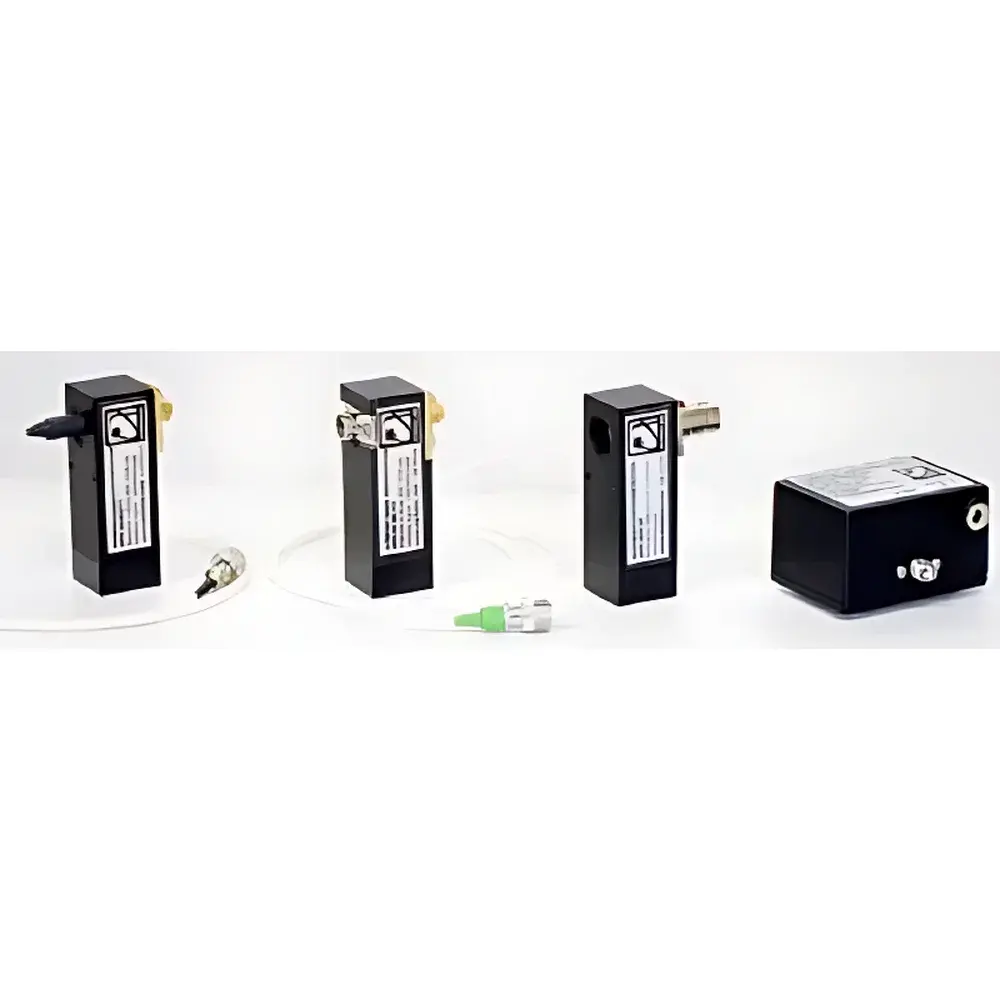
UPD Series Ultrafast Photo-Detectors
| Origin | USA |
|---|---|
| Manufacturer Type | Distributor |
| Origin Category | Imported |
| Model | UPD series |
| Price | ¥12,000 |
Overview
The UPD series ultrafast photo-detectors are engineered for high-fidelity optical-to-electrical signal conversion in time-domain photonics applications. Based on low-capacitance, diffusion- or drift-dominated photodiode architectures—optimized for minimal carrier transit time and parasitic inductance—the detectors operate on the principle of direct photocurrent generation under incident optical irradiance. They deliver flat frequency response from DC to 25 GHz, enabling accurate capture of sub-nanosecond optical transients, ultrashort laser pulses, and high-speed modulated waveforms. Designed for integration into laboratory-scale optical test benches, ultrafast spectroscopy setups, and fiber-optic communication characterization systems, these detectors serve as primary front-end sensors where temporal fidelity, impedance stability, and spectral coverage are critical. Their solid aluminum housings provide electromagnetic shielding and thermal mechanical stability, supporting repeatable measurements under varying ambient conditions.
Key Features
- Ultrafast temporal response: rise times down to 15 ps, corresponding to bandwidths up to 25 GHz (–3 dB)
- Extended spectral coverage: 170–2600 nm across silicon (UV-enhanced) and InGaAs variants; UV-extended Si models cover 170–1100 nm, while InGaAs versions span 350–1700 nm
- Flexible biasing: compatible with battery operation (enabling portable, low-noise configurations) or external DC power supply (for stabilized, high-current operation)
- Impedance-optimized RF output: 50 Ω matched design minimizes signal reflections; optional high-impedance load configuration available for enhanced voltage output at reduced bandwidth
- Multiple packaging options: free-space input with AR-coated fused silica window, FC/PC receptacle, or fiber-pigtailed versions with SMF-28 or PM fiber
- Output polarity customization: standard positive output; negative-output variants available upon request (model-specific)
- Optional TEC cooling module for low-noise operation in high-sensitivity applications (non-standard housing required)
Sample Compatibility & Compliance
The UPD series is compatible with continuous-wave (CW), pulsed (nanosecond to femtosecond), and modulated optical sources—including Ti:sapphire, Yb:fiber, Er:fiber, and DFB lasers—as well as supercontinuum and LED-based broadband sources. All models comply with RoHS 2011/65/EU directives. The UV-enhanced silicon photodiodes meet ASTM E1318-20 standards for spectral responsivity calibration traceability when used with NIST-traceable reference detectors. For GLP/GMP-aligned environments, the detectors support integration into validated measurement workflows compliant with ISO/IEC 17025:2017 requirements for calibration uncertainty propagation. No internal amplification or analog-to-digital conversion is performed—ensuring full compatibility with third-party oscilloscopes, spectrum analyzers, and lock-in amplifiers meeting IEEE 1057 or IEC 61000-4-3 standards.
Software & Data Management
As passive analog transducers, UPD detectors require no embedded firmware or driver software. Output signals interface directly with industry-standard instrumentation via SMA or K-type RF connectors. When paired with high-bandwidth digital storage oscilloscopes (e.g., Keysight Infiniium, Tektronix DPO70000SX), raw pulse waveforms are acquired with full temporal resolution. Time-domain data may be post-processed using MATLAB, Python (NumPy/SciPy), or LabVIEW for deconvolution, jitter analysis, FWHM calculation, or cross-correlation. For audit-ready environments, timestamped waveform datasets can be archived alongside instrument metadata (e.g., scope settings, trigger source, sampling rate) to satisfy FDA 21 CFR Part 11 electronic record integrity requirements when integrated into validated QC/QA systems.
Applications
- Pulse duration and jitter characterization of mode-locked lasers and optical parametric oscillators
- Optical synchronization and timing distribution in multi-channel pump-probe experiments
- Heterodyne and beat-note detection in optical frequency comb stabilization
- High-speed optical modulation analysis (OOK, PAM4) in free-space and fiber-coupled links
- Time-resolved photoluminescence decay measurements in semiconductor and 2D material research
- Calibration transfer standards for photodetector linearity and frequency response verification per ISO 11554
FAQ
What is the maximum average optical power these detectors can handle?
Maximum average power handling depends on active area size and wavelength. Standard models tolerate up to 10 mW at 1550 nm; UV-extended Si variants are rated for ≤5 mW at 254 nm. For higher peak powers, the optional diffused-window variant increases damage threshold but reduces responsivity by ~3–5×.
Can UPD detectors be used with 75 Ω test equipment?
No—these detectors are designed for 50 Ω systems. Using a 75 Ω termination introduces impedance mismatch, causing signal reflection, overshoot, and degraded pulse fidelity. A 50 Ω feed-through terminator is recommended for optimal performance.
Is calibration data provided with each unit?
Yes—each detector ships with a factory-measured spectral responsivity curve (170–2600 nm), rise time verification report, and VSWR plot (1–25 GHz), traceable to NIST via accredited metrology labs.
Are custom fiber pigtails available?
Yes—SMF-28, HI1060, PM980, and polarization-maintaining Panda fiber options are available with FC/APC, FC/PC, or SC connectors; lead times apply for non-stock configurations.
Do UPD detectors require temperature stabilization for stable DC response?
For DC-coupled applications requiring long-term baseline stability (<0.1% drift over 8 h), TEC-cooled variants (UPD-xx-TEC) are recommended. Standard units exhibit typical dark current drift of <1 nA/°C over 20–30 °C ambient range.





