
Periodically Poled Lithium Niobate (PPLN) Crystal – HCP PPLN-OPO Series
| Brand | HCP |
|---|---|
| Origin | Taiwan |
| Manufacturer Type | Authorized Distributor |
| Domestic Origin | Yes |
| Model | PPLN-OPO |
| Wavelength Conversion Range | 330–5500 nm |
| Poling Period Range | 4.5–50+ µm |
Overview
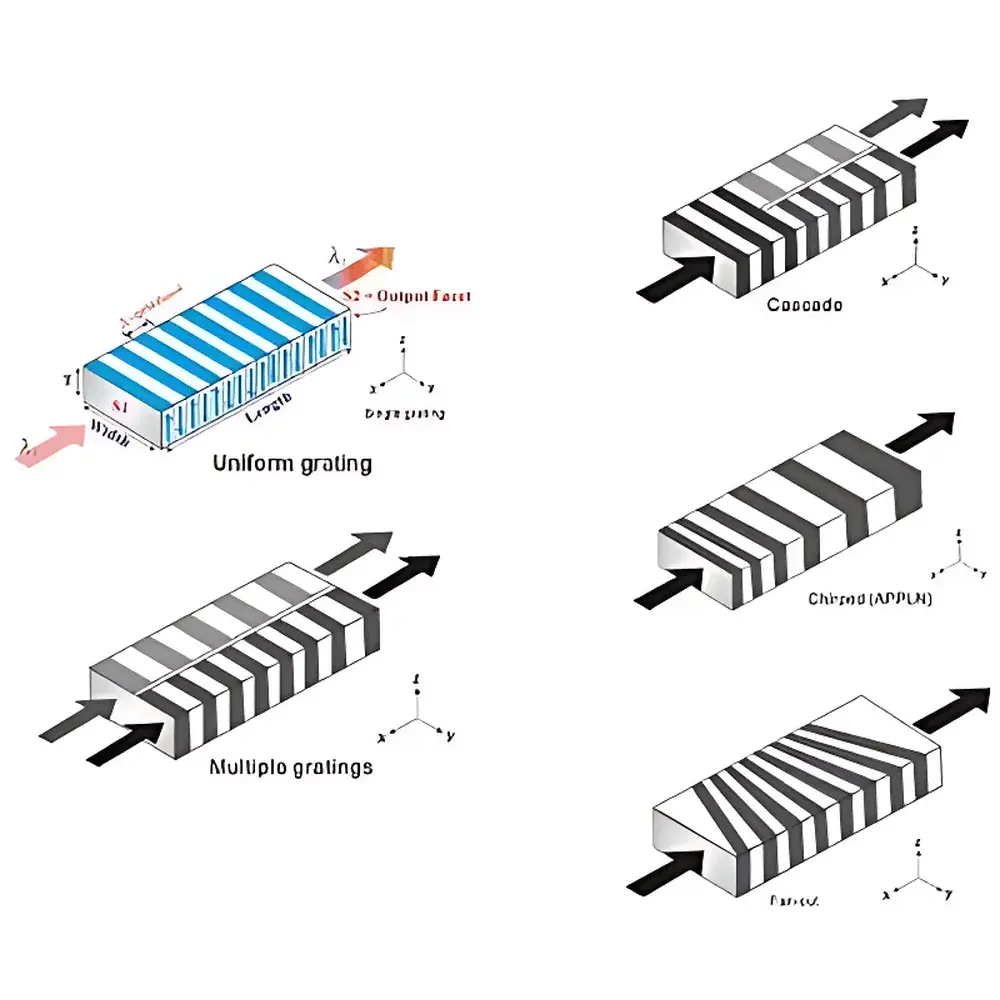
The HCP PPLN-OPO Series consists of high-quality, periodically poled lithium niobate (LiNbO₃) crystals engineered for efficient quasi-phase-matched (QPM) nonlinear optical frequency conversion. These crystals operate on the fundamental principle of second-order nonlinear susceptibility (χ⁽²⁾), enabling robust and scalable generation of tunable coherent radiation across ultraviolet (UV), visible (VIS), near-infrared (NIR), and mid-infrared (MIR) spectral regions — specifically from 330 nm to 5500 nm. Unlike bulk birefringent phase-matching approaches, QPM via periodic domain inversion in LiNbO₃ provides significantly higher effective nonlinearity, broader spectral acceptance, and precise wavelength control through tailored poling period design. The PPLN-OPO crystals are optimized for use as the core nonlinear medium in optical parametric oscillators (OPOs), difference-frequency generation (DFG), and second-harmonic generation (SHG) systems, particularly where high conversion efficiency, low walk-off, and thermal stability are critical.
Key Features
- High-fidelity periodic domain engineering with poling periods ranging from 4.5 µm to over 50 µm — enabling precise targeting of target signal/idler wavelengths under specific pump conditions.
- Custom crystal length selection (standard lengths: 5 mm to 50 mm; extended options available) to balance conversion efficiency, spectral bandwidth, and group-velocity matching requirements.
- Thermally diffused titanium (Ti)-indiffused or proton-exchanged waveguide-compatible substrates available upon request for integrated nonlinear photonics applications.
- AR-coated surfaces (R < 0.2% per surface) optimized for common pump laser wavelengths (e.g., 532 nm, 1064 nm, 1550 nm) and corresponding signal/idler bands.
- High optical homogeneity (Δn < 5 × 10⁻⁵) and low propagation loss (< 0.05 dB/cm at 1550 nm), ensuring minimal beam distortion and long-term operational reliability.
- Robust mechanical architecture: Z-cut or X-cut orientation options with polished surfaces meeting ISO 10110-7 scratch-dig specifications (20–10 or better).
Sample Compatibility & Compliance
The PPLN-OPO crystals are compatible with standard solid-state pump sources including Nd:YAG (1064 nm), Nd:YVO₄ (1342 nm), Ti:sapphire (700–1000 nm), and fiber lasers (1550 nm, 2000 nm). Crystals are fabricated using photolithographic domain patterning followed by high-field electric field poling — a process validated for repeatability and long-term domain stability (>10⁶ shots at 10 Hz, 10 ns pulse width). All batches undergo full interferometric verification and spectral response characterization. While not classified as medical or diagnostic devices, these components comply with RoHS Directive 2011/65/EU and meet material traceability requirements aligned with ISO 9001-certified manufacturing workflows. For regulated environments (e.g., GLP/GMP-aligned laser development labs), full lot documentation—including poling map files, transmission spectra, and coating reflectance data—is provided upon order confirmation.
Software & Data Management
No embedded firmware or proprietary software is included, as the PPLN-OPO is a passive optical component. However, comprehensive technical support includes access to HCP’s online QPM calculator tool (web-based, no installation required), which enables users to compute optimal poling periods, temperature tuning curves, and gain bandwidths for given pump/signal/idler configurations. Exportable CSV outputs support integration into MATLAB®, Python (SciPy), or LabVIEW® environments. For customers deploying OPO systems in FDA-regulated R&D settings, HCP provides audit-ready documentation packages that include calibration certificates, domain uniformity reports, and traceable metrology logs — fully compatible with 21 CFR Part 11-compliant electronic record systems when paired with appropriate lab infrastructure.
Applications
- Tunable mid-IR spectroscopy (2.5–5.5 µm) for gas sensing (CH₄, CO₂, NH₃, NOₓ), environmental monitoring, and breath analysis.
- Ultrafast laser pulse shaping and broadband parametric amplification in femtosecond OPA systems.
- Quantum optics experiments requiring degenerate/non-degenerate photon-pair generation via SPDC.
- Frequency comb extension into molecular fingerprint regions for dual-comb spectroscopy.
- Compact SHG modules for UV generation (e.g., 266 nm from 532 nm pumps) in fluorescence microscopy and semiconductor inspection tools.
- Industrial laser processing systems requiring precisely controlled MIR wavelengths for polymer welding or thin-film ablation.
FAQ
What is the maximum average power this PPLN crystal can handle?
Thermal lensing and photorefractive damage thresholds depend strongly on crystal orientation, coating design, and cooling configuration. Under conductive heat sinking and AR-coated 10-mm-long X-cut devices, continuous-wave (CW) operation up to 5 W at 1064 nm is routinely demonstrated. For pulsed operation (10 ns, 10 kHz), peak intensities up to 500 MW/cm² have been validated without degradation.
Do you provide cavity mirrors matched to the PPLN crystal?
Yes — high-reflectivity (HR) and output coupler (OC) mirrors are available for standard OPO configurations (e.g., HR @ 1064 nm / HT @ 1500–4000 nm). Custom coatings for multi-band operation or dispersion compensation are offered with lead times of 4–6 weeks.
Can I integrate this crystal into an existing OPO cavity?
Absolutely. Dimensions, clear aperture, and mounting interface recommendations (e.g., kinematic mounts with ±0.5 mrad angular tolerance) are supplied with each shipment. Mechanical drawings and thermal expansion coefficients (αx = 14.4 × 10⁻⁶/K, αy = 6.8 × 10⁻⁶/K, αz = 23.2 × 10⁻⁶/K) are included in the datasheet package.




