
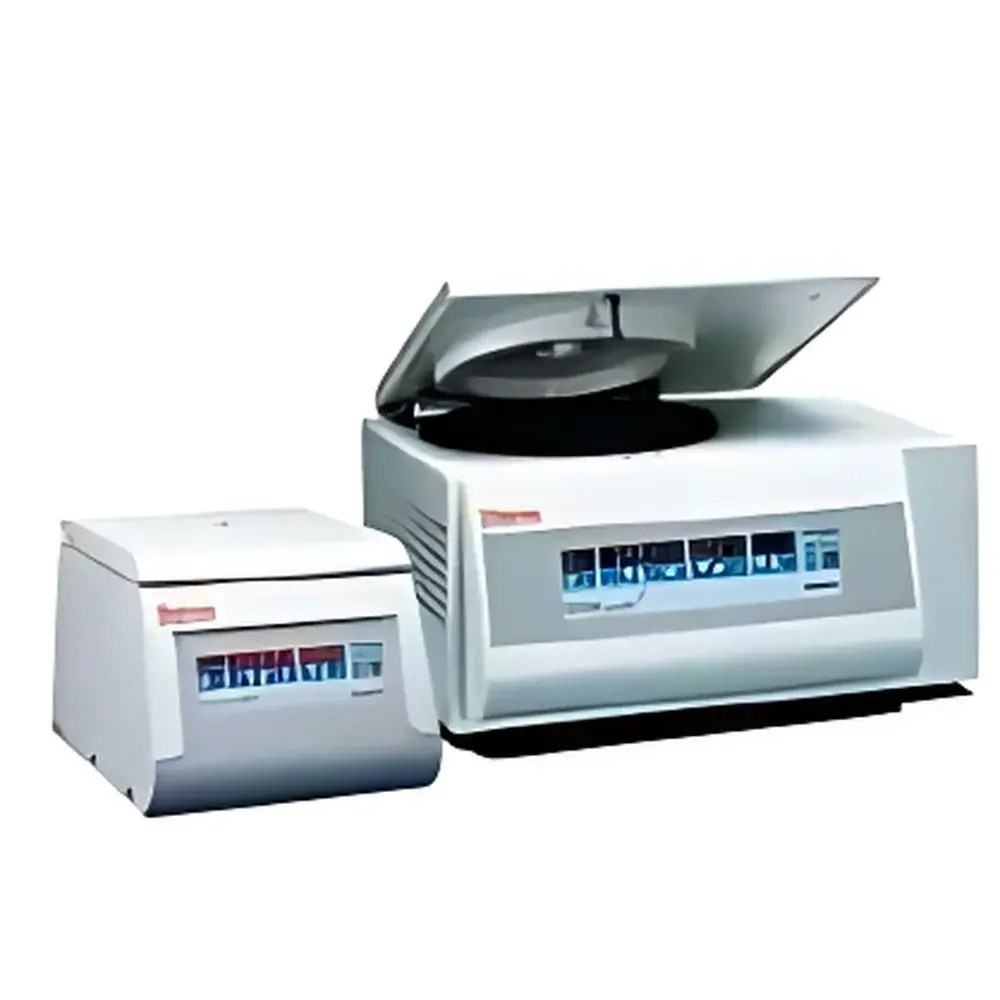
Thermo Fisher Heraeus Biofuge Primo R Benchtop Refrigerated Centrifuge
| Brand | Thermo Fisher |
|---|---|
| Origin | USA |
| Model | Heraeus Biofuge Primo R |
| Drive System | Brushless Motor |
| Control System | EASYcontrol II Microprocessor |
| Max Speed | 15,000 rpm |
| Min Speed | 300 rpm |
| Max RCF | 21,885 × g |
| Temperature Range | –9 to +40 °C |
| Acceleration/Deceleration Steps | 9 / 2 |
| Timer | 0–9 h 59 min or Continuous |
| Noise Level | < 60 dBA |
| Max Capacity | 6 × 50 mL (fixed-angle), 4 × 100 mL (swing-bucket), 12 × 7–15 mL (blood tubes) |
| Rotor Recognition | Automatic |
| Imbalance Detection | Electronic, universal across all rotors |
| Program Memory | Stores most recent run parameters |
| Dimensions (H×W×D) | 313 × 580 × 493 mm |
| Weight | 69.5 kg |
| Power Consumption | 490 W |
| Safety Compliance | EN 61010-1, EN 61010-2-020, EN 50081-1, EN 50082-1, UVV VBG 7z |
Overview
The Thermo Fisher Heraeus Biofuge Primo R is a high-performance benchtop refrigerated centrifuge engineered for precision, reliability, and operational flexibility in modern life science laboratories. Utilizing brushless motor technology and active refrigeration control, it delivers consistent temperature stability across its full operating range (–9 °C to +40 °C), enabling reproducible separation of thermally sensitive biological samples—including plasmids, viral particles, organelles, and nucleic acids—without thermal degradation. Its rotor-agnostic electronic imbalance detection system continuously monitors load symmetry during acceleration, steady-state operation, and deceleration, automatically halting rotation if asymmetry exceeds safe thresholds—whether due to improper tube loading, sample leakage, or tube fracture. Designed for compliance with international laboratory safety and electromagnetic compatibility standards (EN 61010-1, EN 61010-2-020), the Biofuge Primo R supports GLP- and GMP-aligned workflows through robust mechanical construction, stainless-steel base housing, and dual interlock door safety mechanisms.
Key Features
- Triple-Function Versatility: Integrates microcentrifuge, high-speed, and general-purpose centrifugation capabilities within a single platform—eliminating the need for multiple instruments in routine molecular biology, clinical diagnostics, and bioprocessing labs.
- Intuitive EASYcontrol II Interface: Features a high-contrast LCD display with tactile, icon-based navigation; all critical parameters—including speed, RCF, time, temperature, and acceleration/deceleration profiles—are visible at a glance and adjustable without menu nesting.
- Universal Rotor Recognition: Automatically identifies installed rotors (including fixed-angle, swing-bucket, and microplate carriers) and enforces speed and temperature limits specific to each rotor’s certified specifications—preventing inadvertent over-speed operation.
- Acoustically Optimized Design: Operates below 60 dBA at maximum speed, minimizing ambient noise interference in shared lab environments while maintaining rapid acceleration (0–15,000 rpm in ≤18 s) and controlled deceleration (9-step programmable braking).
- Biocontainment Assurance: Certified to third-party biosafety standards for handling BSL-2 and BSL-3 agents; sealed rotor chambers and validated containment integrity reduce aerosol risk during high-speed pelleting of pathogenic samples.
Sample Compatibility & Compliance
The Biofuge Primo R accommodates a broad spectrum of sample formats via six interchangeable rotor configurations—including 6×50 mL fixed-angle, 4×100 mL swing-bucket (DIN standard), 12-position blood tube carriers, and microcentrifuge adapters for 0.2–2.0 mL tubes. All rotors are individually certified to ISO 15189-relevant mechanical integrity requirements and comply with IEC 61010-2-020 for centrifugal equipment safety. The instrument’s refrigeration system meets ASTM E2917 criteria for temperature uniformity (±2 °C across chamber volume at 4 °C), ensuring consistent sedimentation kinetics across replicate runs. Its electrical architecture conforms to EN 50081-1 (EMI emission) and EN 50082-1 (immunity), supporting stable operation in electromagnetically dense core facilities.
Software & Data Management
While the Biofuge Primo R operates as a standalone instrument, its EASYcontrol II firmware supports audit-ready data retention: the last executed protocol—including rotor ID, setpoints, actual run duration, final RCF, and temperature deviation logs—is retained in non-volatile memory. Optional integration with Thermo Fisher’s LabManager™ suite enables centralized device monitoring, remote parameter validation, and export of run metadata in CSV format for inclusion in electronic lab notebooks (ELN). For regulated environments, the system supports manual documentation of calibration events, maintenance logs, and user access records—aligning with FDA 21 CFR Part 11 principles when paired with institutional procedural controls.
Applications
This centrifuge serves critical roles in nucleic acid purification (e.g., plasmid isolation at 13,000 rpm), protein subcellular fractionation (mitochondrial and nuclear pellet recovery), clinical hematology (RBC/WBC separation in 15–50 mL conical tubes), vaccine formulation (virus concentration via swing-bucket ultracentrifugation), and quality control testing of biologics (aggregation analysis under controlled temperature gradients). Its –9 °C capability enables cold-active enzyme preservation during lysate clarification, while programmable soft-brake settings prevent resuspension of delicate pellets—making it suitable for RNA integrity workflows per MIQE guidelines.
FAQ
Does the Biofuge Primo R support rotor autoclaving?
No—rotors are not autoclavable. They must be cleaned using ethanol or approved neutral detergents and sterilized via ethylene oxide or vaporized hydrogen peroxide where required.
Can I run protocols without setting temperature?
Yes—the instrument defaults to ambient temperature mode when refrigeration is disabled, allowing ambient-speed optimization for heat-stable samples.
Is rotor lifetime tracked by the system?
No built-in rotor hour meter exists; however, each rotor bears a serial number and manufacturer-certified maximum run count, which users must log manually per institutional SOPs.
What happens during a power interruption?
The centrifuge immediately initiates emergency deceleration and locks the door until manual reset—preventing accidental rotor ejection or exposure to unbalanced loads.
Are third-party rotors compatible?
Only Thermo Fisher-certified Heraeus rotors are supported; use of non-OEM rotors voids safety certification and invalidates warranty coverage.



