
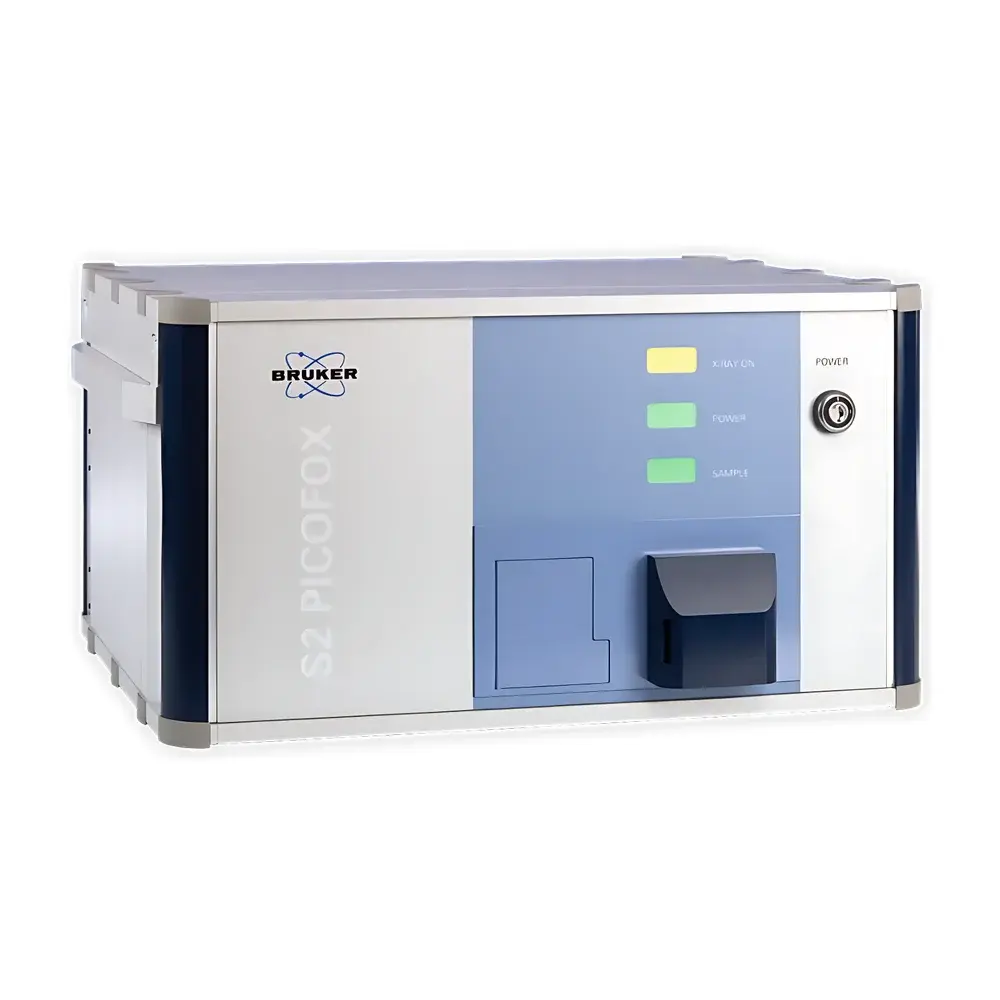
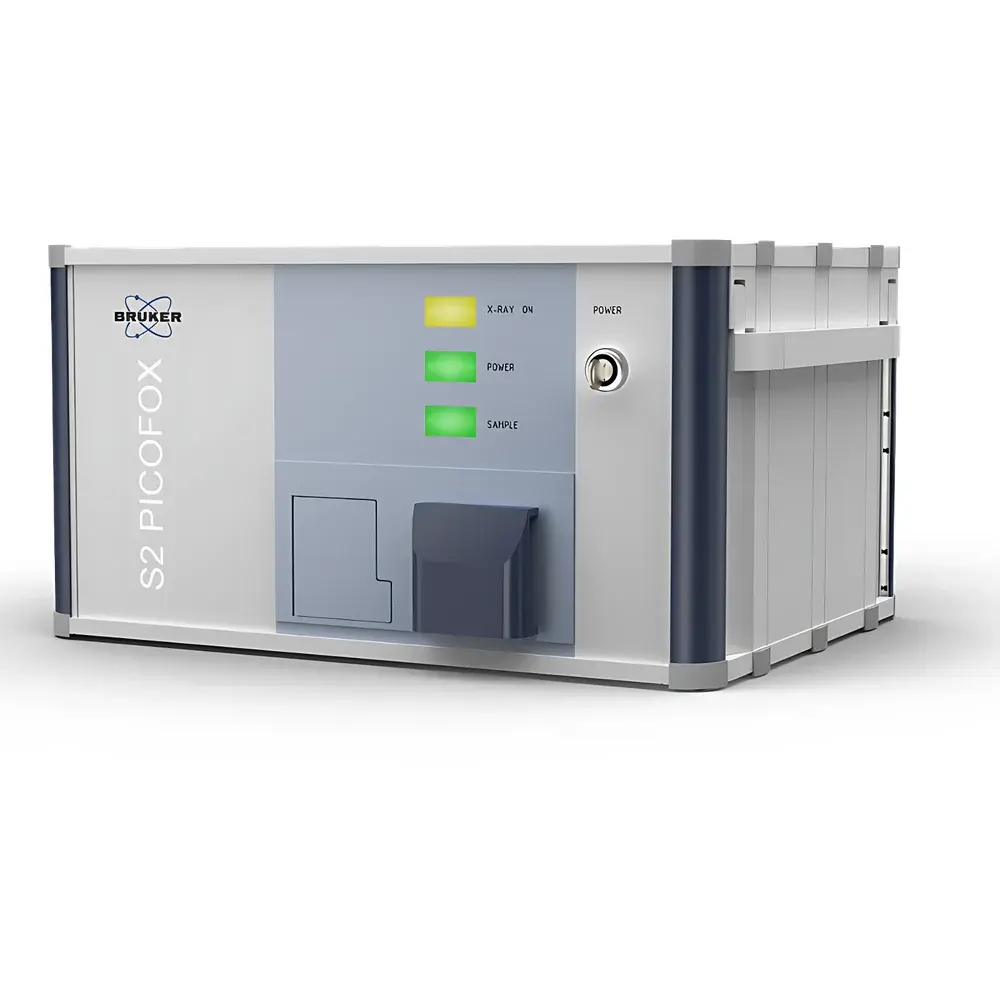
Bruker S2 PICOFOX Total Reflection X-Ray Fluorescence (TXRF) Spectrometer
| Brand | Bruker |
|---|---|
| Origin | Germany |
| Model | S2 PICOFOX |
| Detector | 4th-generation XFlash® silicon drift detector (SDD) with Peltier cooling |
| Energy resolution | 160 eV at Mn Kα (100 kcps) |
| Elemental range | Al (13) to U (92) |
| Sample volume | 1–50 µL (liquid/suspension), ≤10 µg (powder) |
| Automation options | 1-position or 25-position autosampler |
| Compliance | Fully compliant with ISO 8258 (control charts), ISO/IEC 17025 (testing laboratories), and supports GLP/GMP data integrity requirements per FDA 21 CFR Part 11 |
Overview
The Bruker S2 PICOFOX is a benchtop total reflection X-ray fluorescence (TXRF) spectrometer engineered for ultra-trace elemental analysis in the sub-ppt (pg/g) concentration range. Unlike conventional energy-dispersive X-ray fluorescence (ED-XRF), TXRF employs a grazing-incidence excitation geometry—typically 10⁴×, dramatically enhancing signal-to-noise ratio and enabling direct quantification without matrix-matched standards. The instrument integrates a high-brilliance microfocus X-ray tube (Cr or Mo anode, selectable), a precision goniometer for angle stabilization, and a vacuum-optimized optical path to minimize air absorption—critical for light element sensitivity down to aluminum (Z = 13). Its compact monolithic architecture eliminates dependency on liquid nitrogen, compressed gases, or external chillers, making it suitable for regulated laboratory environments as well as field-deployable applications requiring rapid, non-destructive screening.
Key Features
- Fourth-generation XFlash® silicon drift detector (SDD) with integrated Peltier cooling—zero consumables, stable operation at −20 °C, and long-term spectral stability.
- Optimized TXRF geometry with automated angle calibration and real-time beam alignment feedback to maintain <0.02° angular reproducibility.
- Two autosampler configurations: manual single-position stage for method development and validation; motorized 25-position carousel for unattended batch analysis with barcode support.
- Pre-calibrated factory quantification modules for aqueous standards (e.g., multi-element ICP-MS traceable solutions), enabling rapid quantitative analysis without user-generated calibration curves.
- Embedded vacuum system (≤10 Pa) with pressure-regulated chamber control to ensure consistent detection efficiency for elements below potassium (K, Z = 19).
- Robust mechanical design compliant with IEC 61000-6-2 (EMC immunity) and IEC 61000-6-4 (EMC emission) standards for use in shared analytical facilities.
Sample Compatibility & Compliance
The S2 PICOFOX accepts a broad spectrum of sample forms—including liquids, colloidal suspensions, digested biological matrices (e.g., serum, urine), filter-collected airborne particulates, thin-film deposits, and homogenized powders—without digestion or dilution in many cases. Sample deposition is performed via pipette or spin-coater onto certified low-background quartz carriers (10 mm × 10 mm), followed by controlled drying under inert atmosphere to prevent crystallization artifacts. All measurement protocols adhere to ISO 12847 (TXRF for environmental water analysis) and ASTM D7721 (standard test method for trace metals in hydrocarbon fuels by TXRF). Data acquisition and reporting meet audit-trail requirements under FDA 21 CFR Part 11 when used with Bruker’s ELDI software suite configured for electronic signatures and role-based access control.
Software & Data Management
Acquisition and evaluation are managed through Bruker’s ELDI (Elemental Detection and Identification) software platform, built on a .NET framework with SQLite backend for local data persistence. The interface provides real-time spectrum visualization, peak deconvolution using fundamental parameter (FP) algorithms, internal standard normalization (e.g., Ga or Y addition), and automatic limit-of-detection (LOD) calculation per element based on 3σ of blank measurements. Raw spectra, processing parameters, and metadata (operator ID, timestamp, carrier ID, ambient conditions) are stored in encrypted binary containers compliant with ISO/IEC 17025 record retention guidelines. Export formats include CSV (for LIMS integration), PDF analytical reports with embedded spectral overlays, and XML files compatible with ELN systems supporting ASTM E2535 interoperability.
Applications
The S2 PICOFOX delivers validated performance across regulatory and research domains requiring ultra-low detection limits. In environmental laboratories, it quantifies As, Cd, Pb, and Hg in drinking water per EPA Method 200.9 adaptations. Clinical labs apply it to monitor toxic metal burden (e.g., Pb in whole blood, Cd in urine) aligned with CLIA and CAP proficiency testing criteria. In pharmaceutical manufacturing, it verifies elemental impurities in active pharmaceutical ingredients (APIs) per ICH Q3D, particularly for catalyst residues (Pd, Pt, Ni). Additional use cases include forensic glass fragment analysis, leachate testing of construction materials (cement, ceramics), and quality control of semiconductor wafer rinse solutions where Na, K, Ca, and Fe contamination must remain below 10¹⁰ atoms/cm².
FAQ
Does the S2 PICOFOX require liquid nitrogen or external cooling gas?
No. It uses a solid-state Peltier-cooled XFlash® SDD with no cryogenic consumables.
Can it quantify light elements such as sodium or magnesium?
Yes—under vacuum operation and with optimized Cr-anode excitation, detection of Na (Z=11) and Mg (Z=12) is achievable, though routine quantification begins at Al (Z=13) per ISO 12847 validation scope.
Is method transfer possible between different S2 PICOFOX units?
Yes. Factory calibrations are traceable to NIST SRM 2783 (Air Particulate on Filter) and NIST SRM 1643e (Trace Elements in Water), ensuring inter-instrument comparability within ±5% RSD for mid-Z elements.
How is data integrity ensured during regulatory audits?
ELDI software supports full ALCOA+ principles: attributable, legible, contemporaneous, original, and accurate records—with immutable audit trails, electronic signatures, and configurable user permissions aligned with 21 CFR Part 11 Annex 11.
What maintenance is required for long-term operational reliability?
Annual verification of goniometer angular accuracy, detector resolution (Mn Kα FWHM), and X-ray tube output stability—performed by Bruker-certified field service engineers using traceable reference sources.
Related Products





