
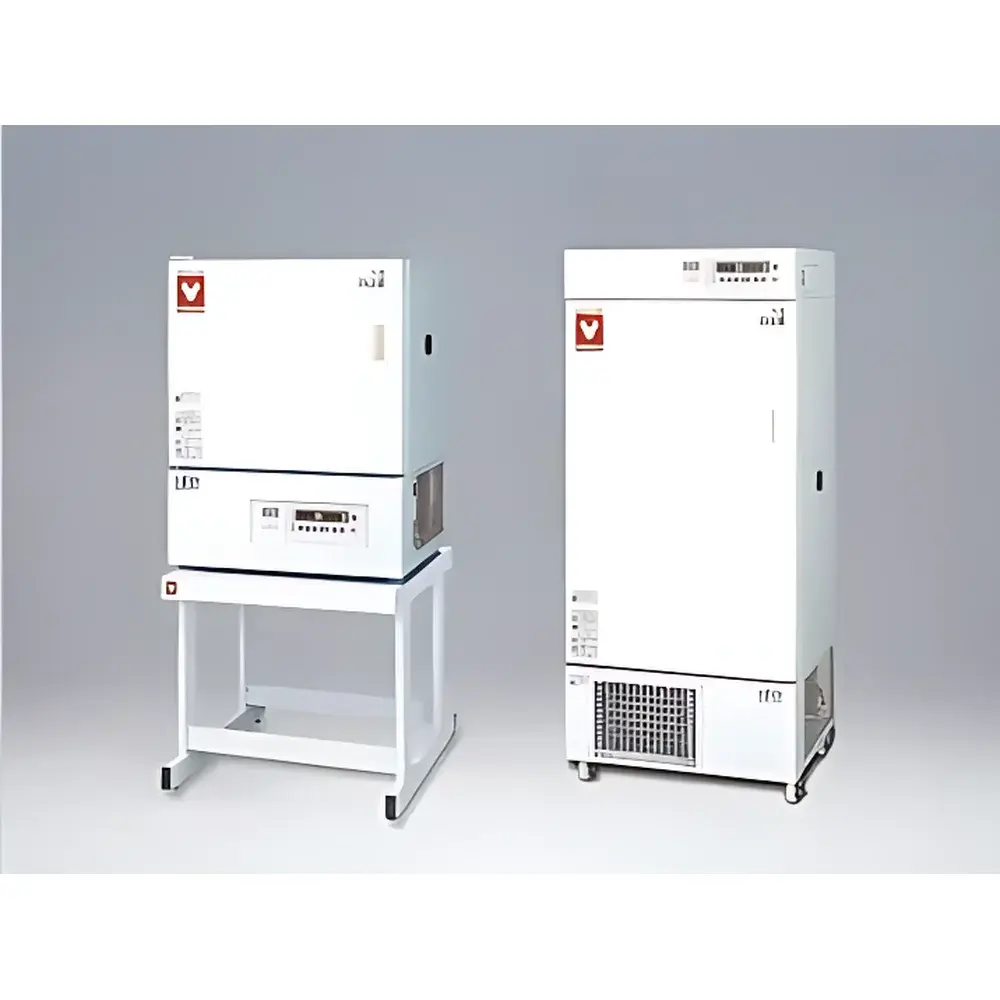
YAMATO IN612C / IN812C Low-Temperature Forced-Air Biochemical Incubator
| Brand | YAMATO |
|---|---|
| Origin | Japan |
| Model | IN612C / IN812C |
| Temperature Range | −10 to +50 °C |
| Temp. Control Accuracy | ±0.3 °C (compressor continuous operation) / ±1.0 °C (cyclic operation) |
| Temp. Uniformity | ±1.0 °C at 37 °C |
| Interior Volume | 143 L (IN612C) / 286 L (IN812C) |
| Construction | Stainless Steel Interior / Powder-Coated Cold-Rolled Steel Exterior |
| Insulation | Foamed Polystyrene |
| Compressor | Air-Cooled Hermetic Type (275 W / 375 W) |
| Refrigerant | R134a |
| Heating | Ni–Cr Wire Heater (550 W / 750 W) |
| Sensor | Pt100 RTD (control) + K-Type Thermocouple (overheat protection) |
| Air Circulation | Axial Fan |
| Control System | PID Digital Controller with VFD & LED Displays |
| Programming | Up to 32-Step Ramp/Soak Profiles, Repeat Function |
| Safety | Independent Over-Temp Protector, Compressor Overload Relay, Earth Leakage Circuit Breaker, Self-Diagnostic Circuit (sensor fault, heater open, SSR short), Audible Alarm |
| Power Supply | AC 220 V, 50/60 Hz (5 A / 6 A) |
| Accessories Included | 3 × Stainless Steel Perforated Shelves (IN612C) / 5 × Shelves (IN812C), Shelf Supports, Manual |
Overview
The YAMATO IN612C and IN812C are precision-engineered low-temperature forced-air biochemical incubators designed for stable, reproducible environmental control in life science laboratories. Based on YAMATO’s long-standing expertise in thermal management systems, these models employ a dual-mode thermoregulation architecture—combining high-efficiency air-cooled hermetic compressors with Ni–Cr wire heating elements and PID-controlled feedback loops—to maintain temperature setpoints across the full operating range of −10 °C to +50 °C. Unlike natural-convection units, the axial fan-driven forced-air circulation ensures uniform thermal distribution (±1.0 °C at 37 °C), minimizing spatial gradients critical for cell culture, enzyme kinetics, microbial growth studies, and stability testing per ICH Q1 guidelines. The double-glazed inner door reduces thermal loss during observation, preserving chamber integrity without compromising real-time sample monitoring.
Key Features
- Forced-air convection system with adjustable axial fan speed for optimized airflow homogeneity and reduced thermal inertia
- Dual-sensor safety architecture: Pt100 RTD for primary PID control + independent K-type thermocouple for redundant over-temperature cutoff (setpoint-independent)
- Comprehensive self-diagnostic circuitry detecting heater open-circuit, RTD disconnection, SSR failure, and automatic over-temperature activation
- Power-loss recovery function that restores pre-interruption setpoint and operational mode upon grid restoration
- VFD fluorescent display for real-time measured temperature (orange) and 4-digit LED for setpoint (red), enabling simultaneous visual verification
- Programmable operation supporting up to 32-step ramp/soak sequences with loop repetition, start delay, and auto-stop functionality
- Robust mechanical construction: 304 stainless steel interior chamber, powder-coated cold-rolled steel exterior, and foamed polystyrene insulation (≥50 mm thickness)
Sample Compatibility & Compliance
The IN612C (143 L) and IN812C (286 L) accommodate standard laboratory vessels—including Petri dishes, multiwell plates, Erlenmeyer flasks, and serum bottles—across up to 13 or 23 shelf levels respectively (30 mm pitch). Each shelf supports up to 15 kg, enabling stacked configurations for high-throughput assays. The internal 32 mm-diameter cable port (right-side mounted) facilitates integration with external sensors, data loggers, or process controllers. Designed and manufactured in Japan under ISO 9001-certified production lines, the units comply with JIS B 7950 (incubator performance standards), IEC 61010-1 (safety requirements for lab equipment), and support GLP/GMP workflows through audit-ready operational logs (cumulative runtime up to 49,999 hours), timestamped event records, and programmable alarm outputs. Optional RS485 interface enables SCADA integration and remote supervision compatible with LabArchives or electronic lab notebook (ELN) platforms.
Software & Data Management
While the IN-series operates via an embedded microcontroller without proprietary PC software, its hardware-level data infrastructure supports regulatory-compliant documentation. All temperature setpoints, program steps, alarm triggers, and power-cycle events are logged internally with time/date stamps. The cumulative timer and elapsed-run counter provide traceable usage metrics for preventive maintenance scheduling. Optional analog output (4–20 mA) allows connection to third-party chart recorders or PLC-based monitoring systems meeting FDA 21 CFR Part 11 requirements when paired with validated acquisition software. External alarm terminals (dry contact) interface directly with building management systems (BMS) or centralized lab alert networks. Firmware updates are performed via physical terminal access—ensuring deterministic behavior and eliminating cloud dependency or cybersecurity exposure vectors common in networked instruments.
Applications
- Low-temperature microbial cultivation (e.g., psychrophilic bacteria, lactic acid fermentation)
- Long-term stability studies for biologics, vaccines, and diagnostic reagents per ICH Q5C
- Enzyme activity profiling across sub-ambient temperature ranges
- Seed germination and plant tissue culture requiring precise chilling phases
- Environmental simulation for material degradation testing (e.g., polymer aging, battery electrolyte analysis)
- QC/QA hold rooms for temperature-sensitive reference standards and calibration materials
FAQ
What is the difference between IN612C and IN812C beyond capacity?
The IN812C features a higher-capacity compressor (375 W vs. 275 W), increased heating power (750 W vs. 550 W), and extended vertical dimension to accommodate 23 shelves—enabling greater throughput while maintaining identical temperature accuracy and uniformity specifications.
Does the unit support validation protocols such as IQ/OQ/PQ?
Yes. The documented temperature stability, traceable sensor calibration paths (Pt100 and K-type), mechanical design conformity to JIS/IEC standards, and built-in diagnostic logging provide foundational evidence for qualification. Users may perform mapping per ISO 14644-3 using external calibrated probes.
Can the incubator operate continuously at −10 °C in ambient environments above 30 °C?
Rated performance assumes ambient conditions of 15–30 °C. Sustained operation at minimum temperature under elevated ambient loads may extend cooldown time and increase compressor duty cycle; consult YAMATO’s thermal derating curves for site-specific installation planning.
Is the RS485 option compliant with Modbus RTU protocol?
The optional RS485 interface supports ASCII command protocol defined in YAMATO’s technical manual; Modbus RTU implementation requires middleware translation or custom driver development.
Are spare parts and service support available outside Japan?
As an authorized global distributor, YAMATO maintains regional service centers with certified technicians and genuine spare compressors, SSRs, RTDs, and control boards—backed by 24-month warranty and documented repair histories per unit serial number.




