
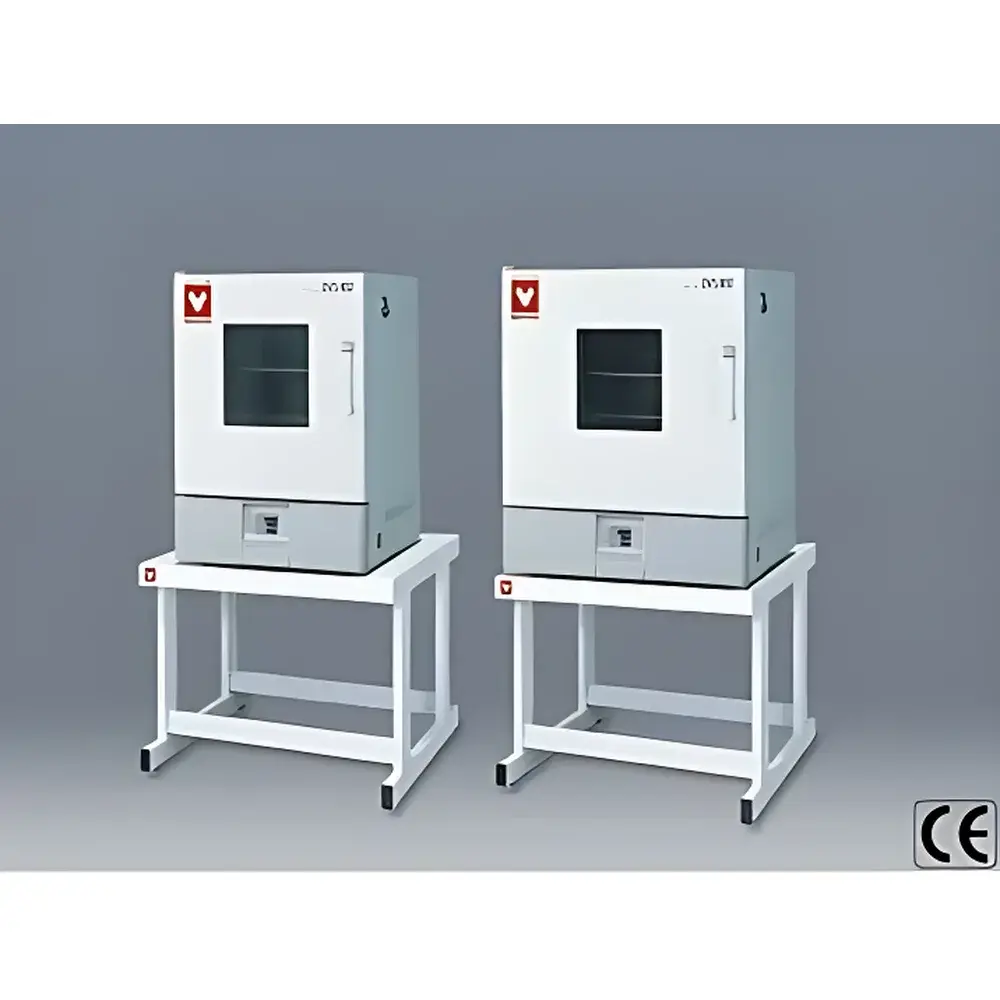
Yamato DVS412C / DVS612C Programmable Natural Convection Drying Oven
| Brand | Yamato |
|---|---|
| Origin | Japan |
| Model | DVS412C / DVS612C |
| Heating Method | Natural Convection |
| Temperature Range | Ambient +10°C to 260°C |
| Temperature Control Accuracy | ±1°C (at 260°C) |
| Temperature Uniformity | ±5°C (at 260°C) |
| Chamber Volume | 99 L (DVS412C) / 162 L (DVS612C) |
| Power Supply | AC 220 V, 50/60 Hz |
| Heating Capacity | 1.2 kW (DVS412C) / 1.36 kW (DVS612C) |
| Internal Dimensions (W×D×H mm) | 450×490×450 (DVS412C) / 600×540×500 (DVS612C) |
| Shelf Load Capacity | 15 kg per shelf |
| Number of Shelves | 9 (DVS412C) / 12 (DVS612C) |
| Shelf Spacing | 30 mm |
| Observation Window | 250 × 280 mm |
| Ventilation Ports | Two Ø30 mm exhaust ports (top), one Ø30 mm cable port (right side) |
| Controller | 3-Stage PID with Digital LED Display (Green for actual temp, Red for setpoint) |
| Timer Range | 1 min – 99 h 59 min & 100 – 999 h 50 min (with delay start function) |
| Program Capability | Up to 30 steps per program, configurable in 3-segment modes (30×1, 15×2, or 10×3) |
| Safety Systems | Dual independent overtemperature protection (main controller + dedicated overheat preventer), self-diagnostic circuitry (sensor fault, heater open, SSR short, auto overheat cutoff), earth leakage circuit breaker, key lock, and power failure recovery |
Overview
The Yamato DVS412C and DVS612C are precision-engineered programmable drying ovens designed for laboratories requiring repeatable thermal processing under natural convection conditions. These units operate on a robust, non-forced-air principle—eliminating turbulence-induced sample disturbance while ensuring stable, uniform heat distribution across the chamber. Engineered for compliance-critical environments, they support temperature-controlled drying, conditioning, sterilization validation, residual solvent removal, and pre-weighing sample stabilization in accordance with ASTM E145, ISO 17025, and USP guidelines. The dual-sensor architecture—comprising a primary K-type thermocouple for process control and a secondary independent thermocouple feeding the overheat prevention circuit—ensures functional safety integrity per IEC 61508 SIL 2 principles. Both models feature a stainless steel interior, corrosion-resistant cold-rolled steel exterior with chemical-resistant coating, and high-density glass fiber insulation—optimized for thermal efficiency and long-term dimensional stability.
Key Features
- Intuitive digital interface with dedicated function keys and up/down navigation for rapid parameter entry—no menu diving required.
- Three-segment, 30-step programmable controller supporting flexible ramp-soak-hold profiles; configuration options include 30 steps × 1 segment, 15 steps × 2 segments, or 10 steps × 3 segments.
- Dual-display LED system: green 4-digit display for real-time measured temperature, red 4-digit display for setpoint—enabling immediate visual verification of thermal deviation.
- Comprehensive self-diagnostic system continuously monitors sensor integrity, heater continuity, SSR functionality, and automatic overheat response activation.
- Integrated safety suite includes independent overtemperature preventer, earth leakage circuit breaker (ELCB), mechanical key lock, and power-failure compensation with resume-on-restoration capability.
- Standard equipment includes two stainless steel wire mesh shelves and four shelf supports; adjustable 30 mm shelf pitch allows vertical customization for heterogeneous sample loads.
Sample Compatibility & Compliance
The DVS412C and DVS612C accommodate a broad range of sample formats—including Petri dishes, weighing boats, crucibles, glassware, polymer films, and pharmaceutical dosage forms—without airflow-induced displacement or edge cooling artifacts. Their natural convection design minimizes convective drying gradients, making them suitable for moisture content determination per AOAC 950.46 and gravimetric analysis workflows compliant with GLP and GMP Annex 11 data integrity requirements. Optional RS485 communication enables integration into centralized lab management systems with audit-trail-capable logging. All firmware and controller logic are designed to meet electromagnetic compatibility standards IEC 61326-1 and electrical safety standard IEC 61010-1. The unit’s construction materials comply with RoHS Directive 2011/65/EU and do not emit halogenated compounds during normal operation or thermal stress.
Software & Data Management
While the DVS series operates via embedded microcontroller without external PC dependency, optional RS485 serial interface supports Modbus RTU protocol for remote monitoring and command execution (e.g., start/stop, setpoint change, status query). When paired with validated third-party SCADA or LIMS platforms, full operational history—including timestamped temperature logs, program execution records, alarm events, and diagnostic flags—can be archived with electronic signatures and user access controls aligned with FDA 21 CFR Part 11 requirements. The built-in timer supports delayed start and duration-based termination, with time-of-day scheduling enabling unattended overnight operation. All parameter changes are logged internally with date/time stamps and operator ID (when configured with external authentication gateway).
Applications
- Moisture content analysis in food, feed, and agricultural commodities per ISO 665 and AOAC methods.
- Pre-drying of filter papers, crucibles, and volumetric glassware prior to gravimetric assays.
- Thermal conditioning of reference standards and certified reference materials (CRMs) before calibration.
- Stabilization of hygroscopic samples (e.g., lithium salts, metal oxides) prior to XRD or TGA analysis.
- Low-stress drying of biological matrices (tissue sections, lyophilized powders) where forced air may cause structural degradation.
- Accelerated aging studies for packaging materials and polymer films under controlled thermal exposure.
FAQ
What is the difference between DVS412C and DVS612C?
The DVS612C offers larger internal volume (162 L vs. 99 L), higher heating capacity (1.36 kW vs. 1.2 kW), increased shelf count (12 vs. 9), and correspondingly larger external dimensions—otherwise, both models share identical control architecture, safety systems, and programming capabilities.
Does the oven support GLP-compliant data recording?
Yes—when equipped with RS485 interface and connected to a validated data acquisition system, full traceable temperature logs with user attribution, timestamps, and event annotations can be generated in compliance with GLP and 21 CFR Part 11.
Can the unit maintain ±1°C accuracy across the entire temperature range?
Temperature control accuracy is specified as ±1°C at 260°C; typical performance across the usable range (ambient +10°C to 260°C) falls within ±1.5°C under steady-state conditions per factory calibration certificate.
Is the observation window resistant to thermal shock?
Yes—the tempered glass viewport is rated for continuous exposure up to 260°C and features anti-fog coating to maintain optical clarity during humidity transitions.
What certifications does the unit carry?
It bears PSE mark (Japan), CE marking (EMC & LVD directives), and complies with IEC 61010-1 for laboratory equipment safety; full test reports available upon request for IQ/OQ/PQ validation support.



