
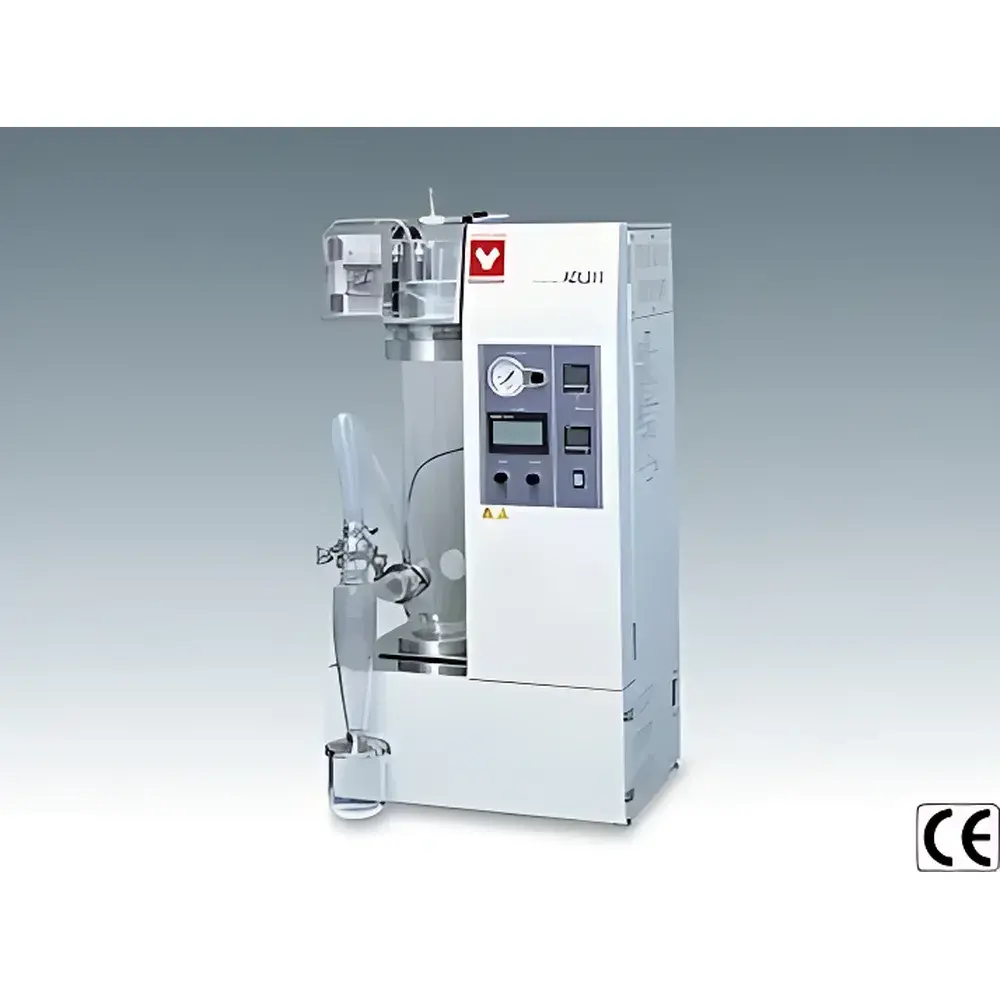
YAMATO ADL311 Water-Soluble Spray Dryer (Authorized Distributor Model)
| Brand | YAMATO |
|---|---|
| Origin | Japan |
| Model | ADL311 |
| Solvent Compatibility | Aqueous Only |
| Max. Evaporation Rate | 1300 mL/h |
| Inlet Temperature Range | 40–220 °C (±1 °C control accuracy) |
| Outlet Temperature Range | 0–60 °C |
| Drying Air Flow | 0–0.7 m³/min |
| Atomizing Air Pressure | 0–0.6 MPa (standard operation at 0.3 MPa) |
| Heating Power | 2.0–2.88 kW (200–240 V AC) |
| Dimensions (W×D×H) | 580 × 420 × 1150 mm |
| Weight | 80 kg |
| Electrical Supply | AC 200–240 V, 50/60 Hz, 16–18 A |
Overview
The YAMATO ADL311 Water-Soluble Spray Dryer is an engineered laboratory-scale spray drying system designed for gentle, reproducible conversion of aqueous solutions and suspensions into free-flowing, low-moisture micropowders. Operating on the principle of concurrent-flow spray drying, the ADL311 atomizes feedstock through a precision nozzle into a heated drying chamber, where rapid solvent evaporation occurs within milliseconds—minimizing thermal exposure to thermally labile compounds such as proteins, enzymes, polysaccharides, and pharmaceutical actives. Its design prioritizes process integrity: the absence of intermediate filtration, centrifugation, or mechanical milling eliminates cross-contamination risks and preserves particle morphology. The system integrates PID-based digital temperature control, real-time inlet/outlet temperature monitoring (4–20 mA analog output), and pulse-jet nozzle cleaning to ensure operational continuity and long-term repeatability across R&D, formulation development, and pilot-scale feasibility studies.
Key Features
- Gentle thermal processing: Inlet temperature precisely regulated between 40 °C and 220 °C (±1 °C), with independent outlet temperature monitoring (0–60 °C) to maintain sensitive material integrity.
- Modular, tool-free accessibility: Removable drying chamber and cyclone separator enable rapid cleaning and validation—critical for multi-product labs operating under GLP or GMP-aligned workflows.
- Integrated pulse-cleaning function: Manual triggerable air pulses from the nozzle tip prevent clogging during continuous operation with viscous or particulate-laden feeds.
- Intuitive touchscreen interface: Centralized control of blower, heater, peristaltic feed pump, pulse jet, and alarm status—with selectable inlet- or outlet-temperature control modes.
- Robust safety architecture: Dual overtemperature cutoffs (inlet/outlet), liquid pump rotation monitoring, earth-leakage circuit protection, and interlock detection for nozzle/GAS410 connection integrity.
- Scalable utility integration: Equipped with dedicated service sockets (AC 220 V, 2 A) for optional stirrers, plus standardized pneumatic (Φ7 mm), cooling (dual Φ10.5 mm), and exhaust (Φ50 mm) ports compliant with ISO 8573-1 Class 4 compressed air specifications.
Sample Compatibility & Compliance
The ADL311 is validated for aqueous-based feedstocks—including saline buffers, polymer solutions (e.g., PVP, HPMC), protein formulations, and colloidal dispersions—without solvent recovery. When paired with the optional GAS410 solvent recovery unit (sold separately), its operational envelope extends to low-boiling organic solvents (e.g., ethanol, acetone, dichloromethane) under Class I, Division 2 hazardous location guidelines. All wetted components are constructed from electropolished stainless steel (AISI 316L) and food-grade silicone tubing, meeting USP extractables requirements. The system supports audit-ready documentation: temperature sensor calibration traceability to NIST standards, electrical safety compliance with IEC 61010-1:2010, and CE marking for EMC and LVD directives. While not inherently 21 CFR Part 11-compliant, its analog outputs and event logging capability allow integration with validated third-party SCADA or ELN systems supporting electronic signature and audit trail functions.
Software & Data Management
The ADL311 operates via embedded firmware with no proprietary software dependency—ensuring long-term maintainability and cybersecurity resilience. All critical process parameters (inlet/outlet temperatures, air flow, atomizing pressure) are continuously logged to internal memory and exported via 4–20 mA analog signals for connection to external PLCs, chart recorders, or LIMS platforms. Optional accessories—including standalone temperature data loggers (e.g., YAMATO TR-72Ui) and analog flow meters—enable full traceability aligned with ISO/IEC 17025 method validation protocols. For laboratories requiring enhanced data governance, the system’s deterministic control loop timing (100 ms sampling interval) and timestamped alarm history support root-cause analysis in deviation investigations per ICH Q5C and Q9 frameworks.
Applications
- Pharmaceutical R&D: Production of inhalable dry powders, amorphous solid dispersions, and lyophilization pre-formulation surrogates.
- Food & Nutraceuticals: Encapsulation of probiotics, vitamins, and flavor oils into stable, non-hygroscopic microcapsules.
- Materials Science: Synthesis of uniform ceramic precursors (e.g., LiCoO₂ slurries), battery electrode slurries, and functionalized silica nanoparticles.
- Academic Research: Kinetic studies of particle formation dynamics, moisture sorption isotherm generation, and comparative drying efficiency assessments against freeze-drying or vacuum oven methods.
- Quality Control: Rapid batch release testing of excipient compatibility, residual solvent quantification (post-GAS410 coupling), and powder flowability screening (via Hausner ratio correlation).
FAQ
Is the ADL311 suitable for organic solvent processing without the GAS410?
No. The base ADL311 configuration is certified exclusively for aqueous feedstocks. Organic solvent use requires mandatory integration with the GAS410 solvent recovery system, including explosion-proof air handling and condensate management.
What is the minimum recommended feed volume for reproducible drying?
For optimal droplet size distribution and thermal efficiency, a minimum continuous feed rate of 10 mL/min is advised. Lower rates may result in nozzle wetting and inconsistent powder morphology.
Can the outlet temperature be actively controlled as the primary setpoint?
Yes—though with operational constraints: outlet temperature control is only enabled when inlet temperature is fixed and feed rate is stabilized, as it relies on dynamic modulation of drying air flow rather than heater power.
Does the system include validation documentation (IQ/OQ)?
Factory-issued performance qualification reports (PQ) are provided. Installation and Operational Qualification protocols must be executed by the end user or qualified third party in accordance with ASTM E2500 and EU Annex 15 guidelines.
What maintenance intervals are specified for the GF300 spray nozzle assembly?
YAMATO recommends visual inspection after every 20 hours of operation and ultrasonic cleaning with isopropanol every 50 hours; full replacement is advised at 500-hour cumulative runtime or upon observed erosion of the stainless-steel orifice.



