
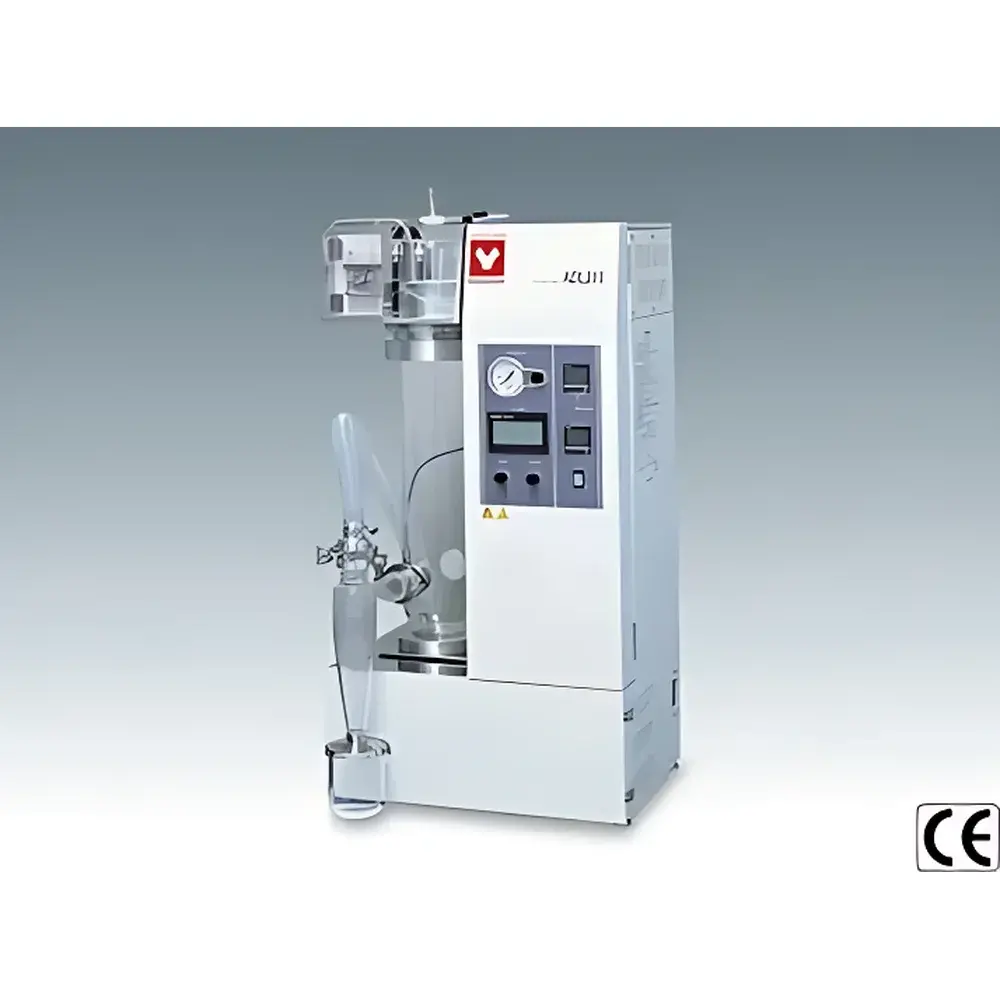
Yamato ADL311S Water-Soluble & Organic Solvent Spray Dryer
| Brand | Yamato |
|---|---|
| Origin | Japan |
| Model | ADL311S |
| Solvent Compatibility | Water-soluble & organic solvents (with optional GAS410 solvent recovery unit) |
| Max. Evaporation Rate | 1300 mL/h |
| Inlet Temperature Range | 40–220 °C (±1 °C accuracy) |
| Outlet Temperature Range | 0–60 °C |
| Drying Air Flow | 0–0.7 m³/min |
| Atomizing Air Pressure | 0–0.6 MPa (operating at 0.3 MPa) |
| Heating Power | 2.0–2.88 kW (200–240 V AC) |
| Dimensions (W×D×H) | 580 × 420 × 1150 mm |
| Weight | 80 kg |
| Power Supply | AC 200–240 V, 50/60 Hz, 16–18 A |
| Safety Features | Overheat protection (inlet/outlet), pump reverse detection, earth-leakage circuit breaker, nozzle connection monitoring (when paired with GAS410) |
Overview
The Yamato ADL311S is a benchtop spray dryer engineered for precise, reproducible microencapsulation and powder formation from aqueous and organic solvent-based feedstocks. It operates on the principle of rapid solvent evaporation via concurrent-flow atomization: liquid feed is pneumatically atomized into fine droplets within a heated drying chamber, where controlled hot air induces instantaneous surface drying—forming low-moisture, non-oxidized, contamination-free microparticles without thermal degradation. Unlike conventional oven or freeze-drying methods, the ADL311S eliminates intermediate steps such as filtration, centrifugation, or mechanical milling, thereby minimizing cross-contamination risk and preserving labile molecular integrity—critical for proteins, polymers, APIs, and nanocarriers. Its modular architecture supports seamless integration with the optional GAS410 solvent recovery system, enabling safe, closed-loop processing of flammable organic solvents including ethanol, acetone, and dichloromethane in compliance with OSHA 1910.106 and IEC 60079-0 explosion-protection frameworks.
Key Features
- Dual-mode compatibility: Standard operation for water-based solutions; extended capability for organic solvents when coupled with the GAS410 solvent recovery unit—equipped with integrated oil-free compressor and condensate trap.
- Precision thermal control: Digital PID temperature regulator maintains inlet air stability within ±1 °C across the full 40–220 °C range; outlet temperature is independently monitored (0–60 °C) and configurable for feedback-controlled drying endpoints.
- Operator-centric design: Tool-free, quick-release drying chamber and cyclone separator; motorized lift mechanism for effortless attachment/detachment of spray head, collection vessel, and exhaust ducting.
- Integrated cleaning functionality: Manual pulse-jet nozzle purge delivers compressed air directly to the atomizer tip, preventing clogging during continuous operation with viscous or particulate-laden feeds.
- Robust safety architecture: Dual thermal cutoffs (inlet/outlet), electronic pump rotation verification, residual-current device (RCD), and real-time nozzle connection status monitoring (GAS410-linked mode).
- Industrial-grade instrumentation: K-type thermocouples, 4–20 mA analog outputs for inlet/outlet temperatures, touch-panel interface with dedicated controls for blower, heater, peristaltic pump, and pulse-jet actuation.
Sample Compatibility & Compliance
The ADL311S accommodates a broad spectrum of feed materials—including aqueous polymer dispersions, protein hydrolysates, small-molecule drug suspensions, and organic-phase nanoparticle colloids—provided viscosity remains ≤500 mPa·s and solid content ≤30 wt%. When used with the GAS410 solvent recovery module, it complies with ISO 8573-1:2010 Class 3 compressed air purity standards and meets key requirements for GMP-compliant pilot-scale development under FDA 21 CFR Part 211 and EU Annex 1. Exhaust filtration includes both intake and exhaust HEPA-grade particulate traps (EN 1822-1 H13), while solvent-laden effluent is fully captured and condensed—enabling VOC emissions below 10 ppmv (measured per EPA Method 18). All electrical components conform to IEC 61000-6-2/6-4 immunity/emission standards and carry PSE certification for Japan-market deployment.
Software & Data Management
While the ADL311S operates via standalone touchscreen control, its 4–20 mA analog outputs enable direct integration with third-party data acquisition systems (e.g., LabVIEW, DeltaV, or Siemens Desigo CC). Users may log time-stamped inlet/outlet temperature profiles, airflow rates, and pump speed for batch traceability. For regulated environments, external recording devices compliant with FDA 21 CFR Part 11—featuring audit trails, electronic signatures, and secure user access tiers—can be deployed to satisfy GLP and pharmaceutical process validation requirements (ICH Q5C, Q8). Optional accessories include calibrated temperature chart recorders (ASTM E2251-compliant) and digital flow meters traceable to NIST standards.
Applications
- Pharmaceutical R&D: Production of inhalable dry powders (DPIs), amorphous solid dispersions, and enteric-coated microparticles without solvent residues.
- Food science: Encapsulation of heat-sensitive probiotics, flavors, and omega-3 oils using GRAS-compliant solvents.
- Materials engineering: Synthesis of metal-organic framework (MOF) precursors, ceramic nanoparticles, and conductive polymer composites.
- Academic research: Rapid prototyping of battery electrode slurries, catalyst supports, and responsive hydrogels with controlled particle morphology (typical d50: 1–15 µm).
- Quality control labs: Batch-to-batch consistency verification for spray-dried excipients per USP dissolution and powder flow specifications.
FAQ
Can the ADL311S handle chlorinated solvents such as chloroform or dichloromethane?
Yes—when configured with the GAS410 solvent recovery system, which features chemically resistant fluoropolymer seals, stainless-steel condenser coils, and explosion-proof motor housings rated for Group IIA hazardous atmospheres.
Is the peristaltic pump flow rate adjustable during operation?
Yes—the touch interface allows real-time adjustment of pump speed (0–30 rpm) with 0.1 rpm resolution, enabling dynamic control over droplet size distribution and residence time.
What maintenance intervals are recommended for routine operation?
Daily: Visual inspection of filters, nozzle purge, and silicone tubing integrity. Weekly: Cleaning of cyclone interior and exhaust duct with isopropanol. Annually: Calibration verification of thermocouples and airflow sensor against NIST-traceable references.
Does Yamato provide IQ/OQ documentation packages for GMP installations?
Yes—validated qualification protocols (including installation, operational, and performance testing templates) are available upon request and align with ASTM E2500-13 and ISPE Baseline Guide Vol. 5 standards.
Can the ADL311S be operated under inert gas (e.g., nitrogen) atmosphere?
Not natively—but the drying chamber and GAS410 interface support retrofitting with nitrogen purging kits (ODL-N2 series), enabling oxygen levels <0.5% v/v for oxidation-prone compounds.



