
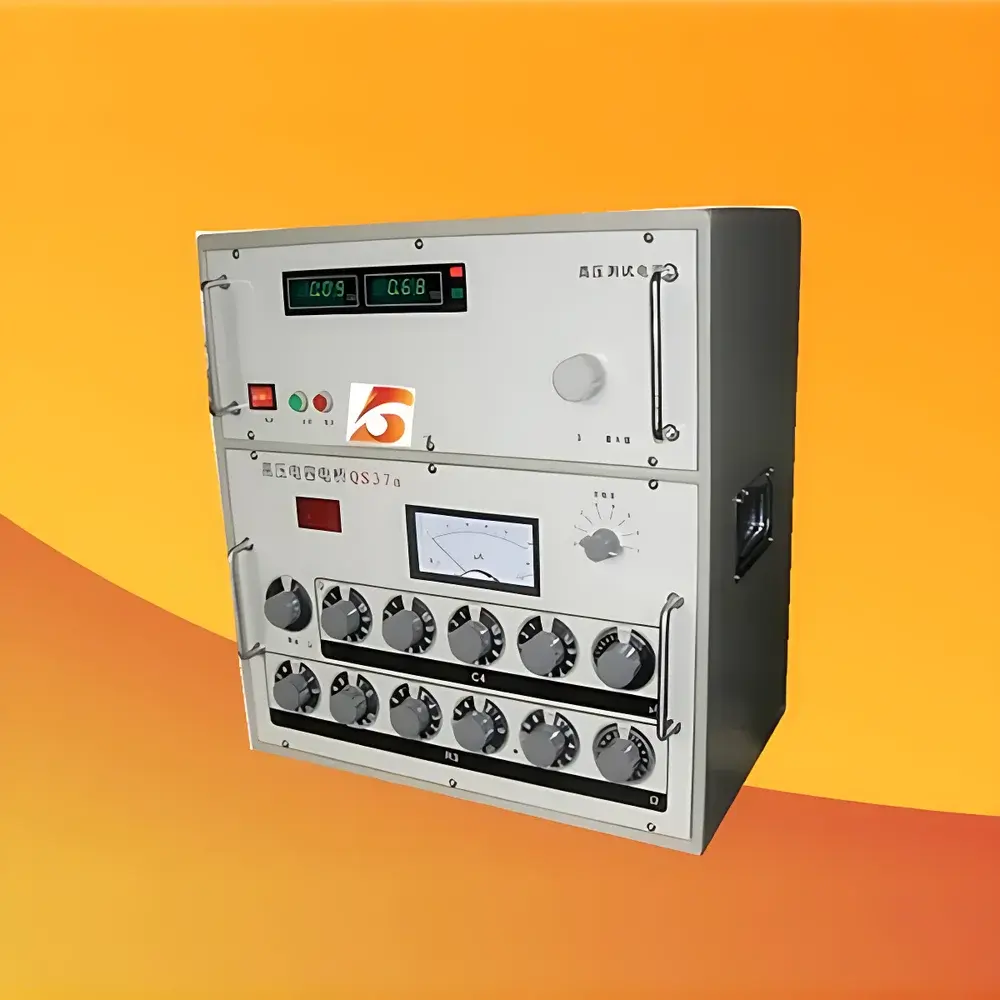
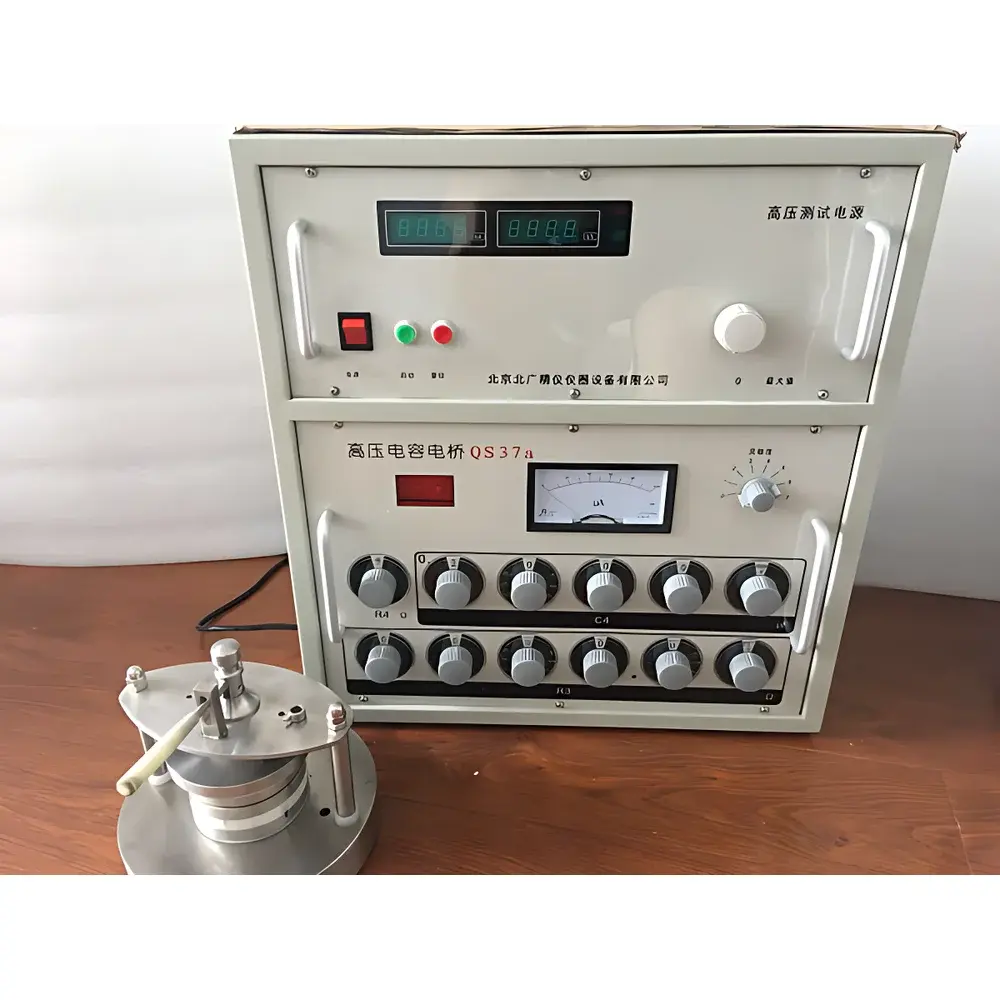
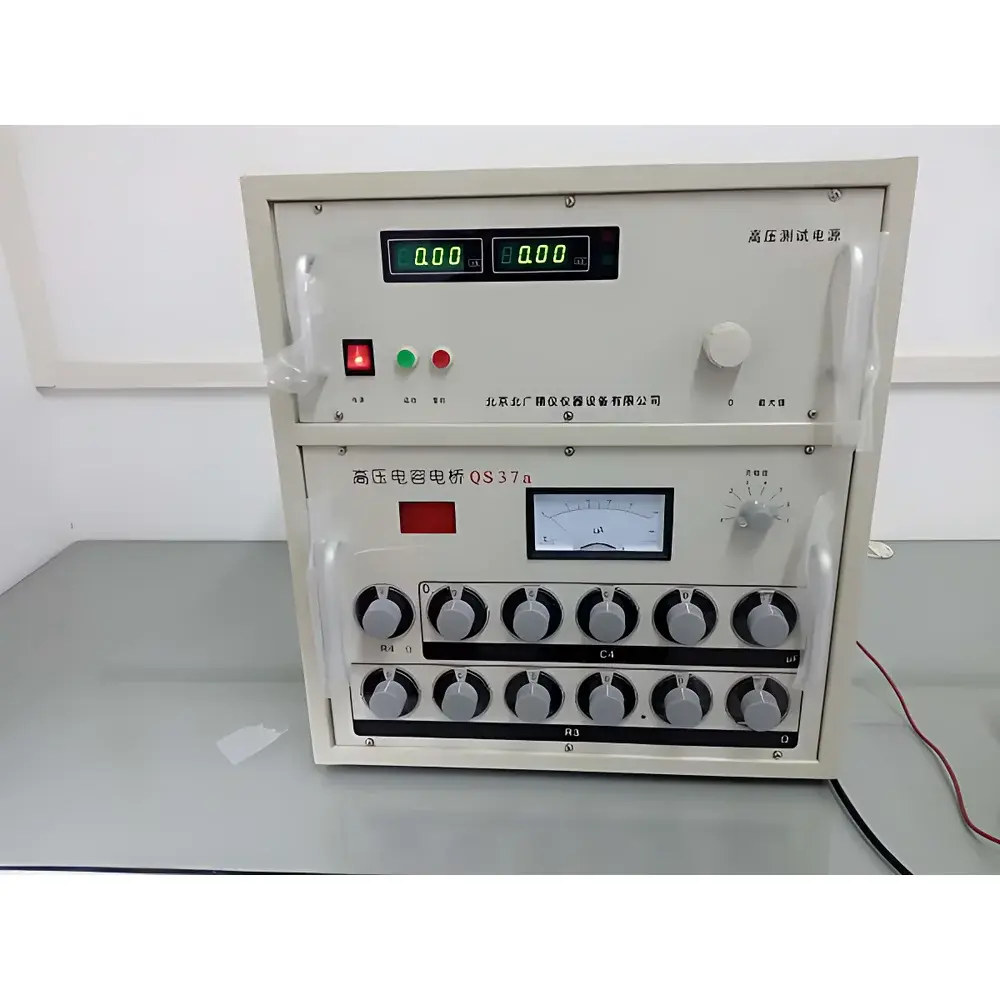
Beiguang Jingyi BQS-37a Power-Frequency Dielectric Constant & Dissipation Factor Tester for Polymeric Insulating Materials
| Brand | Beiguang Jingyi / All Precision Instrument |
|---|---|
| Origin | Beijing, China |
| Manufacturer Type | OEM Manufacturer |
| Country of Origin | China |
| Model | BQS-37a |
| Price | USD 4,950 (FOB Beijing) |
Overview
The Beiguang Jingyi BQS-37a is a precision high-voltage Schering bridge system engineered for the accurate determination of dielectric constant (εr) and dissipation factor (tan δ) of polymeric insulating materials under power-frequency (50 Hz) AC excitation. It operates on the classical Schering bridge principle—a four-arm AC impedance balance method—optimized for low-loss, high-resistivity solid dielectrics. The instrument integrates a digitally displayed high-voltage source (0–5 kV), a factory-calibrated 100 pF reference capacitor (loss < 5×10⁻⁵), and dual-layer electrostatic shielding to suppress stray capacitance and external electromagnetic interference. Designed in strict compliance with GB/T 1693, GB 1409, GB 5654, and ASTM D150–1998 (2004), it delivers traceable, reproducible measurements essential for quality control in cable insulation, transformer bushing materials, epoxy composites, and aerospace-grade polymer laminates.
Key Features
- Stable Schering bridge architecture with automatic potential-tracking auxiliary bridge, eliminating parasitic coupling effects during balance acquisition.
- Dual-shielded enclosure (outer guard + inner S-shield) with grounded electrostatic shielding to ensure measurement integrity in industrial lab environments.
- High-reliability decade switches (low contact resistance, >100,000 mechanical cycles) for R3 and C4 arms, ensuring long-term repeatability of resistance and capacitance settings.
- Pre-aged precision resistors and stable film capacitors minimize thermal drift and aging-induced calibration drift over time.
- Integrated high-voltage source with ±3% output accuracy and built-in current-limiting protection per IEC 61010-1:2012 Class II requirements.
- Analog null detector with voltage sensitivity ≥1×10⁻⁶ V/div and current sensitivity ≥2×10⁻⁹ A/div; harmonic rejection >25 dB (2nd) and >50 dB (3rd).
Sample Compatibility & Compliance
The BQS-37a accommodates solid sheet, film, and molded specimens up to 100 mm × 100 mm using standard parallel-plate electrodes (included). It supports both internal (100 pF) and external reference capacitor configurations for extended Cx range flexibility. Measurement validity is maintained within ambient conditions of 20 ± 5 °C and 30–80% RH. All electrical safety design elements conform to IEC 61010-1 for laboratory measurement equipment. Test procedures align with ISO/IEC 17025–2017 accredited laboratories’ requirements for traceable dielectric characterization. Data generated satisfies documentation needs for GLP-compliant material qualification dossiers and supplier technical specifications referencing ASTM D150 or IEC 60250.
Software & Data Management
While the BQS-37a is an analog-dominant benchtop instrument, its manual balancing protocol ensures full auditability and operator transparency—critical for regulated environments where digital black-box algorithms are restricted. All balance steps (R3, C4, sensitivity adjustment) are recorded manually in accordance with 21 CFR Part 11–aligned laboratory notebooks. Optional RS-232 interface (available upon request) enables timestamped export of final Cx and tan δ values to LIMS or Excel-based QA databases. Calibration certificates include as-found/as-left data, uncertainty budgets per GUM (JCGM 100:2008), and verification against NIST-traceable standards.
Applications
- Quality assurance of thermoset resins (e.g., phenolics, epoxies) used in high-voltage insulators and printed circuit board substrates.
- R&D evaluation of nanocomposite dielectrics (SiO2/polyimide, Al2O3/PEEK) for aerospace and EV battery module encapsulation.
- Batch release testing of cross-linked polyethylene (XLPE) and ethylene-propylene rubber (EPR) cable insulation per IEEE 400.2.
- Failure analysis of aged polymer samples via comparative tan δ trend monitoring at 50 Hz.
- Validation of dielectric homogeneity in multi-layer laminates prior to high-frequency RF component integration.
FAQ
What is the maximum test voltage supported by the BQS-37a?
The instrument supports a maximum bridge excitation voltage of 5 kV RMS (50 Hz), with internal voltage limits enforced at ≤11 V across bridge terminals A/B relative to ground (V point) to ensure operator safety and component integrity.
Can the BQS-37a measure materials with very low loss (tan δ < 0.0001)?
Yes—under optimal environmental conditions (20 ± 2 °C, <50% RH) and with proper electrode guarding, the system achieves a resolution of ±0.0001 in tan δ for samples within the 0–0.1 range, verified per ASTM D150 Annex A3.
Is external calibration required before first use?
The unit ships with a factory calibration certificate traceable to CNAS-accredited standards. Users must perform initial verification using a certified 100 pF reference capacitor and documented procedure per GB/T 1693 Appendix B prior to routine operation.
How does the auxiliary bridge improve measurement accuracy?
The active potential-tracking auxiliary bridge dynamically matches the voltage at shield point S to bridge node B, eliminating capacitive leakage paths between inner and outer shields—reducing systematic error from stray admittance by >95% compared to passive shielding alone.
Does the system comply with FDA or EU regulatory documentation requirements?
While the BQS-37a itself is not a medical device, its measurement methodology, calibration traceability, and procedural documentation fully support 21 CFR Part 11 and EU Annex 11 compliance when integrated into validated QA workflows for pharmaceutical packaging or biocompatible polymer certification.



