
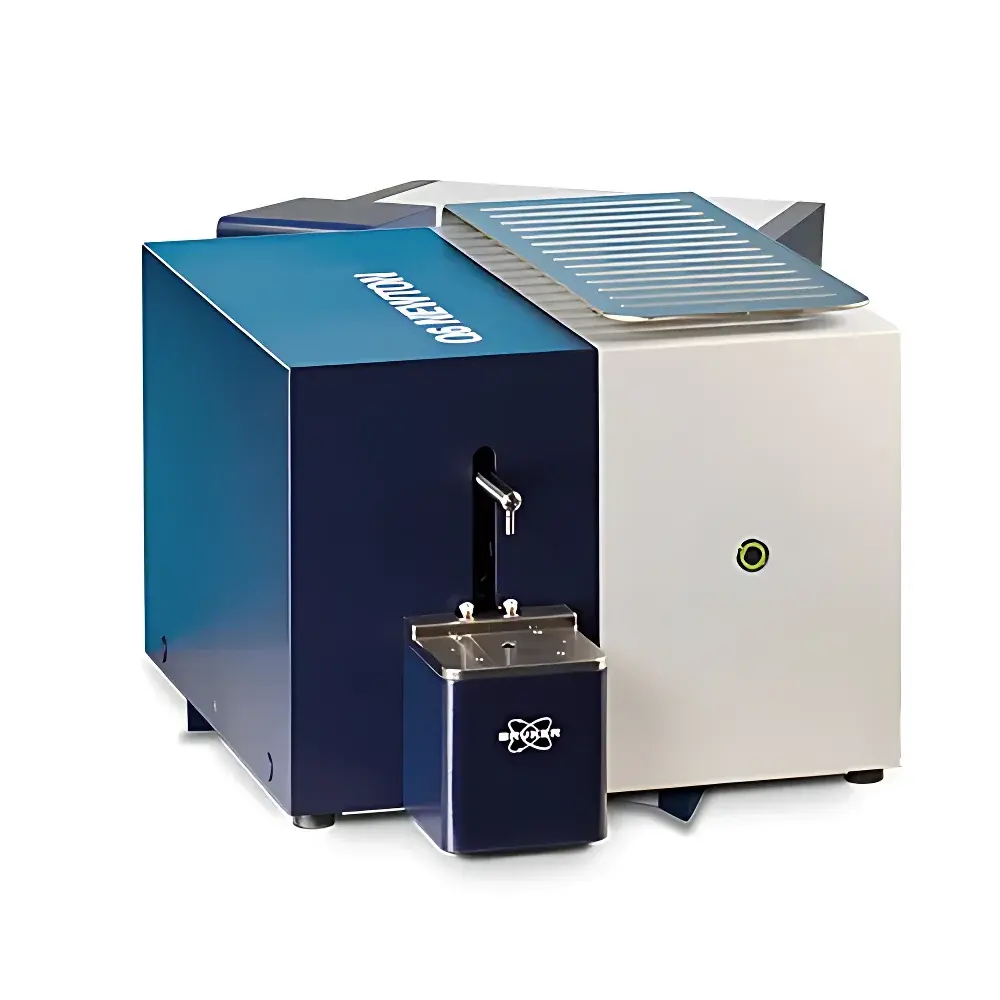
Bruker Q6 NEWTON Spark Optical Emission Spectrometer (OES)
| Brand | Bruker |
|---|---|
| Origin | Germany |
| Instrument Type | Benchtop |
| Excitation Source | Spark |
| Detector Type | Photomultiplier Tube (PMT) |
| Focal Length | 800 mm |
| Grating Density | 3600 lines/mm |
| Wavelength Range | 120–200 nm |
| Number of Channels | 128 |
| Argon Consumption | 2–4 L/min (during analysis) |
| Detector Configuration | Single PMT with 3880 discrete detection channels |
Overview
The Bruker Q6 NEWTON Spark Optical Emission Spectrometer (OES) is an industrial-grade benchtop analytical instrument engineered for high-precision, high-reproducibility elemental analysis of conductive metallic samples. Based on the fundamental principle of spark-induced optical emission spectroscopy, the system generates controlled micro-plasma discharges on the sample surface under inert argon atmosphere; emitted atomic line spectra are dispersed by a high-resolution Czerny-Turner optical system and quantified using synchronized photomultiplier tube (PMT) detection. Designed for continuous operation in demanding production environments—including foundries, metallurgical laboratories, and quality control floors—the Q6 NEWTON integrates thermal stabilization, spark optimization, and real-time plasma monitoring to deliver sub-ppm detection limits, measurement repeatability ≤1% RSD for major elements, and full quantitative analysis in under 20 seconds per sample.
Key Features
- SmartSpark™ Digital Spark Source: A maintenance-free, fully digital excitation generator delivering stable, matrix-optimized pre-spark and analytical sparks. Pre-spark conditioning minimizes surface oxidation effects and reduces inter-element interference; material-specific discharge profiles enhance ablation efficiency and spectral intensity for improved signal-to-noise ratio.
- SafeGuard™ Plasma Monitoring System: A TÜV-certified hardware safety module that halts spark generation upon detection of unsafe conditions—including insufficient argon purity, vacuum leak indicators, electrode contamination, or improper sample contact—ensuring operator protection and data integrity compliance.
- HighSense™ Detection Architecture: Dual-path readout electronics with low-noise amplification and synchronized gating enable rapid spectral acquisition without compromising resolution or detection sensitivity. Achieves typical detection limits of 0.1–5 ppm across key alloying and trace elements (e.g., C, P, S, N, B, Sn).
- RockSteady™ Active Thermal Control: Precision thermoelectric regulation maintains optical bench temperature at ±0.2 °C, eliminating thermal drift in grating alignment and detector response—critical for long-term calibration stability and inter-laboratory comparability.
- Parallel MultiVision™ Dual Optics: Simultaneous VUV (130–200 nm) and UV/VIS (190–800 nm) optical paths, each equipped with RockSteady™ and HighSense™ subsystems. The VUV path employs uncoated CMOS-compatible optics and direct-light-path design for enhanced transmission below 190 nm; the UV/VIS path uses fiber-coupled delivery and ultra-low-noise readout.
- SmartButton™ Operator Interface: A multi-state tactile control enabling one-touch measurement initiation, manual sample positioning (via timed press), and real-time status feedback via LED color coding (green = ready, amber = warm-up, red = fault).
- Low-Maintenance Spark Stand: Robust pneumatic sample clamping mechanism accommodates irregular geometries up to Ø100 mm × 50 mm height; integrated electrode cleaning cycle and wear-resistant ceramic inserts extend service intervals beyond 10,000 analyses.
- Optimized Argon Delivery System: Coaxial dual-gas-flow architecture supplies purified argon independently to both optical chambers and electrode gap. Adaptive gas-savings algorithm reduces average consumption by up to 40% versus conventional OES systems while maintaining spectral stability.
Sample Compatibility & Compliance
The Q6 NEWTON supports solid, electrically conductive metallic samples—including ferrous alloys (steels, cast irons), non-ferrous metals (Al, Cu, Ti, Mg, Zn, Ni, Co), and specialty alloys (Inconel, Monel, Hastelloy). Sample preparation follows ISO 11577 and ASTM E415 guidelines: flat, clean, and properly ground surfaces (Ra ≤ 0.8 µm) are required for reproducible spark interaction. The instrument complies with IEC 61000-6-3 (EMC), IEC 61000-6-4 (immunity), and EN 61010-1 (safety). Its firmware architecture supports audit trail logging and electronic signature workflows aligned with FDA 21 CFR Part 11 and EU Annex 11 requirements when deployed in GLP/GMP-regulated environments.
Software & Data Management
Control and evaluation are performed via Bruker’s Spark Analyzer Pro software—a Windows-based platform featuring method editor, calibration manager, QC trend analysis, and automated report generation. All raw spectral data, integration parameters, and user actions are timestamped and stored in a relational database compliant with SQL Server standards. Calibration models support type-standard-based quantification (ISO 11577) and empirical matrix-matched standards. Data export formats include CSV, XML, PDF, and LIMS-ready ASTM E1382-compliant structured output. Optional integration with enterprise MES/ERP systems is supported via OPC UA and RESTful API interfaces.
Applications
- Steel & Iron Production: Rapid verification of C, Si, Mn, P, S, Cr, Ni, Mo, V, Nb, Ti, Al, N, and B in incoming scrap, molten bath, and finished products—enabling real-time furnace control and grade certification per ASTM A751 and ISO 4949.
- Aluminum Alloy Certification: Accurate determination of trace P, Na, Ca, and Li in primary and secondary Al alloys, critical for aerospace-grade 2xxx and 7xxx series qualification.
- Copper & Titanium Analysis: Quantification of oxygen in OFHC copper (per ASTM B115) and simultaneous measurement of Al, V, Fe, O, and H in Ti-6Al-4V billets per AMS 2249 and ASTM B348.
- Non-Ferrous Metal Recycling: Sorting and grade verification of Pb, Zn, Sn, and Ni in mixed scrap streams, supporting ISO 14001-compliant material recovery operations.
- Research & Development: High-accuracy compositional mapping of novel high-entropy alloys and additive manufacturing feedstock powders, where trace impurity levels directly influence mechanical performance.
FAQ
What sample preparation is required prior to analysis?
Flat, clean, and uniformly ground surfaces (Ra ≤ 0.8 µm) are mandatory. Samples must be dry, free of oil or oxide layers, and electrically conductive. Non-conductive coatings must be removed mechanically.
Is vacuum pumping required for VUV spectral access?
No. The VUV optical path is purged with high-purity argon (≥99.999%) at flow rates of 2–4 L/min; no mechanical vacuum pump is used, reducing maintenance and operational complexity.
Can the Q6 NEWTON analyze nitrogen in stainless steels?
Yes. With optimized VUV optics and high-sensitivity PMT channels at 149.26 nm, the system achieves reliable N quantification down to 10 ppm in austenitic and duplex stainless grades.
How often does calibration require verification?
Daily verification using certified reference materials (CRMs) is recommended per ISO/IEC 17025. Full recalibration is typically performed quarterly or after major maintenance, depending on usage frequency and regulatory requirements.
Does the system support remote diagnostics and firmware updates?
Yes. Integrated Ethernet connectivity enables secure remote access via Bruker’s ServiceLink portal for predictive diagnostics, log file retrieval, and over-the-air firmware upgrades—all compliant with modern IT security protocols (TLS 1.2+, role-based authentication).



