
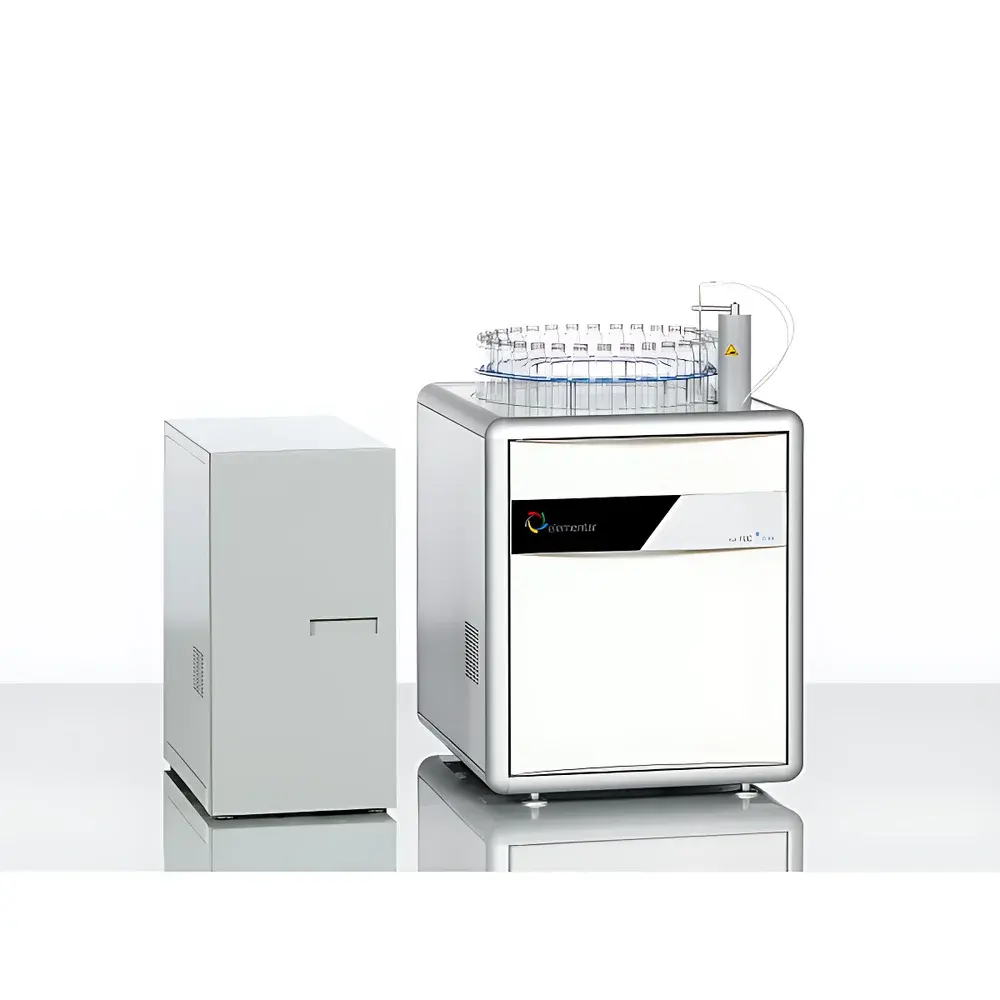
Elementar iso TOC cube Total Organic Carbon and Total Nitrogen Isotope Ratio Analyzer
| Brand | Elementar |
|---|---|
| Origin | Germany |
| Model | iso TOC cube |
| Instrument Type | Laboratory-based TOC/TNb Isotope Ratio Analyzer |
| Detection Principle | Non-Dispersive Infrared (NDIR) Absorption |
| Oxidation Method | High-Temperature Catalytic Combustion |
| Measurement Range | C: 5–60,000 ppm |
| N | 25–60,000 ppm |
| Accuracy | ±2% |
| Isotopic Precision | ≤0.1‰ (δ¹³C and δ¹⁵N) |
| Resolution | High Mass Resolution for ¹³C/¹²C and ¹⁵N/¹⁴N ratio determination |
| Detection Capability | Coupled to Isoprime IRMS for compound-specific isotopic analysis |
| Sample Introduction | Direct liquid injection up to 3 mL |
| Automation | Integrated 32-position liquid autosampler |
| Compliance | Designed for GLP/GMP environments |
Overview
The Elementar iso TOC cube is a purpose-built, fully integrated laboratory system that combines high-precision total organic carbon (TOC) and total bound nitrogen (TNb) quantification with stable isotope ratio mass spectrometry (IRMS). Engineered on the foundation of Elementar’s decades-long expertise in elemental combustion analysis and Isoprime’s industry-leading isotope ratio mass spectrometers, the iso TOC cube operates on the principle of high-temperature catalytic oxidation followed by non-dispersive infrared (NDIR) detection for carbon and nitrogen quantification—and subsequent isotopic analysis via IRMS. This dual-capability architecture eliminates the need for offline derivatization, freeze-drying, or chemical pre-concentration, enabling direct, quantitative conversion of dissolved organic carbon (DOC) and dissolved nitrogen species (e.g., DON, NO₃⁻, NH₄⁺) into CO₂ and N₂ gases under rigorously controlled combustion conditions. The system is designed for laboratories requiring trace-level isotopic fidelity in environmental aqueous matrices—where matrix-induced fractionation, memory effects, and incomplete oxidation have historically compromised data integrity.
Key Features
- True end-to-end integration of TOC/TNb combustion module and Isoprime IRMS—no external gas transfer lines or intermediate cryo-traps
- High-temperature (1,200 °C) Pt-catalyzed oxidation ensuring quantitative conversion of refractory and particulate-bound organics in complex aqueous samples
- Direct liquid injection capability (up to 3 mL per analysis) with programmable dilution and internal standard addition
- Integrated 32-position refrigerated autosampler with syringe-based precision metering and vapor-tight sample handling
- Real-time self-diagnostic routines for catalyst activity, IR cell stability, carrier gas purity, and combustion efficiency
- Automated calibration using certified isotopic reference materials (e.g., IAEA-CH-7, USGS40) with bracketing and drift correction algorithms
- Modular design allowing future expansion to include TNb-only or TOC-only operational modes without hardware modification
Sample Compatibility & Compliance
The iso TOC cube accepts undiluted or diluted liquid samples across a broad physicochemical spectrum: ultrapure water, drinking water, seawater, brines, municipal and industrial wastewater (influent and effluent), soil leachates, colloidal suspensions, and humic-rich extracts. No filtration, acidification, or lyophilization is required prior to analysis—provided total suspended solids remain below 50 mg L⁻¹ to avoid injector clogging. The system complies with ASTM D7573–22 (Standard Test Method for Total Carbon and Total Nitrogen in Aqueous Samples by High Temperature Catalytic Oxidation), ISO 8245:1999 (Water quality — Guidelines for the determination of total organic carbon), and supports method validation per EPA Method 415.3 and USP . Its firmware architecture includes configurable audit trails, electronic signatures, and user-access controls aligned with FDA 21 CFR Part 11 requirements when deployed with Elementar’s optional LIMS-ready software suite.
Software & Data Management
Control and data acquisition are managed through Elementar’s proprietary vario ELEMENTS Software v4.x—a Windows-based platform built on .NET Framework with native support for SQL Server databases. Key capabilities include: automated sequence generation with adaptive dilution logic; real-time isotopic ratio visualization (δ¹³C, δ¹⁵N) with peak integration confidence metrics; batch processing of multi-point calibration curves; export of raw ion current files (.raw) compatible with Isodat v3.x and third-party isotope data reduction tools (e.g., Easotope, SigSpec); and bidirectional communication with laboratory information management systems (LIMS) via ASTM E1384-compliant HL7 or CSV interfaces. Optional modules enable GLP-compliant electronic lab notebook (ELN) integration and instrument performance qualification (IQ/OQ/PQ) reporting templates.
Applications
The iso TOC cube serves advanced research and regulatory applications in biogeochemistry, hydrology, wastewater treatment optimization, and climate science. Typical use cases include: tracing anthropogenic vs. natural DOC sources in riverine and coastal systems using δ¹³C–δ¹⁵N dual-isotope fingerprints; evaluating nitrogen transformation pathways (nitrification, denitrification, anammox) in activated sludge via isotopic enrichment factors; assessing carbon sequestration potential in wetland porewaters; validating isotopic mass balances in mesocosm studies; and certifying isotopic reference materials for inter-laboratory comparison programs. Its ability to deliver sub-0.1‰ reproducibility across heterogeneous matrices makes it suitable for long-term monitoring networks requiring metrological traceability.
FAQ
Does the iso TOC cube require external gas purification systems?
No—integrated gas purifiers (O₂, He, CO₂) with real-time pressure and dew point monitoring ensure optimal combustion and IRMS interface stability without auxiliary hardware.
Can solid or semi-solid samples be analyzed directly?
Not without prior extraction; the system is optimized for liquid-phase analysis. Soil/sediment samples must be subjected to aqueous leaching or centrifugation to obtain filterable supernatants.
What maintenance intervals are recommended for the combustion catalyst?
Catalyst lifetime exceeds 10,000 injections under routine operation; performance is continuously monitored via CO₂/N₂ yield diagnostics and automatically flagged when regeneration is advised.
Is remote monitoring and troubleshooting supported?
Yes—via secure HTTPS-enabled web interface with role-based access, live status dashboards, and diagnostic log export for Elementar Field Service Engineers.
How does the system handle high-salinity samples such as seawater?
A dedicated salt-tolerant combustion protocol reduces chloride interference through optimized oxygen flow modulation and post-combustion halogen scrubbing—validated per ISO 14852 for marine matrices.
Related Products







